

Alexander Calder: The Nature of Movement
Selby Botanical Gardens, Sarasota., Florida
By: Carrie Seidman - Feb 16, 2026
When I was in my adolescent years, my father — an ambitious man in the midst of reluctantly inheriting management of the successful national accounting firm founded by his immigrant father — started dabbling, as a hobby, in art. Seeking an outlet from what he considered a boring life of numbers as a CPA and fascinated by mechanics and movement, he began making a great mess in the basement cutting sheet metal into geometric shapes, painting them in vivid primary colors and using wire to hang and balance them in the style made famous by the American artist Alexander Calder, who was credited with inventing mobiles in the 1930s.
Dad was, by nature, an athlete, not an artist; he quarterbacked his high school football team to a championship; founded a community ski hill near our western Michigan home and loved nothing more than to trounce his children on a tennis court. It was my mother who had all the right brain talent. She was a gifted drawer and painter, a splendid actress and in high demand as a volunteer art teacher at her childrens’ schools. What might well have been a successful professional career fell by the wayside when she married my father and proceeded to have six children who left her little time for her own creative pursuits. But she retained a life-long interest in art and artists.
In fact she was the one who introduced my father to Calder’s work in the first place. In addition to taking care of her brood, she devoted herself to community service and one of her earliest passion projects was the Grand Rapids Art Museum, which she served many years as presidents. One of her close friends and cohorts at the museum was an equally voracious arts lover, Nancy Mulnix (later Tweddale), who had loved Calder’s work since discovering his miniature circus as a child. They both became instrumental in a scheme to get the city, as part of its urban renewal efforts, to commission a large art installation for the plaza in the center of downtown that happened to be just outside my father’s office windows.
At the recommendation of my father, Mulnix reached out to Michigan Congressman Gerald R. Ford, at the time minority leader of the U.S. House of Representatives and in charge of overseeing the funding for the newly established National Endowment for the Arts. (It was all quite incestuous; Ford had graduated from the same high school as my father and Dad would eventually give up accounting to follow him to D.C. and head the Council of Economic Advisers after Ford became President.)
A panel of local officials and arts experts, which included both of my parents, was convened to select an artist for the commission. After zeroing in on Calder, the committee took a trip to France, where Calder was living and working at the time, to see if the artist would agree to a contract. In a biography (never published) I later wrote of my father, he recalled Calder as “a delight, a big man who enjoyed his red wine and tolerated few pretensions.” He agreed to the commission and, over pushback from a goodly number of Grand Rapids’ conservative stuffed shirts, who found his abstract works “absurd” and “overpriced,” the committee officially selected him in 1967.
Ford succeeded in procuring partial funding from the NEA and donors helped raise the rest of the $128,000 cost (an amount equal to more than $1 million today). Mulnix and my parents became the intermediaries with the artist, who agreed to visit Grand Rapids for the installation and dedication two years later.
Over the next two years, the giant steel stabile (a term coined by artist Jean Arp to describe Calder’s stationary, abstract, sheet-metal sculptures, in contrast to his moving “mobiles”) was fabricated at a foundry in France. In 1969, it was shipped in 27 pieces across the Atlantic and on to Michigan, where my father watched from the window of his accounting office as it was assembled on the plaza below over five days in May.
Calder, who liked giving his work French names despite his American heritage, dubbed it “La Grande Vitesse” (“the great swiftness”) both for Grand Rapids and the Grand River that flowed through the city. It was the very first work of the NEA’s Public Art Initiative.
As I was a pre-teen at the time, all of this went on pretty much outside my sphere of awareness — that is, until the dedication approached and I learned Calder would make good on his promise to visit our home in nearby Ada, along the banks of the Grand River, for a dinner in his honor.
The biggest debate prior to his arrival was over the menu. My father had asked Calder what he’d like to eat at the party and the great man answered, “Hot dogs.” Since my father was a man who never met anything stuffed in a sausage casing he didn’t think was the ultimate gourmet delight, he readily acquiesced, much to the dismay of my more refined mother, who blanched at the idea of such plebian fare.
When the day arrived, my sisters and I were sent on our bikes to the top of our winding rural driveway to serve as emissaries greeting Calder’s arrival. We rode home as fast as we could pedal as the great guest and his entourage patiently idled along behind us. I remember shaking his hand, which seemed, like him, enormous. But I also remember not being intimidated because, despite his seemingly gruff exterior, he had a twinkle in his eyes that made it seem as if he was perpetually harboring some untold joke.
My father, who liked nothing more than to give all his grilled meats a fine sheen of blackened charcoal, had set up eight blazing grills on the back porch, each with a different type of sausage. “He thought it was just grand,” he recalled in the biography, remembering Calder as “quite a character, in his red socks and with his very protective wife, Luisa, close by his side.”
Eventually, after copious amounts of red wine, my father confessed to “also making a few mobiles,” and, much to my mother’s horror, escorted Calder down to the messy basement to show him a few. He had enough awareness of an artist’s territoriality to realize imitation might not be considered the sincerest form of flattery, but he had an ulterior motive in showing Calder his work. He wanted to ask the artist if he might visit his atelier in France one day, to observe his mobile constructing process.
When he finally got up the nerve to ask, Calder paused, then admitted that “normally” he did not allow observers.
“He was worried about inviting me to his studio because I’d see how he did his work,” my father would later recall in a newspaper article.
“But after seeing my mobiles, he relented. I guess he didn’t consider me much of a threat.”
Fast forward four years. I am a high school senior, doing a semester at a French language school for foreigners in Tours, in the Loire Valley, a mere 27 miles from Calder’s atelier in Saché, in the Indre-et-Loire Valley. Midway through my studies, my parents, on a European trip, decided to swing through France. I told them I’d be happy to meet them in Paris but no, they insisted, there was a reason for them to come to me: We’d all been invited to visit Calder’s studio and have lunch at his home next door.
By this time, of course, I had a greater awareness of and appreciation for Calder’s work, so the anticipation as we made the short drive through the charming French countryside was palpable. As we drew near, I could make out a tall building with huge glass windows and, on the plateau beside it, a number of large black structures that looked like nothing so much as a bunch of giant vultures. Designed by Calder and built in 1962, both the studio and the adjacent home were simple and functional, blending seamlessly into the surrounding natural environment.
Calder welcomed us into his home with characteristic warmth. Luisa, as I recall, was neither as welcoming nor as warm. It was clear even to an oblivious teenager that she did not relish the idea of having a nubile, young thing flitting around her husband, batting eyes of adulation.
I do not remember what we ate, though I do recall it was simple and French and accompanied by copious amounts of red wine from a carafe which was freely poured for me without anyone asking if I wanted any. We sat at a very long table and I recall being fascinated by the back wall of the house, which had been built into the adjoining hillside and consisted of unfinished natural rock. It was like being inside a cave.
After lunch, my father and I followed Calder down a short path that led to the high-ceilinged studio. which sat on a plateau where the “vultures” I’d noticed from afar, came into view as a flock of stabiles. They were mostly black, a few red, enormous and, despite their stationary nature, seemed as if they were poised to take off at any minute.
Inside the studio, it was … well … vaguely reminiscent of the mess my father used to make in the basement, though on grander scale. Everywhere you looked there was a pile of something — a spilling stack of cut-out sheet metal shapes; paint cans and brushes; tangles of wire, wirecutters and pinchers and tools of every sort. Half finished mobiles hung above, canvases were stacked to the side. It looked like the man cave of a restless, brilliant, absent-minded genius ... which I guess it was.
Before we bid our adieus and got in the car so my parents could return me to school, Calder gifted them an original water-color/gouache made up of large colorful circles in primary colors on an orange background.
“To the Seidmans,” he wrote near the bottom right corner. “Calder ‘72.” Today the painting hangs in the museum of Grand Valley State University, the college my father helped to found in Michigan and where my siblings and I attended a dedication to the Seidman College of Business not long after his death in 2009. Nearby, there is also displayed one of the few remaining examples of my Dad’s mobiles.
In his 2009 obituary in The New York Times, my father was remembered for his work in government (in addition to his service in the Ford administration, he served as Chairman of the FDIC from 1985 to 1991); for his economic acumen and for an eclectic career that also included stints as the Dean of the College of Business at Arizona State and, until his death, as an economic commentator on CNBC.
But in his heart, he was an artist. And Calder was his idol.
IF YOU GO…
”The Nature of Movement,” the Alexander Calder exhibition at Selby Gardens, is both a tribute to the artist’s groundbreaking work and an expansion on his vision. Look up as you approach the visitor’s entry and take in the giant moving mobile of epiphytes created by the Selby staff as a horticultural representation of Calder’s most famous art form. (They admit it took several tries to get the moving parts to balance and move with the breezes.)
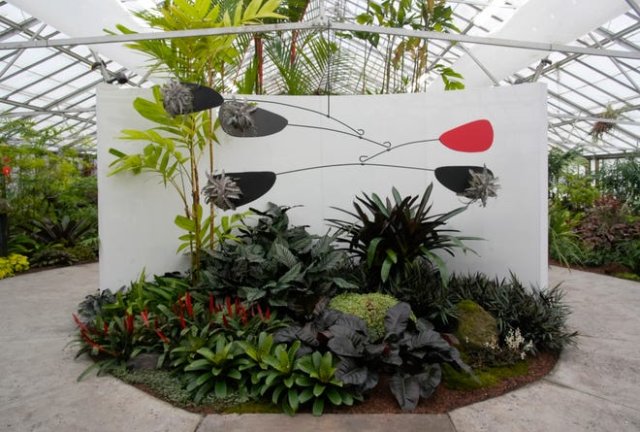
In the greenhouse conservatory, you’ll find a half dozen “vignettes” that both echo and expand on Calder’s work, incorporating natural rock, heavy gauge steel wire, water elements and plants selected for their colors, sizes and shapes, from orchids to bonsai. One even includes red goldfish as moving accents. (A soundtrack of John Cage music that plays in the background is the perfect accompaniment.)
Around the grounds are multiple larger displays, in the style of Calder’s stationary works known as stabiles. There’s a “Calder Cascade” of water tumbling down a series of discs in the primary colors the artist used almost exclusively; a trio of “Rooted in Nature” stabiles on the bay front (crafted from painted plywood, but made to look as if bolted with exposed "steel,” as Calder’s were) that echo Selby’s most iconic tree on the bayfront; some palms grown especially to weave in and around a number of Calderesque shapes; and a wire and flower “Passiflora,” where passion flowers inspire the shape of metal sculptures.
Throughout the grounds you’ll also find signs featuring random quotes from Calder: “You see nature and then you try to emulate it.” Or, “I love red so much I almost want to paint everything red.”
Inside the museum is where you’ll find the final third of the exhibition. In Gallery One is a montage of photos and memorabilia referencing the famous circus Calder crafted in the 1920s-30s, giving performances in which he manipulated the moving miniatures for friends and audiences in Europe. The hallway references Calder’s visit to the painter Mondrian in 1930 and the influence it had on his color palette and abstraction. (It was Calder’s idea to add movement: “Why must art be static? The next step in sculpture is motion,” reads another quote.)
The final room in the house, the North Gallery, is reserved for original Calder works, paintings on loan from private collectors and the piece de resistance, “Black Cascade — 12 Verticals.,” a mobile on loan from The Ringling museum. It is beautifully displayed to capture the full impact of its shapes, shadows and movement — a fitting finale to this tribute to the work of a unique artist.
Alexander Calder: The Nature of Movement is on display through May 31 at Selby Botanical Gardens, 1534 Mound St., Sarasota. selby.org; 941-366-5731
Posted courtesy of ArtsBeat.