

Arms and the Man
G. B. Shaw's Classic Comedy
By: Victor Cordell - Mar 13, 2026
Anti-war messages have appeared in all art forms since their inceptions. Sub-themes include the notion that because of their different nature, we would have no wars if women were national leaders. While there might be fewer wars, you need look no further than Golda Meir, Indira Gandhi, and Margaret Thatcher (or this play’s opening scene?) to disprove the universalism of that thought. Perhaps more reliable is the claim that wars are fought largely by the poor on behalf of the privileged.
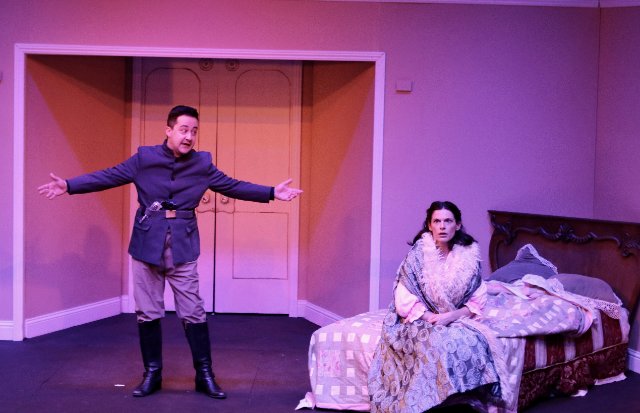
Nobel Prize winner George Bernard Shaw’s 1894 exploration of the futility of war opens with a mother and daughter giddy about the victories that their beloved have scored over the enemy as if they were rhapsodizing over the love scene of a matinee idol. The setup occurs during the final days of the Serbo-Bulgarian War. A Swiss mercenary, Captain Bluntschli, who has fought for the Serbs sneaks away from the fracas into the home of the Bulgarian Army leader, still away, and insinuates himself on the Bulgarian’s daughter, Raina.
The clash of beliefs comes when the professional military man disabuses Raina’s fantasy by claiming that nine of ten soldiers are fools. Her idealism about military comportment is further undermined when he tells her that he uses his ammo pouch to carry chocolates, not bullets. When he later ravages the remains of a box of her chocolates, he would become her “chocolate-cream soldier.” Variations of that term have since entered military parlance worldwide, and always as a pejorative.
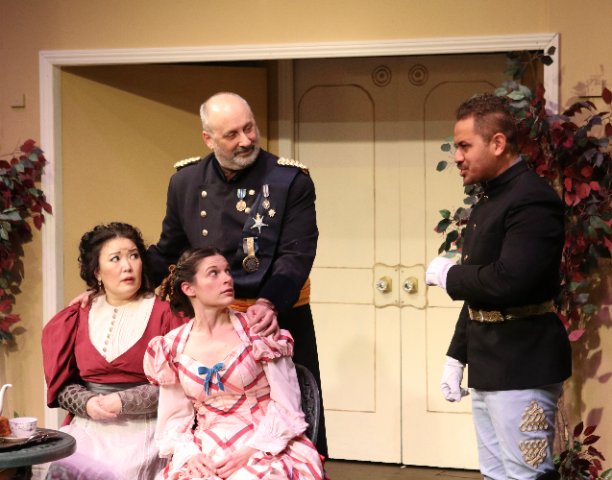
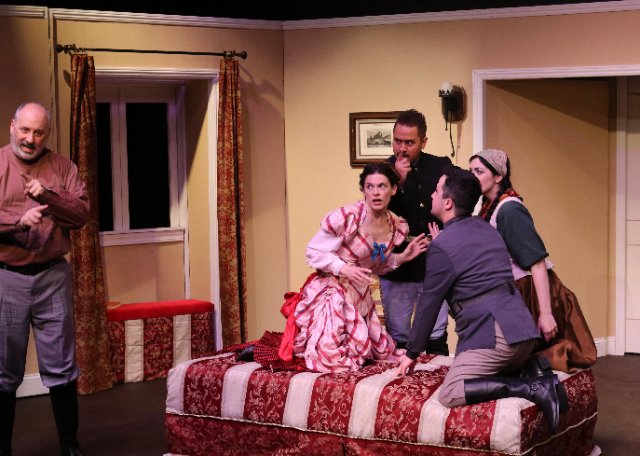
B8 Theater Company of Concord has taken on Shaw’s classic, and their production is another indicator of the depth of theatrical talent in the Bay Area. Director Becky Potter has chosen a farcical mode by having actors exaggerate their portrayals, virtually screaming their lines, and using overwrought gesticulation and expression. While some observers may not care for the mannerism, it works well with the material, and those who often complain that they can’t hear dialog from a stage should not have that issue in this intimate venue.
A minor criticism about the delivery of the dialog is that it is sometimes a little halting, which impairs the effect and slows the pacing. And while drama can usually indulge variations in meter, comedy demands split-second timing. Another concern about transporting these revivals to the stage is that references with emotive impact from other eras may be lost on today’s audience, and the very nature of what tickles the funny bone varies from time and place. That said, this worthy play deserves attention.
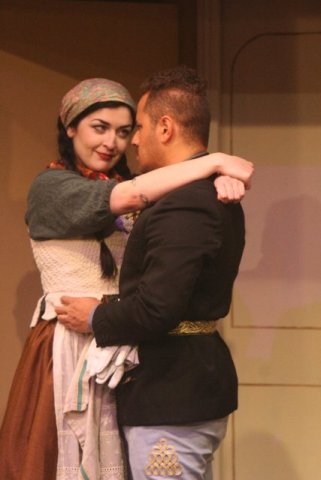
Otherwise, the acting is bright and commendable, particularly from the two male leads. As Bluntschli, Mitchell Van Landingham, at first seems soft for the role of a mercenary officer, but he displays defined facial expressions and verbal demeanor that make for a winsome characterization. His battlefield and romantic rival, Major Sergius Saranoff, played by John Mosa’ati, is engaged to Raina, an effective Samira Shahan, whose part however is one-note. Mosa’ati’s verbal and physical swagger perfectly fit the preening peacock.
Apart from denigrating the quest to conquer enemies in war, Shaw attacks other social behaviors as hypocritical and self-serving. The wealthy Saranoff has dalliances with the maid, Louka. Along with the Bluntschli-Raina relationship, social class implications are revealed. And the spirited major, reflecting the sensibilities of the day, challenges Bluntschli to a duel, but the more experienced and level-headed Swiss man has other ideas.
Kudos to Diane McRice’s staging, which involves a single set-frame which is amended and accessorized as three different locations. One matter prompts comment only because of the Director’s Note in the program. Apparently, the word ottoman appears in the stage directions 27 times but never in the dialog. What appears to be a day bed centers the stage in Act 3. While it could be characterized as a mammoth ottoman, virtually anyone’s vision of that apparatus is as an overgrown, symmetrical foot rest, and this representation doesn’t work. The significance of the word is that Bulgaria was subjugated by the Ottoman Empire when the play was written and would not achieve independence until 1908.
Arms and the Man, written by George Bernard Shaw, is produced by B8 Theatre Company and plays at The Campbell Theatre, 636 Ward Street, Martinez, CA through March 22, 2026.