

The Crucible by Arthur Miller
The Sarasota Players
By: Jay Handelman - Mar 27, 2026
Arthur Miller wrote “The Crucible” in 1953 as a response to Cold War-era congressional hearings about Communist activity in the
Miller’s play, set during the time of the Salem witch trials in 17th century Massachusetts, opened more than 70 years ago, but it continues to resonate whenever it is produced, even in an admirable if not fully realized production like the one running through April 5 at the Sarasota Players.
Miller was enraged by seeing friends and colleagues forced, out of fear for their lives and reputations, to identify others who might have been communists at one point in their lives, even if they had no real connection to the political party. Still today, we see examples of mob mentality in society, as neighbors turn against friends, often under pressure from others, allowing accusations to become guilty verdicts before a court ruling.
That’s why different scenes or moments can take prominence over others depending on what is happening in the world when you see it. At Wednesday’s final preview, one line struck me as it rarely had before.
The play is set in a small
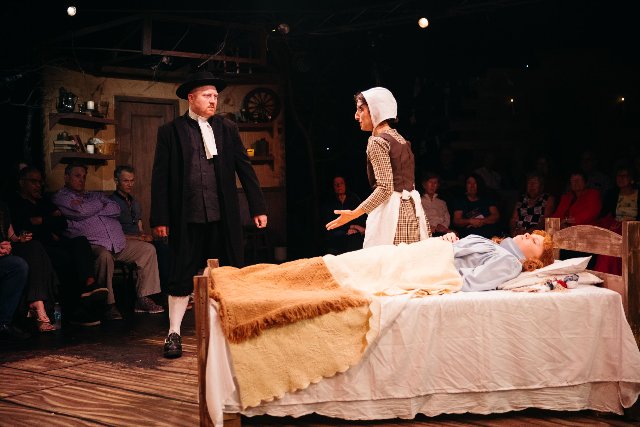
But what are they to do when a group of young girls, caught dancing in the woods, are accused of dealing with the spirit world. To save themselves, those girls turn on the adults in the community, and suddenly innocent people are being hanged.
Abigail Williams, the leader of the girls, points a finger of accusation against Elizabeth Proctor, whose husband, John, once had a brief affair with Abigail. John understands the root of the accusation and screams at the authorities: “Is the accuser always holy now?”
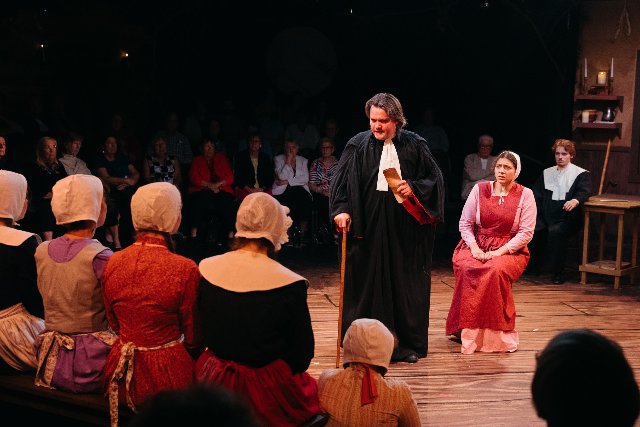
Deputy Governor Danforth is ready to believe any accusation of unholy activity (this was long before the separation of church and state). Director Amanda Heisey does a fine job staging the drama in the round, so that just about everyone in the audience can see at least some of the actors at all times. There is a nervous energy from the start as we watch the young girls dancing in the semi-dark, before the accusations start flying, but the actors come on a bit strong, leaving them nowhere to go.
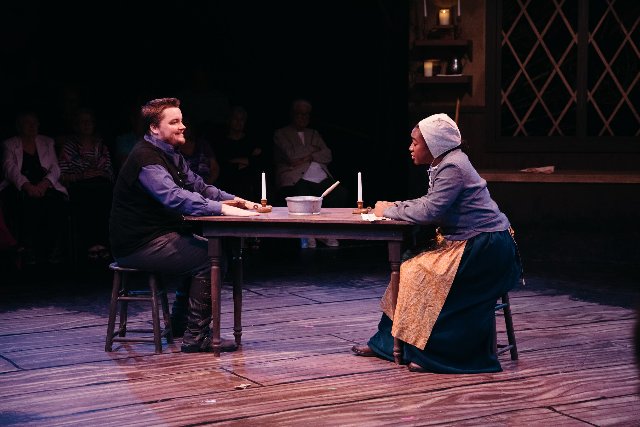
There are some nicely nuanced moments, like the tender if anxious scenes between Vincent Pearson and Ariana Ajené as his wife, Elizabeth. You feel the anger and worry from Scott Schuster as Giles Corey, whose wife faces hanging, and the derision of Kelly Leissler as the Rev. Samuel Parris, who seems to believe the worst of everyone in his parish.
Adrian Van Stee, as the Rev. John Hale, arrives in town with a similar attitude, but it’s nice to see how he softens as the impact of signing death orders forces him to rethink where the truth may lie.
As Abigail, who leads the young women, Jamie Saunders can be frightening yet also flirtatious whenever she has a bit of hope of John returning to her.
But the most impressive and consistent performance comes from Ren Pearson, who brings a fierce, but grounded intensity as Danforth. You may not like his methods, but you can appreciate his approach to getting at the truth. He puts the fear of God and the law into people, with his body language and the way he uses a walking stick to add a bit more force.
The production looks good with Jill Castle’s period costumes, and the woodsy set created by Brian F. Finnerty, with wisps of branches sticking out of the walls around the theater. They help bring a sense of starkness and tension to a story that keeps you interested even if you’re not always as emotionally engaged as possible.
‘The Crucible’ by Arthur Miller. Directed by Amanda Heisey. Presented by The
. Learn more at ArtsBeat.org.