

Giant with John Lithgow
Play Reveals Dark Side of Children's Author Roald Dahl
By: Karen Isaacs - Apr 09, 2026
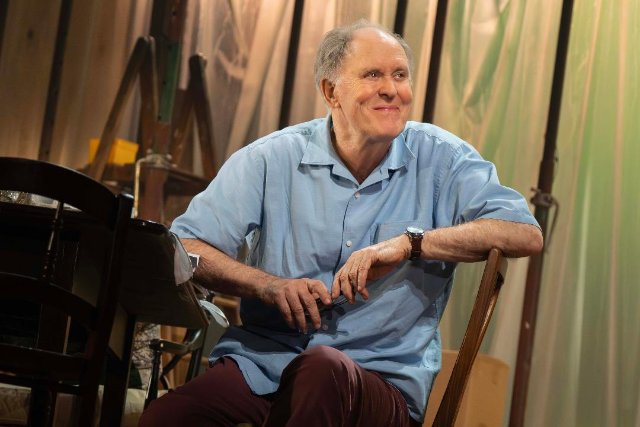
Leaving the theater after seeing Giant, you will be emotionally drained, but also exhilarated by the incredible performance of John Lithgow, which is matched by Aya Cash as Jessie Stone.
You will also leave with questions, large and small. Giant, which won multiple awards in London, is based on a true incident in 1983; the children’s author Roald Dahl wrote a book review about a non-fiction book on the 1982 Israeli-Lebanese war. In his review, Dahl expresses multiple statements that most would consider antisemitic condemning Israel.
His British publisher (himself a Jew, who has a child escaped the Nazis), Dahl’s fiancée. and a representative of his American publisher are at his home to persuade him to make a statement mitigating the damage caused by this book review. The real concern is the impact the review would have on his soon-to-be-published book, The Witches.
Dahl is resistant and during the course of the play becomes more resistant to their efforts as well as expanding on his controversial views.
The overarching question of the play is, how do you separate the creator of a work of art from the art itself? Artists, writers, painters, composers, and musicians are human; not all of them have sterling character or behave ethically or morally, yet they may create everlasting, stupendous works that move and enlighten us.
But there are other questions as well. One is Dahl’s motivation; at times, he seems like one of the naughty boys in his books who just wants to cause mischief and delights in the effect it has on the adults around him. But I also wondered why his publisher stays with him. Is it just the money? Dahl treats him miserably, and during the afternoon of the play he attacks him for his Jewish faith. Then there’s the question of his fiancée, Felicity Crosland, who, at the end of the play, suggests they set a wedding date. She obviously loves him, but why? He is like a petulant, difficult child who has tantrums when he doesn’t get what he wants; in some ways, she is the stereotypical enabler of a creative genius
The first act establishes the position of Dahl, his publisher, and the American representative.
Playwright Marc Rosenblatt makes it clear that this is a work of fiction. A note in the program states that two things are real: Dahl’s book review, which started the whole thing. Two is his final telephone call to a reporter. Both are quoted verbatim.
The play refers to several tragedies in his life: his daughter Olivia died of measles encephalitis, which led him to become an advocate for vaccinations and his son Theo was severely injured when a taxi hit his baby carriage in New York City. Theo suffered hydrocephalus, but recovered. Plus, his wife, actress Patricia Neal, suffered multiple aneurysms. Dahl oversaw her recovery.
There’s also a passing reference to his World War II service as a fighter pilot, as well as his work supporting children’s causes.
Thus, you are left trying to reconcile the accomplished man with his views. Are his beliefs sincere to the extreme that his later phone call would indicate or is he merely a provocateur who likes to stir things up and finds glee in that.
If this were to have happened in the last five years, what we sometimes call “cancel culture” would’ve taken over. What’s surprising is how this all blew over. It did not affect his stature as a writer in Britain.
It is Lithgow’s performance that raises these questions. He has always had a unique ability to bring humanity to even the most dislikeable character. His Dahl is at times charming, childlike, bullying, and delighted with himself. He is like a cat torturing a mouse, except this time it is his publisher, played by Elliott Levey and, particularly, Aya Cash as the representative of his American publisher. Lithgow doesn’t soften what Dahl is doing, says, or apparently believes, but incorporates all that more to provide us see a portrait of this complex man. It is due to Lithgow’s skill that some of the issues are developed.
Lithgow’s portrayal is matched by Cash’s as Jessie Stone. She goes from deferential to intimidated to angry, and then to shell-shocked. Her major confrontation with Dahl was terrific.
Levey, as publisher, Tom Maschler, an actual person, has a more difficult job. He seldom confronts Dahl directly, preferring a more diplomatic approach, which is no more successful than Stone’s direct approach. Rachel Stirling is excellent as Dahl’s fiancée, though at times I wasn’t sure what her position was.
Director Nicholas Hytner, Rosenblatt, and Lithgow prevent the play from becoming so dominated by Dahl that everyone else seems like a puppet. Lithgow’s performance is astonishing, but he leaves air for the other actors.
I have respected Lithgow’s talent since his very first Broadway appearance in The Changing Room, which I saw at Long Wharf Theatre. Since then, I have been lucky enough to see many extraordinary performances by him.
Giant is a limited run through June 27.