

Death of a Salesman on Broadway
Underwhelming
By: Karen Isaacs - Jun 04, 2026
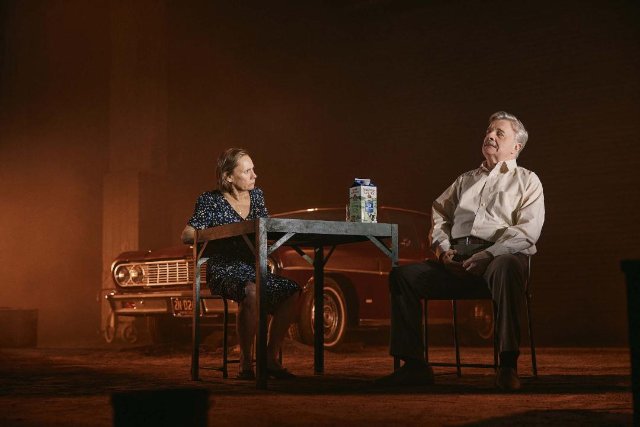
Nathan Lane and Laurie Metcalf in Death of a Salesman sounds like ideal casting; and Lane is giving a fine performance. But this production under the direction of Joe Mantello Arthur left me unmoved.
Playwright Arthur Miller wrote that his masterpiece was an American tragedy. He wasn’t just referring to the ending, but to Aristotle‘s classic definition of tragedy and the tragic hero. One element of that is that the audience should feel catharsis. Over the years I’ve seen multiple productions of this play, and I’ve taught it to hundreds of students. The best productions have left me stunned and near tears. This did not.
Many of my complaints are decisions that Mantello made.
It begins with the decision to use an earlier draft of the play rather than the one that was the final version. Why? Miller obviously for whatever reason considered that this version was not 100% what he wanted and he made changes. Some lines are different. One character is omitted, and a major stage direction is altered. While 99 percent of the audience didn’t notice, those who have seen the play multiple times or have taught it multiple times were jarred when we heard lines we had never heard before.
Willie, a traveling salesman is exhausted after 30 years being away from home during the week, living in hotels, carrying sample cases, waiting to see buyers and hoping for a sale. He is aging, depressed and exhausted, yet the system is ignoring his loyalty to the company.
For some time, Willie has been examining his life, though he certainly wouldn’t call it that. Were the choices he made the right ones? Should he have taken his much older brother’s offer of a job in Alaska? Why are his two sons, now well into their 30s, so lost in many ways?
Death of a Salesman is a memory play, with flashbacks to seventeen years before. Mantello has double cast the roles of the two sons; when Willie is remembering his sons in that earlier time, two other actors play the boys, yet they do not speak most of the lines. The lines are spoken by the adult sons. I found it initially confusing. The reason? The teenage Happy looked a lot like the adult Biff.
Lane’s performance is nuanced and fine. Yet the audience laughed at strange lines in the play. I’m not sure if that was because of Lane’s reputation as a comic actor or if was audience discomfort at what was happening to the characters.
Laurie Metcalf is a terrific actress but her take on Linda, Willie‘s wife, seems to unbalance the play. She stresses the anger rather than balancing Linda’s anger at what is happening with a love for Willie and a concern about his well-being. This is an unsympathetic Linda. When she says in the play that she loves him, it doesn’t ring true.
Christopher Abbott is Biff; he’s fine but doesn’t bring anything memorable to the role. The other cast members are fine, if not stand outs.
I never got a clear vision of Mantello’s rationale for his choices. I didn’t notice it, but a friend in the audience mentioned at intermission that the music (by Caroline Shaw) was annoying. But I noticed that the costumes (by Rlidy Mance) were often jarring because of details that were out of place.
Scenic designer Chloe Lanford has made Willie’s car almost a character in the play. The car remains prominently on the stage throughout the play; characters lean against it, touch it. Periodically the headlights come on blinding the audience.
It is odd that I barely noticed the music whereas an acquaintance who was also in the audience told me at intermission that it was driving her crazy because it was annoying. I think that was part of the problem with the production. Many probably would have found the costumes by Rudy Mance good yet I noticed details that were so inappropriate for the late 40s that it was jarring.
While this is a perfectly acceptable production of the play, I do not understand the critical praise it has garnered. I’ve seen better.