

Lise Davidsen Ignites Carnegie Hall
James Ballieu Collaborates
By: Susan Hall - Jun 07, 2026
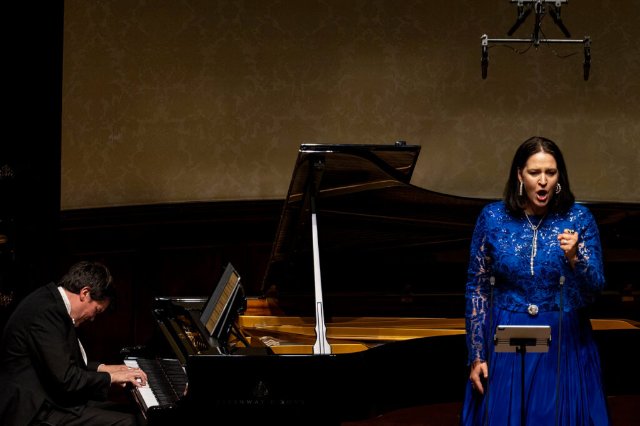
Lise Davidsen ignited Carnegie Hall in a performance of Schubert Lieder. She often speaks about Schubert having a divine spark, which sets afire the full range of human emotion. His music is perfectly suited to the human voice, and the accompaniment for his art songs often has a life of its own, captured expertly by Ms. Davidsen’s longtime collaborator at the piano, James Baillieu.
Davidsen has the big, beautiful tones of her Norwegian predecessor, Kirsten Flagstad. Ms. Davidsen's presentation shines not only in its tonal colors but in its emotional range. She makes the case for an audience member like me, who started out loving the sheer scale of her voice and wondering where the feeling was. Every note at Carnegie is charged with emotion.
The songs were chosen to alternate between the bright and the buried, the joyful and the desperately sad, making for a finely shaped program. The role of the piano is not just a foundation, but often tells a story itself. Nature is depicted in arpeggios, thumping chords, and octave notes. The famous Erlkönig gave us the eerie hoofbeats as a father and son try to escape the seduction of an otherworldly Elf King on horseback. Ms. Davidsen rides on Mr. Baillieu’s thunder, and it would take more than a pack of wild horses to drag us away from her. In this song, three voices are heard: a father, a son, and the Elf King. Ms. Davidsen charged each one with a distinct character, masterfully meeting an operatic challenge.
On stage, Ms. Davidsen glows like a live ember. A tiny blue flower blooms in her first song, and her jacket matches it. So does a stripe on Mr. Baillieu’s socks, subtly connecting the collaborators to the music. While her dress is white for a Goethe-based song about a woman descending to death, her second jacket, which is also white, is alive with shimmers.
The propulsive force of the piano, played with sensitivity and vigor, enables Ms. Davidsen to sink back into her seemingly endless breath, holding notes for their beauty and meaning. One feels a slight reach for the top notes, yet this is incidental to the overall immersion in the beauty and joy of her sound. Ms. Davidsen does not use her hands; her face is a marvel of expression. She leaves the agile, descriptive hands to her collaborator.
Maybe we are following the wrong path to intimacy in the concert hall. Large halls can survive without life support if divas like Ms. Davidsen show the way. Here in Carnegie, all 2,800 seats were taken. The house is rapt. Ms. Davidsen speaks warmly, informatively, and humorously. Yet it is the performance, transmitting feeling and depicting the complex emotional stages of a human life, that makes you feel you are sitting in front of a fireplace with the artist. A log is on fire, with sparks aglow, and surely some of them are those divine sparks of Schubert, awakened by an evening with Lise Davidsen and James Baillieu at Carnegie Ha
Davidsen has the big, beautiful tones of her Norwegian predecessor, Kirsten Flagstad. Ms. Davidsen's presentation shines not only in its tonal colors but in its emotional range. She makes the case for an audience member like me, who started out loving the sheer scale of her voice and wondering where the feeling was. Every note at Carnegie is charged with emotion.
The songs were chosen to alternate between the bright and the buried, the joyful and the desperately sad, making for a finely shaped program. The role of the piano is not just a foundation, but often tells a story itself. Nature is depicted in arpeggios, thumping chords, and octave notes. The famous Erlkönig gave us the eerie hoofbeats as a father and son try to escape the seduction of an otherworldly Elf King on horseback. Ms. Davidsen rides on Mr. Baillieu’s thunder, and it would take more than a pack of wild horses to drag us away from her. In this song, three voices are heard: a father, a son, and the Elf King. Ms. Davidsen charged each one with a distinct character, masterfully meeting an operatic challenge.
On stage, Ms. Davidsen glows like a live ember. A tiny blue flower blooms in her first song, and her jacket matches it. So does a stripe on Mr. Baillieu’s socks, subtly connecting the collaborators to the music. While her dress is white for a Goethe-based song about a woman descending to death, her second jacket, which is also white, is alive with shimmers.
The propulsive force of the piano, played with sensitivity and vigor, enables Ms. Davidsen to sink back into her seemingly endless breath, holding notes for their beauty and meaning. One feels a slight reach for the top notes, yet this is incidental to the overall immersion in the beauty and joy of her sound. Ms. Davidsen does not use her hands; her face is a marvel of expression. She leaves the agile, descriptive hands to her collaborator.
Maybe we are following the wrong path to intimacy in the concert hall. Large halls can survive without life support if divas like Ms. Davidsen show the way. Here in Carnegie, all 2,800 seats were taken. The house is rapt. Ms. Davidsen speaks warmly, informatively, and humorously. Yet it is the performance, transmitting feeling and depicting the complex emotional stages of a human life, that makes you feel you are sitting in front of a fireplace with the artist. A log is on fire, with sparks aglow, and surely some of them are those divine sparks of Schubert, awakened by an evening with Lise Davidsen and James Baillieu at Carnegie Ha