

The Alchemy of Mapo Doufu
Cooking as a Daoist Art
By: Cheng Tong - Jul 14, 2026
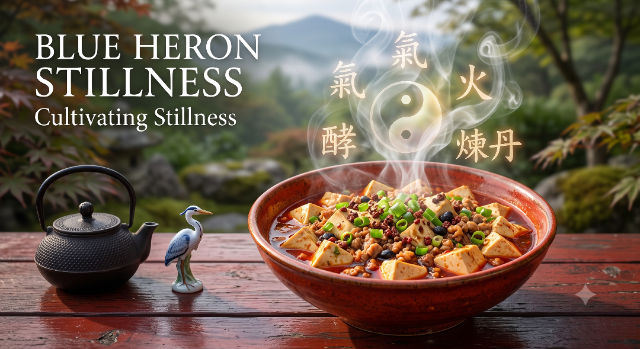
There is a distinct, beautiful paradox in the pursuit of stillness. We often imagine quietude as something fragile—a candle flame protected from the wind, a silent room, a completely motionless seat in a hidden garden. But true internal stillness (Yin) is not the mere absence of movement; it is the centered composure that remains untouched by the greatest activity (Yang).
Nowhere is this dynamic tension more alive than on the dinner plate, specifically in a steaming bowl of Mapo Doufu.
I learned the secrets of this dish in 2019, while traveling throughout
I never ordered off a menu. Instead, I would look to the grandmother and simply ask her to feed me whatever she wanted me to eat—a pure practice of yielding, dropping all demands to trust the master of the space. More often than not, this trust opened doors. I would charm my way into the heat of the kitchen, watching her movements, learning how she layered the flavors of egg and chive dumplings, dan dan mian, and her own Mapo Doufu. Our time together always ended the same way: a warm hug, followed by a deep, formal bow of respect.
To the uninitiated, Mapo Doufu appears to be an assault on the senses—a dish famous for being loud, fiery, and intensely active, cloaked in a deep crimson chili oil. But having stood in the heat of those kitchens, I came to see it as a profound exercise in Daoist alchemy. By choosing to step directly into the fire—preferring, as I do, “the hotter the better”—we are not chasing chaos. We are using a powerful external catalyst, passed down through the hands of generations of grandmothers, to clear out stagnation, open the channels, and ultimately cultivate a deeper, more spacious state of quiet within.
The Three Treasures: Ingredients as Moving Qi
In the traditional kitchens of
Viewed through the lens of traditional philosophy, the dish resolves into three distinct energetic treasures:
1. The Doufu (Tofu) – The Grounded Center
Soft, cooling, and intrinsically receptive, the doufu represents the foundational Yin element of the dish. It is a clean source of nourishment that does not fight against the intensity surrounding it. Instead, it acts like a skilled practitioner practicing push hands: it yields, absorbs the fierce flavors of the sauce, and adapts completely without losing its core structure. It provides the smooth, stabilizing substance that keeps the dish grounded.
2. Chilis and Sichuan
This is the pure Yang engine of the meal. The unique combination of chili heat (là) and the numbing, buzzing vibration of the
3. Mushrooms and Black Beans – The Earth Element
The minced mushrooms and fermented black beans supply the deep, savory umami that anchors the entire experience. Energetically, they speak directly to the Spleen and Stomach channels. Without this rich, dark earth element, the fiery heat of the chilis would simply flare uncontrollably upward, resulting in a scattered mind, headaches, or heartburn. The mushrooms and beans ensure that the heat is digested and integrated, turning a potentially volatile spice into sustained, warming currents of energy.
The Internal Landscape: From Fire to Stillness
To eat a bowl of truly hot, mushroom-based Mapo Doufu is to consciously initiate a minor climate shift within your own body.
With the first few bites, the málà complex begins its work. The tongue tingles, the pores open, the nose runs, and a light sweat begins to break out across the forehead and the back of the neck. This physical reaction is actually a profound clearing of the decks. The intense Yang movement of the spice acts like a sudden summer thunderstorm sweeping through a heavy, humid afternoon. It forcefully breaks up mental clutter, dissolves emotional stagnation, and coaxes the nervous system out of any lingering lethargy. Your focus is instantly pulled entirely into the present moment; it is impossible to dwell on yesterday or worry about tomorrow when your tongue is vibrating with the pulse of the
Then comes the shift.
As the meal ends and the initial fire begins to recede, a remarkable transformation occurs. The explosive Yang energy gives way to a profound, expansive Yin clarity. Because the channels have been forcefully opened and the dampness chased away, the body feels uniquely light, clean, and cool. The pulse settles into its deep, efficient rhythm. The mind becomes exceptionally spacious, entirely emptied of its internal chatter.
It is in this precise aftermath that the true purpose of the alchemy becomes clear: the storm has passed, leaving behind a pristine, effortless state of Zuowang—where sitting still and doing nothing is no longer a task to achieve, but the most natural state of being in the world.
Cooking as a Daoist Art
Ultimately, the alchemy of Mapo Doufu reminds us that the spiritual path is not a matter of retreating into a sterile, bland world free of friction. We do not find exceptional health or internal peace by avoiding the sharp, spicy, or intense elements of life.
True cultivation is found in the kitchen and on the meditation cushion alike: it is the art of taking the fiery, active forces of the world, balancing them with a grounded center, and charting a deliberate path through the heat. When we understand how to transform the fire, we find that the very center of the flame is where the deepest stillness resides.