

Martha Graham at Jacob's Pillow
Centennial Tour of Her Company
By: Charles Giuliano - Aug 17, 2026
Martha Graham Dance Company
Jacobs Pillow
Ted Shawn Theatre/ McCain Stage
August 12 to 16, 2026
Artistic director, Janet Eilber
The Company: Lloyd Knight, Xin Ying, Leslie Andrew Williams, Lorenzo Pagano, Anne Souder, Laurel Dalley Smith, Marzia Memoli, Devin Loh, Antonio Leone, Meagan King, Ane Arrieta, Zachary Jeppsen-Toy, Amanda Moreira, Jai Perez, Ethan Palma, Merideth Brown
Night Journey (1947)
Choreography and costumes, Martha Graham
Music, William Schuman
Set, Isamu Noguchi
Original lighting, Jean Rosenthal
Adapted by Beverly Emmons
Cast: Jocasta, Xin Ying; Oedipus, Lorenzo Pagano; Tiresias the Seer, Ethan Palma; Leader of the chorus, Leslie Andrea Williams; Chorus
En Masse (2026)
Choreography, Hope Boykin and he company
Music, Leonard Bernstein
Additional Music, Christopher Roundtree
Costume design, Lauren Young
Lighting, Al Crawford
Assistants to the Choreographer, Cameron Harris and Terri Ayanna Wright
Immediate Tragedy (1937)
Choreography, Martha Graham reimagined by Janet Eilber
Costume, Martha Graham
Original music, Howard Cowell
Reimagined music, Christopher Roundtree
Music preformed by Richard Valitutto, piano
Lighting, Yi-Chung Chen
Danceturgy, Neil Baldwin
We the People (2024)
Choreography, Jamar Roberts
Music, Rhiannon Giddens
Arranged by Gabe Witcher
Costumes, Karen Young,
Lighting, Yi-Chung Chen
Dancers, the company
There is a direct connection between Martha Graham (1894-1991) and Jacob’s Pillow. In the mid-1910s, Martha Graham began her studies at the newly created Denishawn School of Dancing and Related Arts, founded by Ruth St. Denis and Ted Shawn. She toured with the company and often partnered with Shawn. After leaving in 1923 she formed her own company in 1926.
The performances at Pillow are a part of the company’s centennial tour. She first visited Becket in the 1960s with a lecture demonstration. The company first appeared in the 1980s and intermittently since then.
There are debates about when her last performance occurred. In her 1991 autobiography, Blood Memory, Graham herself lists her final performance as her 1970 appearance in Cortege of Eagles when she was 76 years old. Graham's choreographies span 181 compositions.
She did not respond well to seeing younger dancers performing roles that she had initiated. Alcoholism and depression brought her to the brink. Hitting bottom she got sober and at a remarkable age created ten new dances and revised earlier ones.
To preserve her legacy, arguably the most formidable in modern dance, the only option was to keep working and training the next generation. When she died, through estate issues, the company was at risk. It was revised with Janet Eilber as artistic director. The vision of Graham thrives by preserving her legacy as well as collaborating just as she had always done.
Typically, what was performed at Pillow balanced old and new with four works.
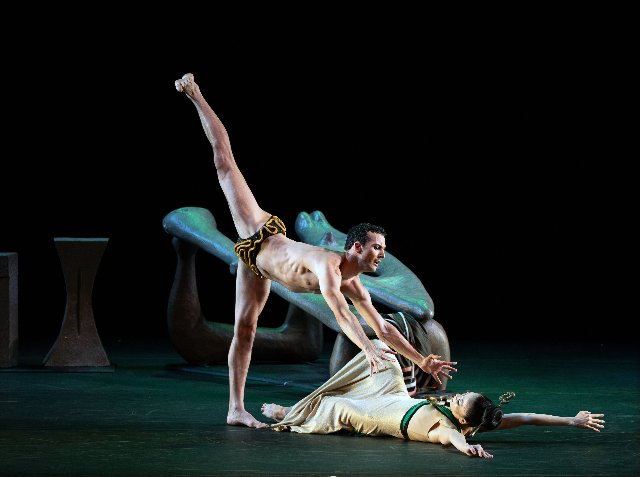
The first of these Night Journey (1947) could not have been more thrilling. It is one of her most iconic works from a period of her greatest inspiration and originality. In a fascinating manner her portrayal of Jocasta, the wife/ mother of Oedipus, deeply reflected the circumstances of her private life.
When Frederick Hawkins (1909-1994) was the first male dancer to join the company that altered its dynamic. Though sixteen years younger they were deeply in love. He was the male lead in her masterpiece Appalachian Spring. At Harvard Hawkins had majored in Greek Civilization. Through his influence she deconstructed the tragedy of Oedipus Rex by Sophocles (ca. 436 BCE). Aristotle referred to it as the paradigm of Greek drama.
In the play as it is revealed that Oedipus, had indeed killed his father (laius) and married his mother, she retreated to the palace. Her death by hanging is announced but not witnessed.
Graham constructed the dance around the final interaction of the ill fated lovers. With a subtle balance of their age differential Graham created for herself one of her greatest roles. Because it was so personal it must indeed have been agonizing to see it performed by other dancers.
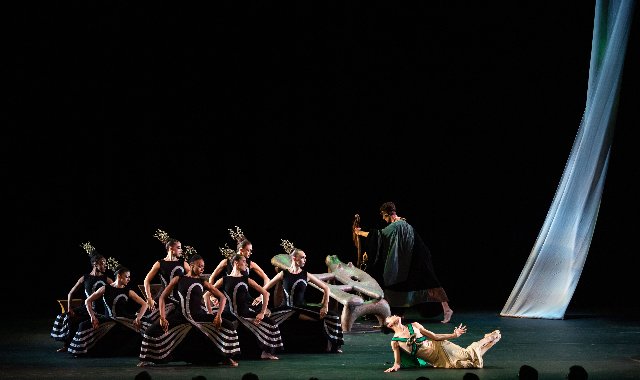
She collaborated with Isamu Noguchi to create the minimalist set and props. He fabricated a bench-like, sloping bronze sculpture. Oedipus uses this to slide toward her and embrace. Noguchi created a large sculptural hair pin for Jocasta as well as twisted, silver wire tiaras for the women of the chorus. The blind seer, Tiresius is equipped with a menacing staff.
There is an original cast video of the dance which allows for appreciating the faithfulness of the current performance to the original. Of course it’s impossible to replicate the passion exuded by Graham and Hawkes. The original Tiresius was Paul Taylor.
The performances by Xin Ying (Jocasta) and Lorenzo Pagano (Oedipus) were utterly galvanic. The signature Graham technique of contraction and release was evident in the silky gown of Ying. The chorus wore starkly designed black and white robes. Initially, Pagano appeared with a cloak. That was thrown off to reveal the chiseled body craved by Jocasta but, in this instance, the crucial age differential was not evident.
There is a sense of something borrowed, something new to En Masse. It has been chorographed by Hope Boykin to fragments of music by Leonard Bernstein. Boykin is a veteran of two decades with Alvin Ailey American Dance Theatre.
Both Jacob’s Pillow and Tanglewood contributed to the new work. Accordingly while in residence the company performed Appalachian Spring at Tanglewood.
The music included sections from Bernstein’s 1971 “Mass” arranged by Christopher Roundtree. He also adapted a score in the archive that Bernstein had composed for her but was never realized. Boykin has used a lot of Graham’s technique to develop this dance which has a somewhat ersatz sensibility.
Passages of the music have a jazzy Broadway feeling which is responded to with zesty dance. But then there are abrupt blackout shifts and mood changes. The audience stumbled into applause several times before it finally ended. This was an assemblage of fragments rather than a cohesive work.
For most of her career Graham was more involved in creating work than archiving it. The work was preserved in the studio and on stage. This is true of all modern dance.
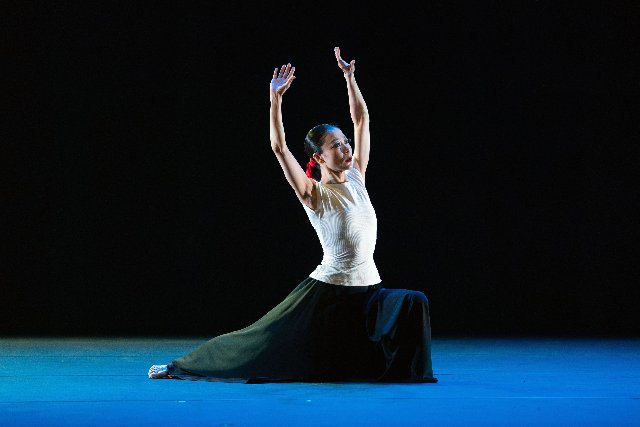
One such lost works was Graham’s “Immediate Tragedy” a solo she created in response to the Spanish Civil War. It was dedicated to the women of Spain. She performed it for several years. It has now been recreated through archival research.
A photographer donated negatives of film he shot from the front row of a performance. It contained 25 images of the piece. Original music by Henry Cowell was found in the Graham archive and inspired a new piano score by Christopher Roundtree. In a flowing skirt with red lining Anne Souder brilliantly evoked a passionate and enraged Graham. One may imagine the poignant and powerful engagement by this strident anti-fascist statement. Give current events the performance could not be more timely or relevant.
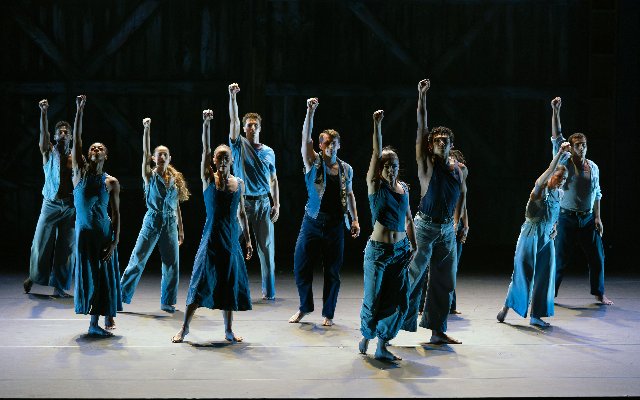
The program ended with an anthem of hope. We the People by Jamar Roberts balances the anger and frustration of flawed democracy as well as the joy of community.
Initially a single black woman performed an unaccompanied frustrated dance. She appeared to be venting as well as self inflicting. That set one up for an angry protest piece. Much to my surprise it broke into a barn dance to a blue grass score by Rhiannon Giddens arranged by Gabe Witcher. There were several more elements with solo introductions.
Overall the uplifting work was an affirmation of solidarity overcoming differences through music and dance. It’s just the kind of Americana that Graham embraced in Appalachian Spring. What better way to celebrate her vision and legacy?