

Hamlet at Shakespeare & Company
Best of the Bard
By: Charles Giuliano - Aug 20, 2026



Hamlet
By William Shakespeare
Shakespeare & Company
Tina Packer Playhouse
August 13 to 30, 2026
Directed by Ariel Block
Set, Omid Akbari; Lighting, Ericka Johnson; Costumes, Arthur Wilson; Sound, Susan F Doyle; Vocal coach; Movement, Susan Dribble; Fight choreography, Kevin G. Coleman
Cast: A. J. Baldwin, Marcellus/ Guildenstern/ Player Queen/ Fortinbras; Johnathan Epstein, Ghost/ Polonius/ Captain/ Grave digger; David Gow, Hamlet; Yaala Muller, Ophelia/ Osric; “ranney,” Claudius; Eddie Shields, Bernardo/Laertes/Rosencranz/ Player King; Austyn Williamson, Horatio/ Player Intern; Kristin Wold, Gertrude.
Run time, 2 hours 20 minutes with intermission
Some time between 1559 and 1601, William Shakespeare (1564-1616) wrote Hamlet, his longest and arguably greatest play. It comprised five acts and ran over four hours. For the Shakespeare & Company production, director Ariel Block, has reduced it to two acts that run 2 hours and 20 minutes with one intermission. That puts it within the endurance limits of appreciative audiences. This staging is among the top attractions of the Berkshire season to experience one the Bard’s greatest works.
In addition to judicious cuts Wold has directed the tragedy at a brisk pace. All of the iconic scenes and soliloquies are in there although at times they seem rushed in a haste to get to the next and then another. There are iconic moments that require breathing room, fully to absorb.
The character of Hamlet, the tragic Prince of Denmark represents one of the great roles in the canon. Brooding, melancholy, unhinged and bent on revenge for the murder of his father he is both sympathetic and not. He’s an early prototype of the modern anti-hero. While young, handsome and charming (well portrayed by David Gow) he is also vile, self absorbed and reprehensible. He has seduced then abandoned the innocent and fragile Ophelia (Yaala Muller) then with ill considered rage killed her father who has been hiding behind a curtain.
While Hamlet seeks revenge for the murder of his father, as events ensue, he is himself a killer. Laertes (Eddie Shields) a former friend of Hamlet is enraged that he killed his father (Polonious) and seduced and abandoned his sister (Ophelia).
Finding a balance through that maze of contradictions comprises the thrust of this greatest of all theatrical challenges from Booth to Barrymore and Olivier.
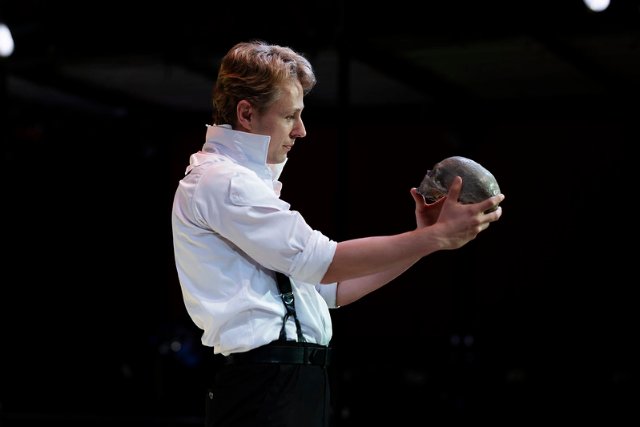
Shakespeare was prescient in his examination of death on several levels. The ghost of his murdered father, King Hamlet, (Johnathan Epstein) appears to him and demands revenge. This destabilizes him with thoughts of suicide. “To be or not to be” may be understood as proto existentialism. If that inspired empathy his treatment of Ophelia ( Yaala Muller) does not. “Get thee to a nunnery” is unprecedented in its callow, chauvinistic cruelty. We witness her emotional descent to madness and later report of her drowning. Muller conveys this with compelling delicacy. Hamlet, who is soon to die examines the skull of the court jester Yorick. "
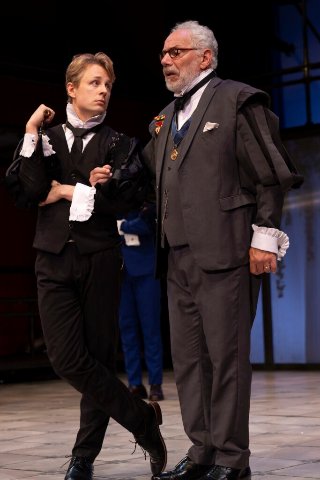
When Hamlet kills Polonius he appears not to give a fig. The corpse remains in an archway for quite some time before it is dragged off. Polonius, a long winded and platitudinous advisor to the king is regarded as a fool by Hamlet. This is generally how the character is played. Epstein, however, turned that on its head. His character was no fool and rather a loving and sage mentor to his children. It made me lend a new ear to his famous advice to his son. Nobody renders the Bard with more ease and clarity than Epstein. He is a treasure of the company.
His ghost of Hamlet, however, through no fault of his own bordered on the absurd. There is so much that can be done with this spectral apparition. Bock has put him center stage under a translucent shroud. Hamlet and the guards observe from the parapet above. I never got past seeing Epstein with a bag over his head.
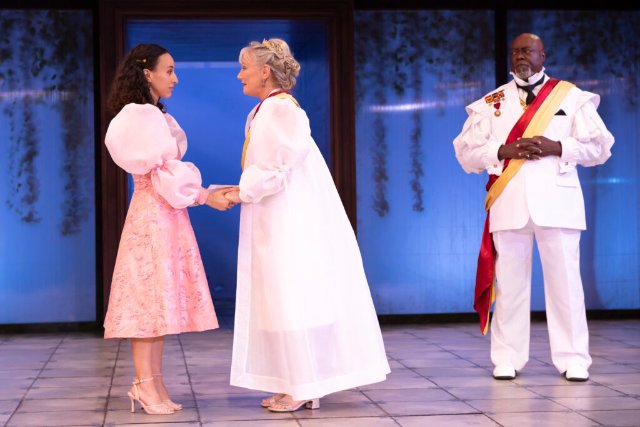
What to make of the royal couple King Claudius (“ranney”) and Queen Gertrude (Kristin Wold)? It is soon obvious that he is a murderer. A large man “ranney” delivered his lines with nuance and grace. He has previously appeared in Lenox performing August Wilson. Hamlet revealed another dimension of his chops.
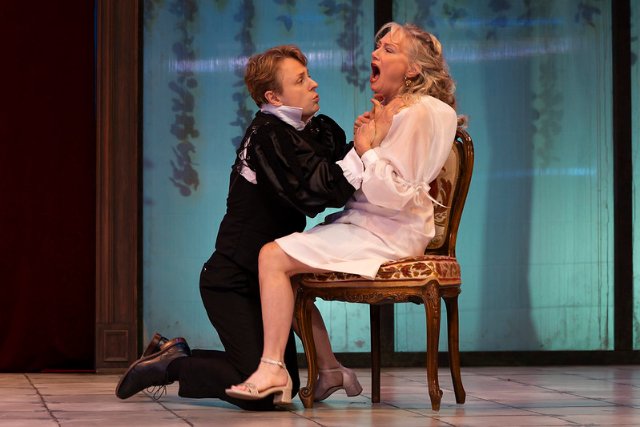
The question that never goes away is why Gertrude married her brother-in-law just one month after the death of her husband. Was she involved in the plot and if so what is her motivation? With hands around her neck Hamlet puts this to her. Wold was quite wonderful in the role that has no ready answers.
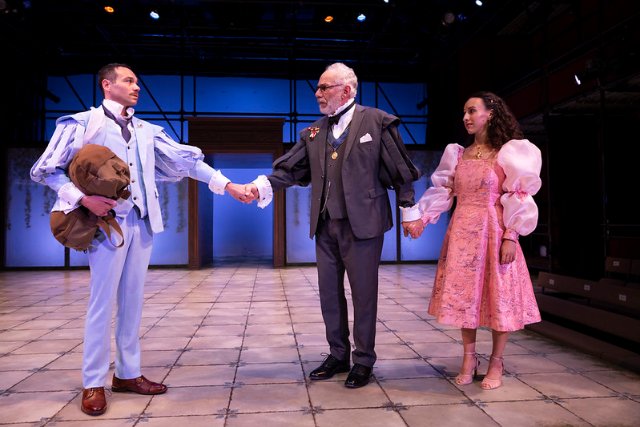
What to make of the over the top, playful but absurd costumes designed by Arthur Wilson? He created puffed and pleated sleeves that are more post modern, Renaissance chic, than one would expect from provincial Denmark. He went all in with the jokers and pals of Hamlet, Rosencranz and Guildenstern. With popsicle colors they seem to be characters from Pee Wee’s Playhouse. Did they really wear Bermuda shorts in old Denmark, or those mismatched harlequin shoes?
Hamlet ends as a bloodbath and Bock does not spare us the details. After clashing poisoned foils and toasts of poisoned wine there are corpses strewn on the stage. They all bounce back up for a little jig off stage.