

Maverick Kings: Three Visionary Pharaohs of Egypt’s Golden Age
Ar the Museum of Fine Arts
By: MFA - Sep 03, 2026
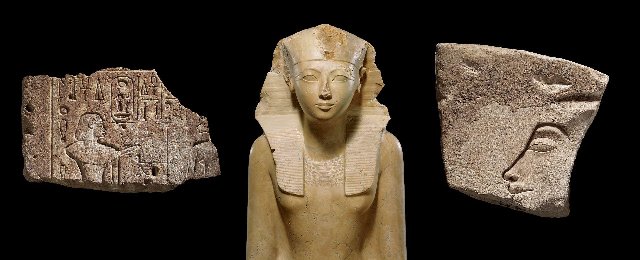
This fall at the Museum of Fine Arts, Boston (MFA), Maverick Kings: Three Visionary Pharaohs of Egypt’s Golden Age explores the reigns of three celebrated rulers who used the power of images to forge enduring legacies. Hatshepsut—one of a handful of women who attained supreme power in ancient Egypt—has only recently been recognized as one of its greatest pharaohs. Amenhotep III ruled during a time of great prosperity, when Egypt was at the height of its power. His son and successor, Akhenaten, shook up religious norms to worship a single deity represented by the sun. Maverick Kings explores these visionary 18th-Dynasty rulers’ lives and legacies through the dramatic art they commissioned and the words they left behind.
The exhibition features nearly 100 objects drawn from the MFA’s extensive collection of ancient Egyptian art. Each work—acquired by the Museum between 1875 and 2024 through archaeological excavations, gifts from private collectors, or purchases—has undergone an extensive provenance review. Additionally, Maverick Kings includes eight exceptional loans from the Metropolitan Museum of Art in New York, the Egyptian Museum in Berlin, the Cleveland Museum of Art, and the Kimbell Art Museum in Fort Worth, Texas.
Maverick Kings is on view from September 6 through December 6, 2026 in the Ann and Graham Gund Gallery. Timed-entry tickets are required for all visitors and can be reserved on mfa.org or purchased at the Museum. Member Preview takes place from September 2–5. The exhibition is curated by Lawrence Berman, John F. Cogan, Jr., and Mary L. Cornille Chair, Art of Ancient Egypt, Nubia, and the Near East.
“The richness and depth of our Egyptian collection never cease to amaze me,” said Berman. “What a joy it is to have this opportunity to see our masterpieces deployed in a new and meaningful way.”
Visitors can explore Maverick Kings with a four-stop multimedia guide on MFA Mobile on Bloomberg Connects. The exhibition also includes kids’ labels for select objects, audio recordings of actors reading ancient inscriptions from each pharaoh’s reign, and in-gallery activities including a dedicated space for learning about writing in hieroglyphs.
Exhibition Overview and Highlights
Hatshepsut (reigned 1479–1458 B.C.E.), Amenhotep III (reigned 1390–1352 B.C.E.), and Akhenaten (reigned 1352–1336 B.C.E.) were all members of the 18th Dynasty, which began in about 1550 B.C.E. and ushered in the New Kingdom. During this period, Egypt was wealthier and more cosmopolitan than ever before. The arts flourished, and pharaohs vied with one another to build, rebuild, and extend temples up and down the Nile, each striving to surpass earlier rulers.
The exhibition opens with a seated statue of Ramesses II, a ruler from the 19th Dynasty, which demonstrates the defining features of a depiction of a pharaoh and attests to the power of images. Ramesses often appropriated earlier kings’ statuary as an act of admiration—in this case, the statue may have originally been made for Amenhotep III. Following the introduction, Maverick Kings is organized chronologically, dedicating a section to each of the rulers in focus.
Hatshepsut
Hatshepsut first ruled as regent after her husband’s unexpected death and then as a full-fledged king alongside her stepson, Thutmose III. Since pharaohs were traditionally male, she was regularly depicted as a bare-chested man in royal regalia, as seen on one of two large fragments from a fallen obelisk. It originally stood at more than 97 feet tall, commissioned by Hatshepsut as one of a pair at the Temple of Amen-Ra at Karnak—its mate remains the tallest obelisk still standing in Egypt. By contrast, a seated sculpture on loan from the Metropolitan Museum of Art shows Hatshepsut with a woman’s body, perhaps because it was meant for a more private setting.
Hatshepsut was the first 18th-Dynasty ruler to have a sarcophagus made of stone—specifically, quartzite, whose ruddy color associated it with the sun, the ultimate symbol of rebirth. The exhibition includes a sarcophagus that Hatshepsut originally commissioned for herself, but later had altered for her father, Thutmose I. The texts and deity figures were completely recarved, but the outlines of the original hieroglyphs remain visible.
After Hatshepsut’s death, her stepson Thutmose III ordered her statues destroyed and her name erased from monuments. Male Egyptologists in the late 1800s and early 1900s interpreted this as an act of resentment to eradicate the memory of a female pharaoh. More recent archaeological evidence, however, indicates that Hatshepsut’s monuments were destroyed at the end of Thutmose’s reign, perhaps to secure the succession of Thutmose’s son, who had no connection to her side of the family.
Amenhotep III
Nearly a century after Hatshepsut, the reign of Amenhotep III is distinguished by a strong economy and transformative construction projects. Artists during this period used costly materials and expert craftsmanship to create an elegant image of the pharaoh, distinguished by almond-shaped eyes, sweeping eyebrows, and full lips.
Among other artistic innovations during Amenhotep III’s reign were large scarabs with lengthy commemorative texts. They have been found everywhere from Syria to Sudan, corresponding to the extent of the king’s empire, and were probably made as royal gifts. The exhibition includes rare examples that record Amenhotep’s accomplishments and—in an usual move for a pharaoh—celebrate his wife, Queen Tiye.
Akhenaten
Amenhotep III’s son and successor Akhenaten rejected the pantheon of traditional Egyptian gods in favor of a single deity, Aten, who was worshipped in the form of a sun disk radiating beams of light. Akhenaten’s chief queen was the famous Nefertiti, who was even more prominent in her husband’s reign than Tiye was during the reign of Amenhotep III. She frequently appeared at his side or even alone in roles traditionally played by the king.
A religious revolution necessitated a new kind of art. Sculptors from this period produced surprisingly informal and affectionate scenes of the royal couple and their daughters basking in the life-giving rays of the sun. Limestone trial pieces—akin to ancient sketchpads—show them experimenting with this new visual language. Exaggerated features—including long necks, high waists, large hips and thighs, and spindly arms—distinguished Akhenaten and Nefertiti from ordinary humans and presented them as extraordinary beings.
After Akhenaten’s death, his young son and successor restored the old gods, changing his name from Tutankhaten (“living image of the Aten”) to Tutankhamen (“living image of Amen”). Later rulers continued to associate the boy king with his heretic father, and he was largely forgotten until the discovery of his treasure-filled tomb in 1922 catapulted him to world fame. Though not from the tomb, a head of Tutankhamen demonstrates his instantly recognizable features. The face was originally painted red with eyes outlined in black and the headdress striped alternately blue and yellow—the same as his famous gold mask.
Despite ancient attempts to erase their existence, Akhenaten and Nefertiti have become cultural icons: him as a religious reformer and her as a symbol of beauty. In the final gallery, a contemporary work by Awol Erizku (American, born in Ethiopia, 1988) reimagines the painted bust of Nefertiti in Berlin—one of the most recognizable works of art in the world—as a symbol of African heritage.
Public Programs
The four-week course “Icons of Power: Art and Identity in Ancient Egypt” (September 24–October 15) uses the works in the exhibition as a jumping off point to explore the changing visual language of the 18th Dynasty and consider how art has long been used to shape history, memory, and political power. On December 5, the free Barbara W. Herman Memorial Lecture brings Hourig Sourouzian, director of the Colossi of Memnon and Amenhotep III Temple Conservation Project, to the MFA to explore royal portraiture created during Amenhotep III’s reign.
Visitors can see Maverick Kings for free during the MFA’s Indigenous Peoples’ Day open house and with $5 admission on September 17, October 15, and November 19 as part of the Museum’s $5 Third Thursdays.