

Hedda Gabler: A Life Arranged
New Adaptation of Henrik Ibsen's Classic Play
By: Aaron Krause - Oct 06, 2026
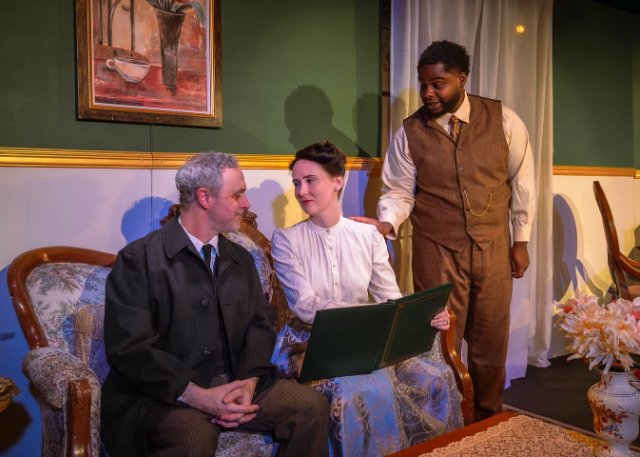
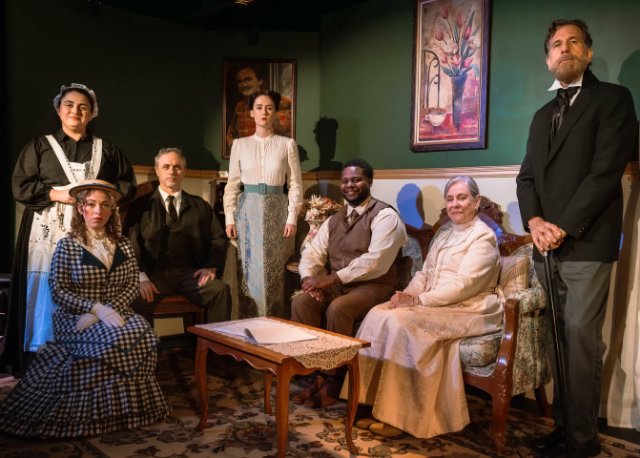
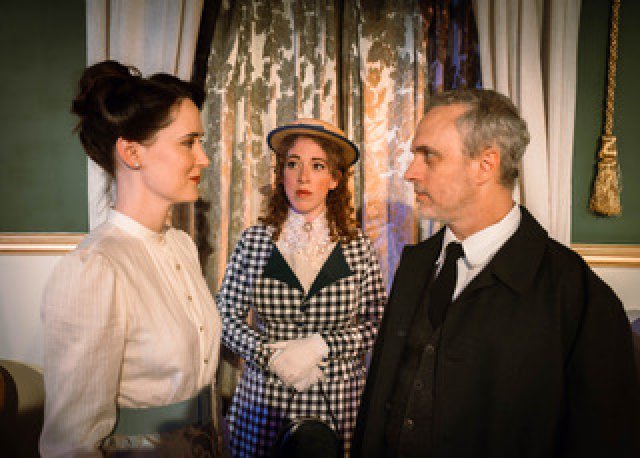
In Shakespeare Troupe of South Florida’s powerful production of Henrik Ibsen’s classic 1890s play Hedda Gabler, the title character cradles Eilert Lovborg’s manuscript to her chest as though it were her baby. Perhaps she’s wishing she helped bring the manuscript into the world. This is a woman who is itching to matter, and Nicole Hulett makes us sense that through her believably restless, uptight portrayal of a woman who wants to do more than maintain her passive married life.
Hulett leads a gifted cast in this production, directed commendably by Peter Galman, the troupe’s producing artistic director and founder. Galman has relocated the story from Ibsen’s original 1890s Norway to 1915 Connecticut, where change is in the air and the title character wants to be part of it by making herself useful.
Shakespeare Troupe of South Florida’s production, which is fully titled Hedda Gabler: A Life Arranged, runs for two more weekends in the intimate Sol Theatre in Boca Raton. The running time is about two-and-a-half hours, including intermission.
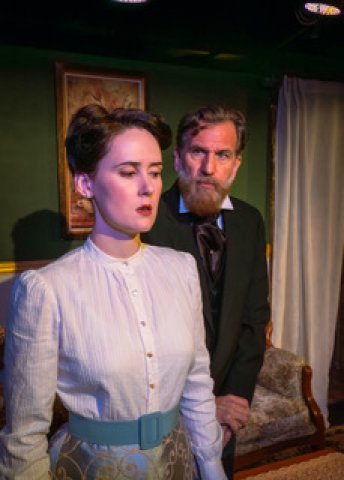
The production unfolds seamlessly under adapter/director Galman’s astute direction. He adeptly paces the production, allowing us to follow and understand the story. Galman also understands when to lighten and darken the mood. Appropriately, characters who are upset with others look away or walk away from the sources of their frustration. Galman also clearly differentiates the title character from her husband, George. As Jonathan Palmer ably portrays him, George is often content and upbeat, while Hulett’s Hedda is uptight and wary. Clearly, they’re an odd couple. In another smart directorial choice, toward the end, Galman positions Judge Brack near one of Hedda’s ears when he essentially blackmails her. His position near her ear lends the moment a threatening aura.
Hedda Gabler is a tragedy that Ibsen (1828-1906), the father of modern drama who pioneered theatrical realism, set during the 1890s in Kristiania (modern-day Norway). Galman’s adaptation moves the setting to New England in 1915, relocating the play to a locale and time of rapid change and industrial growth. Within this period of change, Hedda feels she is merely maintaining, rather than creating, a life for herself.
At the beginning of Hedda Gabler, newlyweds George and Hedda Tesman (née Gabler) have just returned from their honeymoon, and Hedda feels trapped in a marriage that doesn’t reproduce the privileged life she led before wedding George.
Meanwhile, Eilert Lovborg is Hedda’s intelligent but troubled former partner and George’s professional rival. At least for the moment, Lovborg has overcome his alcoholism with the help of Thea Elvsted, Hedda’s former schoolmate. Elvsted has also helped Lovborg write a potentially groundbreaking new manuscript. Driven by jealousy over Thea’s influence and eager to orchestrate a “beautiful” act of fate, Hedda tempts Eilert to start drinking again. Her effort to exert her own influence over someone else’s life, in order to feel powerful and useful, leads to a tragic conclusion.
The title character is a complex anti-heroine in an intense, absorbing psychological study of a person trapped by societal expectations. Hulett, who shone fairly recently as a tightly wound executive in New City Players’ excellent production of Burst, excels here, too, as an uptight Hedda who wants to matter.
With a serious expression, sharp, clipped voice, and purposeful movements, Hulett’s wary Hedda is largely restless and ill at ease. Observe, for instance, her wide dark eyes looking sideways. This suggests she may not even trust her own husband. At another point, George tries to touch her, but she flinches quickly, like a scared, suspicious cat.
When Hulett’s Hedda smiles, you wonder whether she’s genuinely happy and fully present, or merely masking her discomfort. During scenes with Thea, Hulett’s Hedda appears calmer than her former schoolmate and even reassuring. However, knowing that Hedda bullied Thea in school, you wonder if she’s trying to lull Thea into feeling secure around her. A convincing physical struggle between Hulett’s Hedda and Sara Grant’s Thea reinforces the two women’s tense relationship.
When Hedda cradles Lovborg’s manuscript against her chest, you sense just how much she wants to create something meaningful. Overall, Hulett delivers a finely calibrated performance that isn’t one note. Hulett is Australian, but, to her credit, she sounds distinctly American as Hedda in Galman’s Americanized adaptation.
Palmer plays the academic Tesman as a smiling, content, happy, enthusiastic young man. He eagerly shares honeymoon photos, speaks excitedly, and appears to be the polar opposite of his unhappy, wary wife. He also seems blissfully unaware of her feelings. At times, the couple seems to be happily married, but they’re an odd couple locked in an unrequited romance. Fortunately, Palmer’s performance isn’t one-dimensional. At the appropriate time, Palmer’s Tesman grows believably serious, concerned, and even horrified. Palmer’s Tesman speaks eloquently, but we never really get the sense that he’s particularly erudite.
Seth Trucks, a versatile and perennially busy South Florida actor, succeeds mightily as Lovborg. When we first meet him, he seems quite the opposite of a brilliant scholar filled with hubris. Instead, he appears modest and ineffectual, speaking in an unassuming tone. In addition, he seems to have a handle on his drinking problem. Also, it’s clear that his manuscript means a lot to him. While repeatedly tapping the document in his hand, he says, with authentic feeling, that he put his whole self into the project. Later, Trucks’ Lovborg becomes convincingly restless, irritable, troubled, and defeated. He looks down, puts a hand to his forehead, and his voice rises as his anguish increases. Clearly, the manuscript isn’t simply a book to him. He co-birthed it with Thea Elvsted, and it’s an expression of his self. Next up, Trucks will pivot to another tortured character: the title role in Thinking Cap Theatre’s upcoming production of Shakespeare’s Hamlet (Nov. 7-21 at the Hollywood Central Performing Arts Center).
As Thea, Grant fully inhabits a woman who appears to be a nervous wreck from the outset. With impressive spontaneity and naturalness, she moves her hands, blinks, and places two hands on her pocketbook as though she’s afraid someone might suddenly steal it. At the appropriate times, her voice believably breaks and she appears near tears. Later, Grant’s Thea sounds and looks truly devastated by Lovborg’s death and his manuscript’s destruction. With emotion in her voice, she likens its loss to the death of a child.
With a subdued, formal demeanor, Geoff Freitag plays Judge Brack as a man who becomes earnestly concerned, rather than obviously predatory or manipulative. Toward the end of the play, he becomes grave, like a doctor delivering devastating news. While Freitag’s Brack isn’t particularly threatening, he grows a bit ominous as he comes up behind Hedda’s ear and essentially tells her she’s not in danger as long as he remains quiet.
Christine Chavers and Ana Marie Calise also succeed in minor roles, as an eager-to-please Juliana, George’s aunt, and a faithful servant, Berta, respectively.
While the actors succeed admirably, so do the behind-the-scenes artists.
An uncredited set designer (the program lists multiple people as “scenic artists”) has fashioned the play’s sole setting, the Tesmans’ new home in 1915 Connecticut, as a spacious dwelling with colorful, patterned rugs and period, comfortable-looking furniture. Colors such as brown, white, and dark green lend the space an inviting aura, while props such as a phonograph help to place us in the period. As expected, George, a learned man vying for a professorship, has books in the home. There are also portraits on the wall, including one of General Gabler, Hedda’s late father. At least twice, the title character walks over to the portrait and looks at it, possibly for comfort as she mourns her father and her former privileged life.
Hulett not only skillfully portrays Hedda, she designed the upscale costumes with period details. They include three-piece suits with vests and at least one pocket watch. In terms of colors, the costumes are light and dark. Characters such as Lovborg and Judge Brack sport dark suits while the titular character wears a light-colored blouse, perhaps suggesting she hails from a different social class. The combination of light and dark in the costumes could correspond to the distinct moods in the production – somber and upbeat.
Lighting designer Manny Zaldivar appropriately illuminates the set realistically, while an uncredited sound designer renders each word the actors utter clear. Also, the use of suspense music heightens the tension. When Hedda burns Lovborg’s manuscript, likely out of jealousy, we hear flames flickering and melancholy, cello-like music that, combined, create a decidedly downcast mood.
During the tragic ending, we hear what resembles a gunshot, George investigates, and is horrified to discover his wife’s body. The final line is “People don’t do such things,” and then the lights come down and the show ends. The conclusion feels a bit abrupt; at least one more short final scene might bring the show to its more natural conclusion.
In the final analysis, as Hulett portrays her, Hedda can be difficult to like. However, you empathize with her strong desire to matter and create something herself. Watching and listening to her taps into our own desire to be useful when circumstances prevent us from being so.
This production is the kind of strong live theater that we’ve come to expect from the South Florida region. It also proves that the troupe is versatile beyond presenting the Bard’s classics. Galman has said that “audiences are already clamoring for the next classic we’ll give with a fresh new rendering.”
Indeed, we already can’t wait.
IF YOU GO
WHAT: Shakespeare Troupe of South Florida’s production of Hedda Gabler
WHEN: Two more weekends. Remaining performances are 7:30 p.m. Friday and Saturday, Oct. 9 and 10; 3 p.m. Sunday, Oct. 11; 7:30 p.m. Friday and Saturday, Oct. 16 and 17, as well as 3 p.m. Sunday, Oct. 18.
WHERE: Sol Theatre, 3333 N. Federal Highway in Boca Raton
TICKETS: $15-$39. Visit Shakespeare Troupe of South Florida or call (754) 228-7228.