

Minotaur at the New York Film Festival
Grand Prix at Cannes Deserved
By: Viktor Raykin - Oct 11, 2026
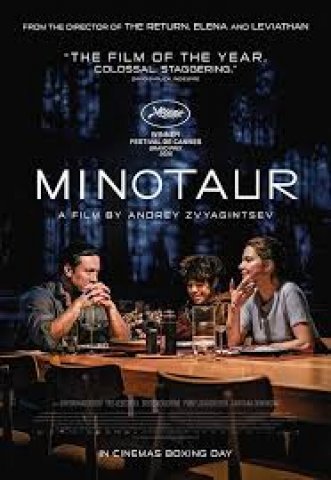
Minotaur, the new film by Andrey Zvyagintsev won the Grand Prix at Cannes.
It is based on Claude Chabrol's 1969 film The Unfaithful Wife. Zvyagintsev updates the narrative, setting it in Russia during the autumn of 2022, right when the partial military mobilization for the war with Ukraine began. On the surface, the characters lead an ordinary life, yet everything unfolds in a deeply ominous atmosphere.
The core plot is simple: an unhappy marriage, the wife cheats, the husband finds out, kills the lover in a fit of hatred, and the wife ultimately returns to him. While the storyline itself is ancient, the setting, events, and characters are completely modern. It is within this very antithesis that the raw nerve of this rather long film resides.
One of Zvyagintsev's signature artistic techniques is his slow, deliberate focus on every single scene. The camera follows what is happening in such meticulous detail that everyday elements become extraordinary. An open window, a voice coming from the television, an unmade bed, the bored look of a teenager—the viewer perceives all of these as assertions, or variables in an important equation they are forced to solve. Yet, the greater question the film poses feels entirely unresolvable: how do we reconcile a comfortable, modern life with absolute barbarism?
The Lie is an important "character" across all of Zvyagintsev's films, but in Minotaur the Lie takes center stage. There is so much lie, both big and small, permeating every single layer of life. The authorities lie, children lie, and the characters constantly lie to each other and themselves.
Lie has two components here. Lying through words, actions, or silence, is the easy part. The other is a kind of emotional numbness that comes over a person who refuses to let themselves feel the reality of what is happening.
The husband, Gleb, lies constantly on both levels. Yet, the exact moment his suppressed feelings finally rupture to the surface, he grabs the first heavy object at hand and kills the intruder. In doing so, the only character who doesn't lie—Galina's lover—perishes.
Galina herself lies through her behavior, but not through her feelings. We see how acutely she suffers from being so tightly woven into Gleb's life, and we watch her repeatedly, fruitlessly trying to draw him into an honest conversation. She leads a double life with no visible way out. Gradually, a sense grows that Galina is doomed. But as it turns out, it wasn't Galina herself who was condemned, but rather her capacity to feel.
The climax arrives when the wife deduces that the murder has taken place. This moment serves as both the film's full stop and its counterpoint, yielding a twist I never could have predicted: the only vibrant human being left chooses a spiritual death over a physical one. She stares into Gleb's eyes for a long time. He realizes she has guessed everything. His gaze communicates: I did this and I remained myself, now you know. In response, Galina moves closer and lays her head on his shoulder. For the first time in the entire film, they kiss on the lips.
Ultimately, the family flies off to a resort. Where exactly? Crete, the birthplace of the Minotaur—returning, so to speak, to the very source. Here, the Minotaur represents the Lie itself, devouring human bodies and souls. Traveling with them is their teenage son. He is only just learning the art of concealing the truth from adults and from himself, but he seems to be mastering the discipline quickly. After all, he has excellent teachers.
Minotaur won the Cannes Soundtrack Award, and for good reason. The almost constant presence in the frame of environmental ambient sounds—nature, the streets, overlapping voices—juxtaposed against a highly minimalist, almost imperceptible musical score, creates a special atmosphere of the continuity of life moving around the characters. This stands as a supreme success for the filmmakers.