

Vikingur Olafsson and The Berlin Philharmoniker
Carnegie Hall Launches New Season
By: Susan Hall - Oct 13, 2026
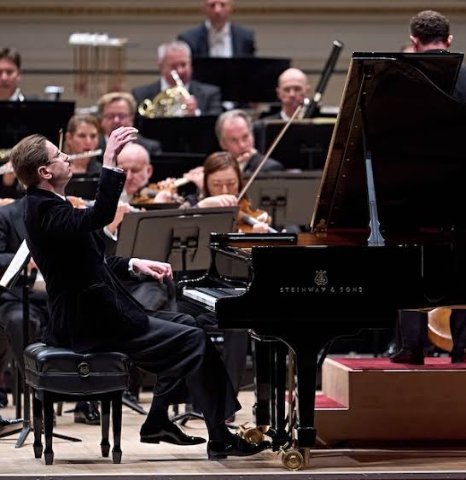
The Berlin Philharmoniker performed a second program on October 9 and 11 to inaugurate Carnegie Hall’s new season. Brahms's challenging first piano concerto began the program. This difficult work began life as a two-piano piece, morphed into a symphony, and finally became a concerto. Its problems were not only solved by the pianist Vikingur Olafsson and the orchestra, but translated musically into virtues.
Musicians first and foremost like to play with time. The soloist Vikingur Olafsson offered a unique and very present interpretation of all three movements. He would linger over notes and phrases. These were not pauses or suspensions of time, but rather personal feelings for a note or phrase, often lavished with detail. The audience never knew quite what to expect. The result not only engaged but thrilled, because it was surprising yet apt.
Kirill Petrenko, leading the Philharmoniker, listened carefully to the artist at the piano and brought all the orchestral solo and ensemble elements of the work forward in time with the soloist. The work became timeless. No Artur Schnabel metronome markings were evident here.
In his encore, Mr. Olafsson played the Largo from a Bach concerto with strings. Here, his method became clear as a bell. He was responding in the moment to what his instrument delivered and capturing the next sound in what felt like just the right moment.
The Philharmoniker and Mr. Olafsson made magic playing with time.
The second half of the program featured Richard Strauss's Also Sprach Zarathustra. Mr. Petrenko is a Strauss fan, and masterfully draws out the orchestral colors and architecture. The composer conducting this work himself was straightforward, not embracing that romantic beauty many find in the work. Maestro Petrenko follows the composer's architecture, but for instance elicits thunder from the brass. Dynamic textures are under control. The entire orchestra feels massive and yet it is radiant, showing clearly the unfolding architecture of the work.
In Petrenko’s hands, the low C which provides the floor of the piece is barely audible until it is picked up by the basses and the contrabassoon. The trumpets introduce and carry the three-note motifs, with the timpani adding to crescendos and providing punctuation throughout the work.
Petrenko is fastidious, but that care gives the first violin the chance to soar in the difficult solos accompanying the dance song, which rollicked. The composition’s inner voices are revealed by quick turns and clipped endings while the overall work continues to move forward.
Double basses and bassoons are dark and mysterious. The harps provide an ethereal texture.
The horns played an important role in providing harmonic warmth throughout the piece.
Each instrumentalist in the Berlin Philharmoniker is a soloist in their own right. This Strauss tone poem under Maestro Petrenko shows off their solo and ensemble talents, providing a perfect way to open the Carnegie Hall season.