
Greek National Opera at Carnegie Hall
Stavros Niarchos Foundation Supports Culture
By: Susan Hall - Oct 17, 2026
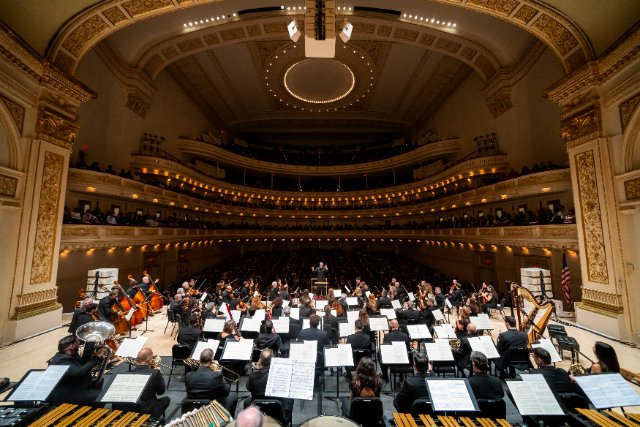
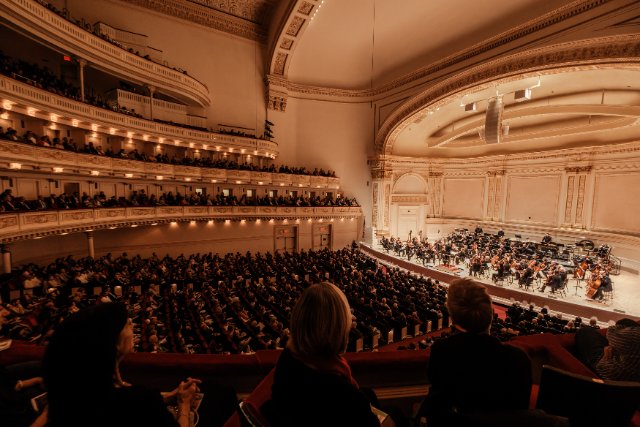
Greek National Opera
Carnegie Hall
New York, New York
October 5, 2026
Program
Dimitri Mitropoulos: Cretan Feast (orchestrated by Nikos Skalkottas)
Nikos Skalkottas: Selections from Greek Dances (including Three Cretan Dances)
Manos Hadjidakis: Selections from Captain Michalis (performed with soprano Manos Hadjidakis: Maria Kostraki)
Giorgos Koumendakis: Amor Fati (U.S. premiere of the 2007 symphonic work))
Mikis Theodorakis: Selections from Zorbas / Zorba the Greek ballet suite (featuring mezzo-soprano Anita Rachvelishvili
The Greek National Orchestra was conducted by Vassilis Christopoulos, Chief Conductor and Music Director of the Graz Opera.
The Greek National Opera (GNO) regularly commissions and performs works by landmark twentieth and twenty first century Greek composers such as Mikis Theodorakis, Manos Hadjidakis, Nikos Skalkottas, and current Artistic Director Giorgos Koumendakis. Even when the orchestra does not use traditional Greek musical instruments like the Cretan Lyra and the Santouri, they successfully simulate their sounds and textures. Amor Fati abandons folk textures to capture the Cretan spirit both minimally and impressionistically. It works.
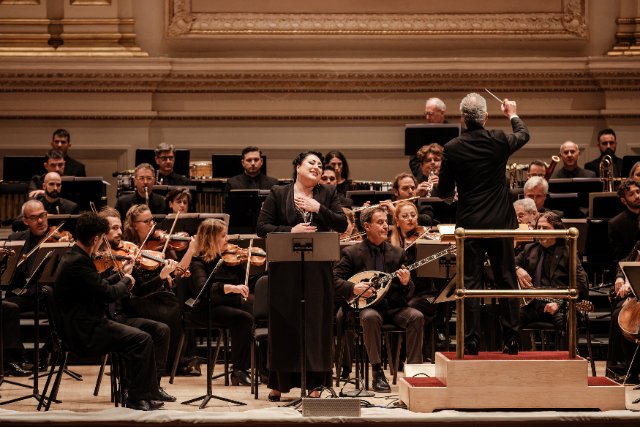
The Manos Hadjidakis Ensemble performed selections from Captain Michalis, sung by emerging Greek opera soprano Maria Kostraki. She beautifully captured the conflict between passion and political duty, “enlighten the untamed beast.”
The orchestra routinely incorporates the bouzouki for arrangements of pieces by Mikis Theodorakis and Manos Hadjidakis. On stage at Carnegie Hall, the bouzouki was amplified so its distinct strums stood out, channeling a spirit of Cretan defiance. Ms. Kostraki brought a clear voice of hope that soared through the hall, and the quiet moments of the piece felt like the transcendental message of the author.
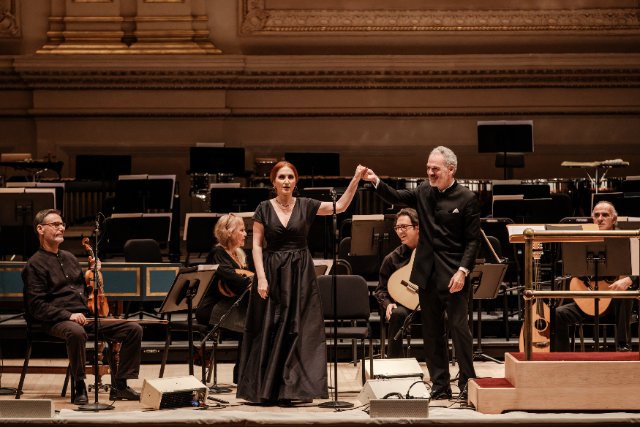
Mezzo-soprano Anita Rachvelishvili took on Zorba in selections from the Zorba the Greek ballet suite. “Through familiar streets, she seeks what she has scattered” when she was together with Zorba.Her strong voice added cinematic color to the music. The uneven beats drove the audience to clap for so long that the conductor graciously had to pause. Later, when Ms. Rachvelishvili took her seat, she joined the applause, making her hands an instrument on their own.
This characteristically Greek music feels wonderfully balanced, where the beat is carried by percussion and basses while crystalline high notes seem to reach for the sky. The dialogue between the harpsichord and basses was intriguing. The orchestra proved that the journey is what truly matters, and with modern Greek classical composers guiding the way, Carnegie Hall is a vibrant stop on the path to the world.
The Greek National Opera is at home in the Stavros Niarchos Hall, as well as its smaller Alternative Stage. Highlights from the current line-up include:
L'Orfeo (October–November 2026): A staging of Claudio Monteverdi’s classic opera at the Stavros Niarchos Hall.
The Emperor's Nightingale (November 2026–January 2027): Lena Platonos' acclaimed musical fairy tale returns for family and school performances.
Giselle (December 2026–January 2027): A major classical production presented by the GNO Ballet, reviving Marius Petipa's historic choreography.
Pikovaya Dama / The Queen of Spades (December 2026–January 2027): Pyotr Ilyich Tchaikovsky's masterpiece under the baton of conductor Dmitri Jurowski.
Tosca (January–February 2027): The revival of Nikos S. Petropoulos' stark, cinematic production of Puccini's tragic opera.
This concert was sponsored by the Stavros Niarchos Foundation, an important cultural support in Greece and in New York.
The GNO is part of the Stavros Niarcos Foundation's Cultural Center in Athens. Designed by Italian architect Renzo Piano and completed in 2016, the project was conceived to give both the GNO and the National Library of Greece a modern, unified architectural and cultural home.
Piano created a gently angled artificial slope by building up an incline from a former 2004 Olympic parking lot. The green roof of the opera and library structure forms the base of the Stavros Niarchos Park, blending buildings seamlessly into a landscape that steps down toward the Aegean Sea.
The Opera building and the National Library are separated by an open-air public gathering space called the Agora. Above the opera house floats a canopy roof covered in 10,000 square meters of photovoltaic cells, which provides shade and generates clean energy for the auditoriums.
Completed in 2016, the entire complex was gifted by the foundation to the Hellenic Republic, marking one of the largest philanthropic cultural gifts in Greece's history.
In New York, the NiarchosFoundation renovated the New York Public Library’s main circulating library at Fifth Avenue and 40th Street. It is a true Agora, which classical scholar Werner Jaeger described in his work Paideia as a” a central physical and social arena where the life, public culture, and political education of citizens is concentrated.” Other SNCF cultural contributions in New York have not met this mark.
We have the Foundation to thank for the delightful Carnegie concert.