

The Universal Religion
Dismantling the Altar of I-ism
By: Cheng Tong - Dec 30, 2025
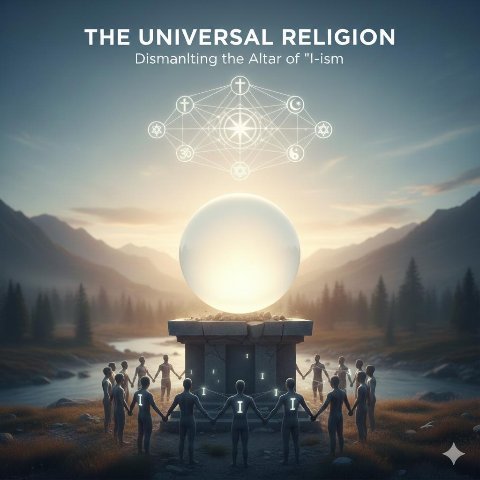
In the vast landscape of human spirituality, we often categorize ourselves by our “isms.” We are Buddhists, Daoists, Christians, or Atheists. We wear these labels like badges of identity, believing they define the parameters of our search for truth. Yet, beneath these formal structures lies a more ancient, more pervasive, and far more stubborn devotion that unites every human being across time and geography. It is the one religion we are all born into, and it is the one we must ultimately renounce if we are to take even a single step toward genuine spiritual growth.
It is called “I-ism.”
I-ism is the religion of the self, the worship of the ego. It is a faith where the “I” is the central deity, the mind is the high priest, and our desires and fears are the liturgy we recite daily. Unlike other religions that require a conversion, we are initiated into I-ism the moment we first say the word “mine.” It is the instinctive belief that we are separate, independent entities moving through a world that exists primarily as a backdrop for our own personal dramas.
The Architect of the Barrier
In my work with and teaching of the 49 Barriers to Spiritual Growth, I have come to realize that these obstacles are not forty-nine separate walls we must climb. Rather, they are forty-nine different masks worn by I-ism. Each barrier—whether it be greed, procrastination, or spiritual pride—is simply the ego’s attempt to defend its territory or expand its influence.
Consider the barrier of Identification. This is the foundational scripture of I-ism. We identify with our bodies, our thoughts, our professional titles, and our past traumas. We tell ourselves, “I am a teacher,” “I am an American,” or “I am a person who has suffered.” By doing so, we create a rigid, calcified version of the self. We build a cage and then complain that we are not free.
When we identify so strongly with these temporary conditions, we lose the capacity for the suppleness and flexibility found in the practice of Taiji. In push hands, if a practitioner identifies with their strength or their need to “win,” they become brittle. They meet force with force because the ego perceives a physical push as an existential threat. They cannot yield because the “I” is too heavy to move. To dismiss I-ism is to realize that there is no “fixed point” for an opponent to strike.
The Paradox of the Search
Perhaps the most seductive aspect of I-ism is how it co-opts the spiritual path itself. We see this clearly in the barrier of Spiritual Pride (or what I have previously called the Demon of the Book). Here, the ego decides it wants to be “enlightened.” It begins to collect spiritual concepts, Sanskrit terms, and meditation hours like a dragon hoarding gold. The “I” wants to be the one who attains stillness, not realizing that the very presence of the “I” is what prevents stillness from occurring.
I recently wrote to a student who was struggling with this very paradox. I told her:
“And what you find at the end of this search you are on, this quest, is what you already are, what you have been all along. You are already what you have been searching for, and the meaning you seek is the search itself. Your mind is trying to solve the mystery, while your heart is already quietly, patiently, living it.”
This is the core conflict of the human condition. The mind—the seat of I-ism—is an analytical tool. It is designed to solve problems, to categorize, and to bridge the gap between “here” and “there.” Therefore, when the mind encounters the concept of spiritual realization, it treats it as a mystery to be solved or a destination to be reached. It creates a “Quest.”
But the heart does not search. The heart is the vessel of the Dao; it is already the mystery. While the mind is busy planning the next spiritual retreat or reading the next book, the heart is already breathing, already beating, and already connected to the silent pulse of the universe. I-ism keeps us trapped in the “search” because as long as we are searching, the “searcher” (the ego) remains alive and relevant.
The Great Yielding
To renounce I-ism is not an act of will, for the will is just another function of the ego. You cannot “self-will” your way out of the self. Instead, it is an act of yielding. It is the transition from doing to being, from the noise of the mind to the silence of the heart.
In the practice of Wu Wei, or non-effortful action, we see the death of I-ism in real-time. When a painter is truly in the flow, there is no “I am painting.” There is only the brush, the ink, and the paper. The “I” has stepped aside, and the Dao has taken over. This is the goal of our practice—not to become a “better” person, but to become transparent, so that the light of the original self, our original nature, can shine through without the distortion of the ego’s agendas.
When we finally dismiss the religion of I-ism, the 49 Barriers do not need to be broken; they simply dissolve. They lose their power because the “I” they were trying to protect is seen for what it is: a phantom, a temporary ripple on the surface of a deep and still ocean.
We find that we have never been away from home. We have only been dreaming of a journey while standing exactly where we needed to be. The mystery isn’t something to be solved at the end of a long road; it is the very ground beneath our feet.
Presence is the practice.