
What's Next
Tabula Rasa
By: Cheng Tong - Jun 30, 2026
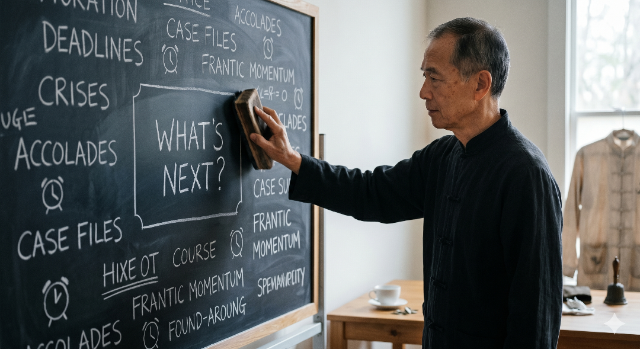
In the early 2000s, there was a popular television drama, The West Wing, that followed the hyper-fast, high-stakes lives of the political elite inside the White House. Whenever the fictional president finished a grueling debate, resolved a global crisis, or wrapped up a staff meeting, he would look around the room, slap his hands together, and utter a signature two-word phrase: “What’s next?”
For him, and for the world he inhabited, those words were a relentless engine of forward momentum. They meant: We have conquered that hill, now let us march to the next. What is the next crisis? What is the next goal? It was the ultimate expression of a life built entirely on “doing”—a ceaseless sprint into the future where the present moment is merely a stepping stone to be trampled across.
For many years, as a local government official and lawyer operating in an arena not unlike that fictional one, my life moved to that exact same frantic rhythm.
But over decades of cultivation in the internal arts, those same two words have returned to me, completely hollowed out of their worldly ambition. It is a beautiful alchemy—turning a phrase born of worldly chaos into a guardian of inner stillness. Today, “What’s next?” has become one of the most vital, grounding tools in my daily practice.
I do not use the phrase to chase the future. I use it to anchor myself firmly in the absolute freshness of the present.
For me, “What’s next?” is a deliberate, internal line of demarcation. It is the act of picking up a felt eraser, wiping life’s blackboard completely clean of whatever was just written upon it, and holding the chalk ready for a completely blank slate.
Moments are heavy things; they like to cling to us. If a student loses their balance during a complex turn in the Taiji form, that frustration wants to bleed into the next step. If a rainy Wednesday disrupts an outdoor class for the third consecutive week, that disappointment wants to color the rest of the morning. Even our successes trap us—a beautiful piece of writing or a profound session of Qi healing can leave us feeling self-satisfied, pulling our minds backward into the past to admire what we just did.
When I say to myself, “What’s next?”, I am gently but firmly enforcing a boundary. I am reminding my consciousness that the moment just ended is gone. It is in the past. It is dead, buried, and no longer available to me. It cannot be altered, and it cannot be relived.
By drawing that sharp line, I refuse to carry the emotional baggage of the last minute into the pristine space of the next breath.
This is the hidden mechanism that allows for Consistency in the Ordinary. To find the sacred in washing a dish, pulling a weed from a garden bed, or pouring a cup of white tea, the mind must be empty of the world. If your mind is still caught up in the argument you had an hour ago, or the accolade you received yesterday, you cannot truly taste the tea. Your blackboard is too crowded with old chalk dust.
“What’s next?” is not a rushed command to perform. It is a quiet invitation to arrive. It is the realization that life is not a long, continuous scroll to be managed all at once, but an infinite series of single, isolated, beautiful moments.
When the bell rings, the class is over. What’s next? The walk to the hearth. When the tea is poured, the pouring is over. What’s next? The warmth of the cup against the fingers.
The blackboard is clean. The slate is empty. The next moment is about to begin, and I am entirely ready to face it exactly as it comes.