

Urban Bush Women at Jacob’s Pillow
SCAT!... The Complex Lives of Al & Dot, Dot & Al Zollar
By: Charles Giuliano - Jul 06, 2026
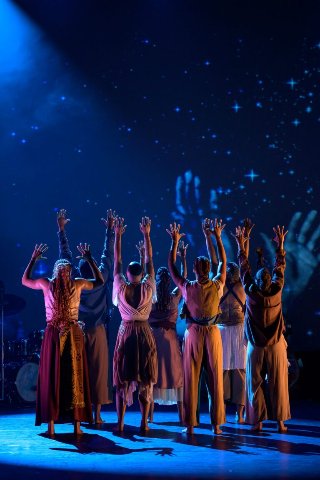
SCAT!... The Complex Lives of Al & Dot, Dot & Al Zollar
Written, conceived, directed and co-choreographed by Jowole Willo Jo Zollar
Co-choreographed by Vincent E. Thomas
Original music composed by Talvin Wilks
Dramaturgy by Talvin Wilks
Community of Memory (Ensemble)
Jowole Willa Jo Zollar
Story Folk: Du’Bois A’Keen, Stephanie Battle, Courtey J. Cook
Dancers: Kentoria Earle, Roobi Starla Gaskins, Jasmine Hearn, Keola Jones, Symarna Sarai
Musical director, bass, Jordyn Davis
Drums, Gary Jones III
Keyboard, TVV Sample
Vocals: Milton Suggs, Brianna Thomas, Charenee Wade
A mandate for the 2026 season of Jacob’s Pillow is to highlight the contributions of women. The week celebrating the 250th anniversary of America focused on Jowole Willo Jo Zollar who founded Urban Bush Women in 1984. The company has been a frequent visitor to the Berkshires and developed new work during a residency at MASS MoCA.
The singular work performed Scat!... The Complex Lives of Al & Dot, Dot & Al Zollar could not have been more relevant and timely. With its focus on African American history and culture it strongly defies Trump’s reactionary, revisitionist attempt to whitewash our past and replace it with a fantasy of Christian white supremacy.
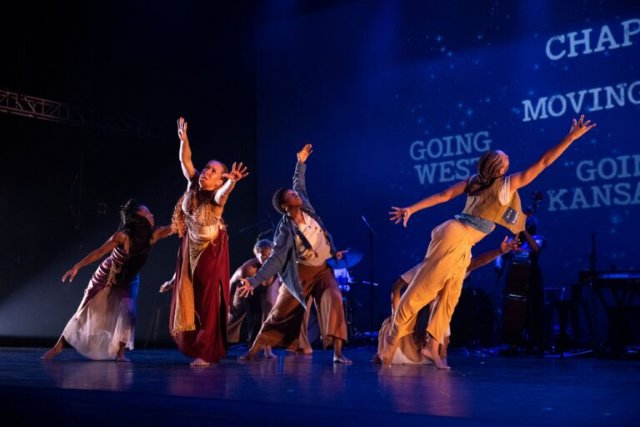
The work in nine segments identified by projected signage with music, song and dance, reveals the triumph and tragedy of her parents, Dot and Al, set in the jazz infused culture of Kansas City. They were part of the Great Migration of black’s fleeing the rural Jim Crow South for a better life and employment in the industrialized North.
They took their music, dance and cuisine with them morphing into new forms and expressions of the diversity of black culture. While, to some extent, blacks thrived there was also brutal backlash and resentment fueled by the Ku Klux Klan. Al Zollar who, for a time thrived as a realtor and bar owner, was annihilated and reduced to bankruptcy.
During Prohibition Kansas City was a wide open town run by Tom Pendergast who only briefly held elected office, as an alderman. His capacity as chairman of the Jackson County Democratic Party allowed him to use his large network of Irish family and friends to help the election of politicians, in some cases by voter fraud, and to hand out government contracts and patronage jobs. He became wealthy in the process, but his addiction to gambling, especially horse racing, later led to a large accumulation of personal debts.
In 1939, he was convicted of income tax evasion and served 15 months in a federal prison. The Pendergast organization helped to launch the political career of future president Harry S. Truman, which caused Truman's early enemies to dub him "the senator from Pendergast".
With a growing black population that spawned a lively music scene which developed a more advanced form of blues based music with an emphasis on riffs and head arrangements. There was a proliferation of territory bands which toured the region. One of the most successful of these was the Benny Moten Band. He died through a botched surgery just as the band was scheduled to tour. He was replaced by Count Basie. Charlie Parker, a friend of Zollar’s mother emerged from Kansas City.
Much of Scat is set in a fictional Kansas City nightclub which highlights the period’s music and dance.
Zollar, who “has had a consistent and innovative interest in mining tradition and creating new ritual” (The New York Times), describes, “I grew up performing in floor shows in Black neighborhoods in a segregated Kansas City in the 1950s & 60s. My mother was a dancer and a jazz singer, and my father sold real estate and ran a bar called Al and Bud’s. During this era, Black businesses were booming, and there was great hope for upward mobility after World War II. SCAT! is modeled after the structure and content of the great tradition of the Black floor show, which included comic MCs (like Moms Mabley and Pigmeat Markham), flash acts (think the Nicholas Brothers or the Crackerjacks), eccentric dancers (like Earl ‘Snakehips’; Tucker), storytelling orators, kiddie acts, striptease/exotic dancers (à la Josephine Baker or Sahji), and the Shim Sham Shimmy—a traditional tap dance finale.”
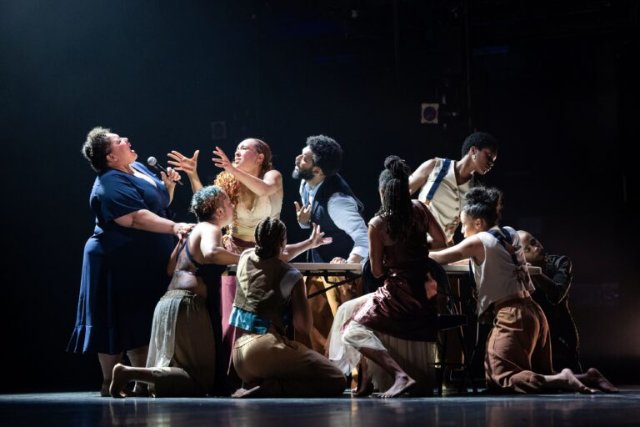
The suite begins with a dream she had decades ago. It is set before a large banquet table, covered with white cloth, in the middle of the ocean. On one side sat her mother at the head of a row of ancestors. On the other side, similarly, sat her father and generations of elders. The dream inspired her to found Urban Bush Women although it would be decades before she created this cohesive version.
An impediment entailed the early deaths of her parents and grandparents. There was no oral family history to draw upon. This work resulted from extensive research which has evolved into a personalized narrative.
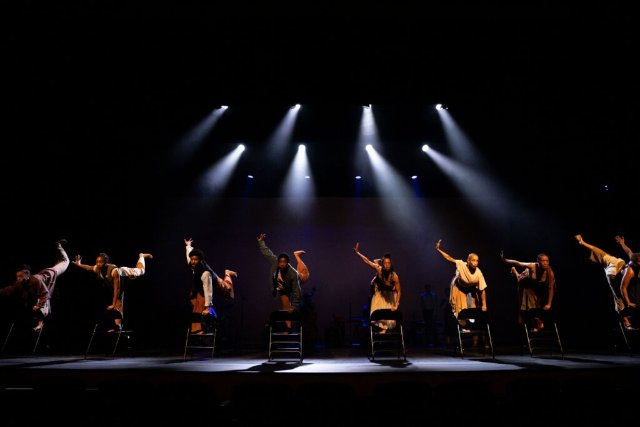
In terms of design the production is austere. There is projected signage but no set. The only props are folding metal chairs which are used in varying configurations. They cling clang about and at one point a row of dancers stand on them.
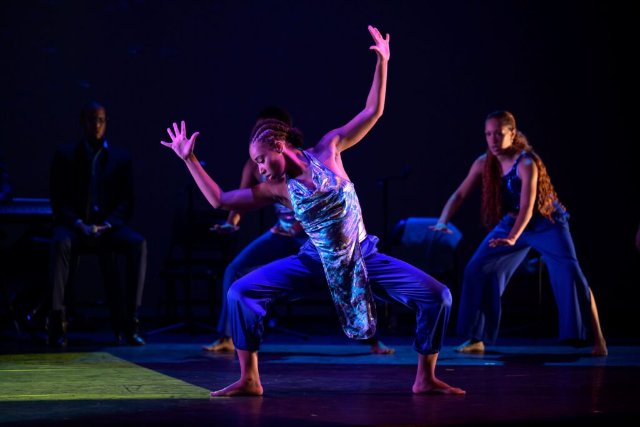
We have an exuberant sense of the social dancing of the clubs. Individuals are highlighted with titubating energy. There are three primary narrators but they also sing and dance. All members of the company were multitasking.
Much of the narration was rendered by scat, a technique of vocalize (A vocal exercise sung in one or more vowels without actually forming any words.) The first recorded example of scat is “Heebie Jeebies” (1926) by Louis Armstrong.
During the Library of Congress sessions folklorist Alan Lomax asked “What does scat mean?” Jelly Roll Morton replied “What scat ain’t nothing but what gives a song a flavor” which he then demonstrated.
It made little sense that there was an intermission after seven of the nine segments. When the program resumed there was an abrupt momentum and emotional shift. Segment eight is a mournful lament of oppression and terror that haunt people of color. We were drawn in and rived by the horror which was a harrowing gut punch.
At the end of that segment Zollar came to center stage and shed a layer of her costume. She was revealed in splendiferous silver lame. With a burst of exuberance the dancers returned for the joyous shim sham shimmy which traditionally ends revues. The rafters shook at Pillow and the audience went home wafted on wings of joy.