

The Happiest Man on Earth
St. Germain One Man Play at Plahouse On Park
By: Karen Isaacs - Oct 03, 2026
The expression goes that a cat may have nine lives, but a man only one. In the case of Eddie Jacku, the only character in The Happiest Man on Earth that is not true. Eddie must have had nine lives.
The one man showed now Playhouse on Park through October 18, may be accused of false advertising. Eddie, at the end of the show tells us he is the happiest man, but the story he tells is horrifying and astonishing. It’s my one complaint; the information said he spent his life encouraging forgiveness, but not enough of that is shown. At the end, he does point out that the German’s weren’t evil but easily manipulated and they got caught up in what was going on.
Many of us have read or heard the stories of those that survived. Sociologists and psychologists report that many never spoke of the horror they endured or if they did, it was in the very sketchiest of terms. As Eddie says in the beginning, “How much can they (the audience) bear to hear, how much can I bear to tell.”
For Eddie, who, in fact lived until 101, survived the holocaust. A German Jew he was in four concentration camps, the death march, plus he escaped at least twice, including once on a train to a concentration camp. He, and his family lived in Belgium and France. One of the ironies of his story is that in Belgium the police arrested him because he was a German, who had crossed the border without papers.
Did you know that some prisoners were categorized as ‘economically indispensable Jews”? They were not to be killed because they possessed some skill that they was necessary for the German war machine. I certainly had never heard that phrase.
Any solo show needs a premise to explain why the character is talking to us, the audience, and telling us this story. Playwright Mark St. German who adopted this from Eddie’s autobiography has created a very effective premise to explain this. Eddie is finally going to talk about his experiences the next day at a Synagogue. He is nervous so he is practicing in front of us who he calls his new friends.
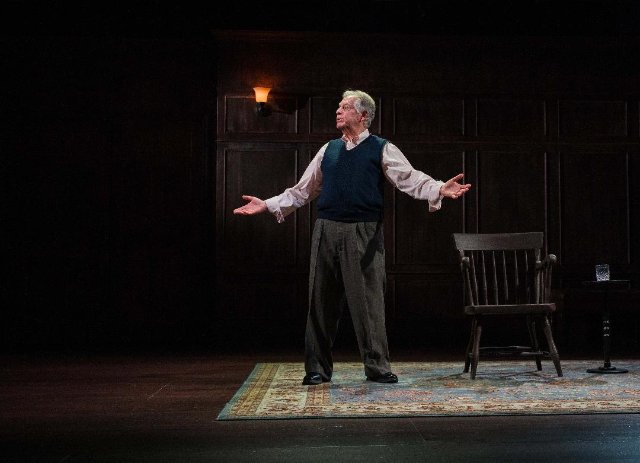
The set is simple. It could be a library or a study: a paneled room with two chairs on a rug and benches on the side and at the back.
Though there is only character, this is not a static piece; director Sasha Brätt doesn’t let Eddie just sit and tell us the story; he moves around the entire large Playhouse on Park stage. Eddie prowls the stage in a three-piece suit He doesn’t need costume changes for us to imagine him as the young boy or as gaunt prisoner who is eventually freed by the Americans
Telling this story must be incredibly difficult for Robert Resnikoff who plays Eddie. The details are horrifying to think about, but Resnikoff conveys Eddie’s ingenuity, instinct for self-preservation and humanity.
He is aided in telling his story by incredible sound effects by Xi (Zoey) Lin that make you feel you are living the story with him. These effects include everything from the sound of tanks and gunfire to more mundane aspects of his life.
This may not be a story you want to listen to, but it is a story you should listen to. World War II ended 80+ years ago and soon no survivors will be alive to tell the story. We are also in the time of increasing antisemitism and scapegoating of immigrants and those who are different.
This show reminds us, but many of the people who helped the German final solution along were as Eddie said not evil people they were playing
His final message is to repeat an expression his father: “family first, family second everyone is family.”
Tickets are available at PlayhouseOnPark.org.