

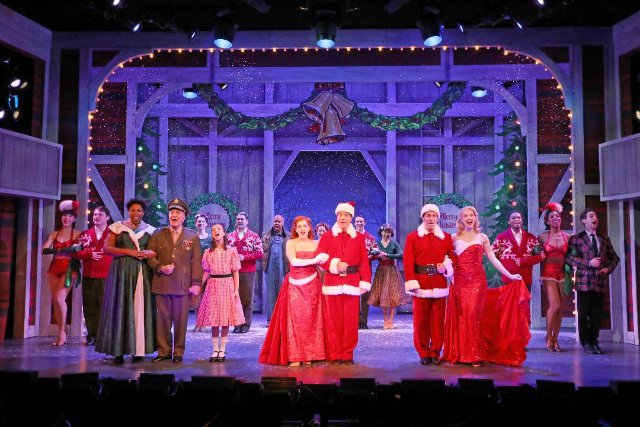
How can you go wrong with spectacular dancing, glorious Irving Berlin tunes, and two romantic couples? With Goodspeed’s production of White Christmas, through Dec. 31, you can’t. This may not be a perfect production, but it is a truly enjoyable one.
But before I quibble about some things, let’s look at the plot. Developed in 2000, this show appeared on Broadway in 2008; authors David Ives and Paul Blake take the basic plot from the 1954 movie starring Bing Crosby, Danny Kaye, Rosemary Clooney, and Vera Ellen, and tweaked it; some songs were added, and others deleted
The first scene sets up at the background – a European WWII army unit in 1944. Captain Bob Wallace and Private Phil Davis have joined forces to put on a Christmas show for the company; Wallace is an established performer, and Davis seems more of a cut-up. When the commanding officer, General Waverly, is reassigned, he addresses his troops and wonders where they will be in 10 years’ time.
Fast-forward to 1954. Wallace and Davis are very successful song and dance men; Wallace is all business, and Davis is a ladies’ man. Just before Christmas, they go to a club to hear a nightclub act featuring the sisters of a fellow soldier (Pvt. Haynes).
Phil and Judy Haynes are immediately attracted to each other and set about bringing Bob and Betty together, though there appears to be an instantaneous dislike. All four end up at a Vermont inn where the sisters are booked to appear, which just happens to be owned (not successfully) by General Waverly. Various romantic complications occur, but, as in a Hallmark movie, it all ends happily; even the inn is saved. The show ends with “White Christmas.”
The highlight is the dancing. An early number, “The Best Things Happen While You’re Dancing,” sets up the expectations with a ballroom number by Phil and Judy. Act two opens with a perhaps over long but spectacular tap number, “I Love a Piano.” It stopped the show.
Director Henter Foster has done a competent job but has made a few choices that seem inexplicable. For example, Ezekiel, a guy who works at the inn, is slow-moving and taciturn in Act One. It’s funny. By the Second Act, he is more vocal, he moves faster and has an apparent romantic exchange with the stage manager. I also expected Foster to make some use of the aisles as well as to make the finale memorable.
But there were also some larger problems. Betty’s dislike of Bob is so extreme and exaggerated that it makes their coming together less believable. In fact, while the four leads are very, very good, that inexplicable chemistry is missing. You don’t really feel the immediate attraction between Phil and Judy, nor the growing attraction between Betty and Bob.
Omar Lopez-Cepero, who was Emile de Beque in Goodspeed’s South Pacific, is vocally more of a crooner here. He doesn’t try to emulate Bing Crosby but brings his own take on the role. At times, he doesn’t seem like the driven businessman/performer. Clyde Alves as Phil Davis dances up a storm and projects the devil-may-care attitude of the role. As the Haynes sisters, Jonalyn Saxer as Judy dances up a storm, and Lauren Nicole Chapman is fine as Betty. Chapman is very effective in “Love, You Didn’t Do Right By Me.”
Sofie Nesanelis, as Martha, the manager of the inn (who just happens to have been a Broadway performer), almost brings the house down with “Let Me Sing and I’m Happy.” The three women join for an unfamiliar Berlin tune – “Falling Out of Love Can Be Fun.”
As usual, the production values are excellent, particularly the costumes by Jeff Hendry, the lighting by Kirk Bookman and Nathan W. Scheuer, and the sound by Jay Hilton. The musical direction by Adam Souza and the Goodspeed orchestra was terrific.
The star of the show is Kelli Barclay’s choreography.
You might be able to snag a ticket to this enjoyable seasonal show at Goodspeed.org.
This content is courtesy of Shore Publications and Zip06.com