

The Dance of Change
Understanding Bagua in the Daoist Tradition
By: Cheng Tong - Mar 18, 2026
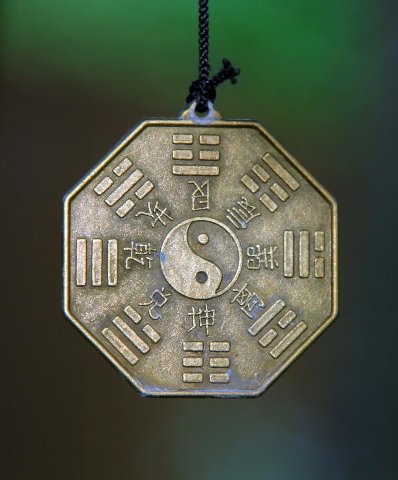
To understand Bagua (Eight Trigrams), one must first look past the physical movements of the martial art and toward the very architecture of the universe as viewed by the ancient Daoist sages. In the Daoist cosmogony, we move from the Wuji (the Empty Void) to the Taiji (the Supreme Ultimate/Yin and Yang). Bagua represents the next step in this unfolding: the diversification of energy into eight fundamental forces that govern all change in the natural world.
The Cosmological Root: The Eight Trigrams
The term “Bagua” literally translates to “Eight Symbols.” These trigrams are composed of three lines—either solid (Yang) or broken (Yin). Each trigram serves as a “DNA strand” for a specific quality of energy.
In Daoist philosophy, nothing is static. Just as the wind eventually turns to rain or the mountain is weathered by time, the trigrams are constantly shifting into one another. This is the essence of the Yi Jing (Book of Changes), which utilizes these eight symbols to map the flow of human life and the cosmos.
Baguazhang: The Martial Expression of the Circle
While you are familiar with the “Internal” (Neijia) family of arts, Baguazhang (Eight Trigram Palm) is perhaps the most visually distinct. If Taiji is the art of the “Great Ultimate” balance, Bagua is the art of Transformation.
The hallmark of the practice is Circle Walking. By walking in a circle while maintaining a twisted posture toward the center, the practitioner creates a “vortex” of energy. In a martial sense, this allows the practitioner to constantly move to the opponent’s “blind spot.” In a spiritual sense, it is a moving meditation designed to harmonize the practitioner with the rotating cycles of the heavens and the seasons.
The Significance to Daoism
The significance of Bagua to Daoism can be broken down into three primary pillars:
- The Pursuit of Harmony (He) Daoism teaches that suffering arises when we resist the flow of the Dao. Bagua provides a map of that flow. By studying the trigrams, a practitioner learns to recognize which “energy” is present in a situation. If an opponent (or a life challenge) comes with the force of Thunder, the practitioner does not meet it with rigidity; they might become like Water, absorbing the blow, or like Wind, redirecting it.
- The Microcosm and the Macrocosm A core Daoist tenet is that the human body is a small universe (Xiao Yuzhou). The Eight Trigrams are not just “out there” in the stars; they are “in here” in our organs and meridians. In Neidan (Internal Alchemy), Bagua is used to describe the “cooking” of the Three Treasures (Jing, Qi, Shen). We use the “Fire” of the heart and the “Water” of the kidneys to create the “Steam” of vitality.
- Stillness in Motion In Bagua the Martial Art, the perimeter of the circle is a place of high-speed movement and rapid footwork. However, for the movement to be effective, the center of the circle (and the center of the practitioner’s being) must remain perfectly still. This is the physical manifestation of Wu Wei—effortless action. You move because the universe moves, but your internal “Blue Heron” remains poised and unruffled.
The Pre-Heaven and Post-Heaven Arrangements
There are two primary ways the Bagua is arranged:
- The Xian Tian (Pre-Heaven): Represents the perfect, primordial balance of the universe before manifestation. It is an ideal state of “Stillness.”
- The Hou Tian (Post-Heaven): Represents the world of time, growth, and change. This is the world we live in, where things are born, grow old, and return to the Dao.
Teaching Bagua is, in effect, teaching the student how to navigate the Post-Heaven world of chaos while keeping their heart anchored in the Pre-Heaven world of peace.
Bagua is more than a martial art; it is a technology for living. It teaches us that change is the only constant, and that by aligning ourselves with the natural “trigrams” of our environment, we cease to struggle against life and instead begin to dance with it. Whether one is walking the circle in a park or navigating a difficult conversation, the principles of Bagua remain: stay centered, stay supple, and never stop changing.
Internal Alchemy (Neidan): The Internal Forge
In Daoist practice, Bagua is not merely an external dance; it is an internal laboratory. Neidan, or Internal Alchemy, uses the language of the Eight Trigrams to describe the transformation of the “Three Treasures”: Jing (Essence), Qi (Energy), and Shen (Spirit).
In the Neidan tradition, the trigrams Kan (Water) and Li (Fire) are of paramount importance. Kan represents the kidneys and our primal vitality, while Li represents the heart and our conscious spirit. In the “normal” state of human life, fire rises and water flows downward—they move away from each other, leading to depletion.
Through Bagua meditation and circle walking, the practitioner performs Kan-Li inversion. We sink the fire of the heart into the lower Dantian to warm the water of the kidneys. This creates a “spiritual steam” that rises to nourish the brain and spirit. Here, Bagua is the map of the stove and the cauldron where immortality (or at least profound health) is cooked.
The Yi Jing and the 64 Hexagrams
To go deeper, we must look at the Yi Jing (Book of Changes, also referred to as the iChing)). While the Bagua consists of eight primary trigrams, the Yi Jing expands this into 64 Hexagrams—stacks of two trigrams each.
If the eight trigrams are the primary colors of the universe, the 64 hexagrams are the infinite shades of human experience. Every possible situation a person can face—conflict, breakthrough, stagnation, or grace—is represented by a hexagram. In Bagua gongfu, there are often 64 basic movements or “changes” that correspond to these hexagrams, teaching the body to physically respond to the archetypal shifts of reality.
Finding Your “Life Hexagram”
A particularly resonant concept is the idea of a Personal Hexagram. In Daoist astrology and many Yi Jing traditions, a person’s birth date and time can be calculated to reveal a “Life Hexagram.”
This is not a fixed “fate” in the Western sense, but rather a “karmic blueprint” or a dominant energetic frequency.
- The Challenge: One person might have a hexagram dominated by Mountain over Water, suggesting their spiritual path involves finding stillness amidst deep emotional danger.
- The Cultivation: Another might be Heaven over Earth, requiring them to learn how to ground their high ideals into practical reality.
Teaching potential hexagrams allows us to see Bagua as a mirror. When we walk the circle, we aren’t just moving our feet; we are walking through the shifting landscape of our own psyche. We learn where we are rigid (too much Yang) and where we are collapsed (too much Yin).
The Union of Stillness and Change
This brings us back to the core of the teachings. The Yi Jing teaches us that the only thing that does not change is the Law of Change itself.
By understanding the 64 hexagrams, the practitioner realizes that no state is permanent. Difficulty (Hexagram 12: Stagnation) eventually gives way to clarity (Hexagram 20: Contemplation). By “walking the hexagrams,” the student develops a profound psychological resilience. They no longer fear the “turns” of life because they have practiced the “turns” of the palms.
They find that at the very heart of the 64 changes lies the Zhong Ding (Central Equilibrium)—that point of stillness that takes a lifetime cultivating. To know Bagua is to know that while the world spins through 64 variations of chaos, the observer at the center remains the “Blue Heron,” silent and unmoving amidst the reeds.
My Hexagram at the ceremony where I received my name and other indicia of enrollment was Kan over Kan. Water over Water. This hexagram was what I carved on the piece of wood from the oldest tree on White Horse Mountain given to me by my Master. It is the strongest talisman I have.
The Wisdom of Kan over Kan
- The Nature of Water: Water does not fear the abyss; it simply fills every hole it encounters and continues to flow. It teaches that one does not overcome danger by struggle, but by remaining true to one’s nature.
- The Heart of Sincerity: The Yi Jing says of Kan: “If you are sincere, you have success in your heart.” In the middle of the double abyss, the only way through is internal clarity.
- The Connection to Wudang: Given the Five Immortals Temple’s connection to the Wudang mountains and the Water element of the North (governed by Zhenwu), my hexagram aligns me deeply with the very source of the internal arts.
Integrating This Into My Teachings
When I speak about Bagua, my personal connection to Kan adds a layer of “living transmission.” I am not just teaching the trigrams as symbols; I am teaching them as a lived experience of moving through the deep waters of life without losing my center. For such an ordinary and simple man to be able to say this is to suggest that this “wisdom” is available to any and all. It requires only that you step forward into growth rather than step backward into the safety of what you know.
Later in the spring, I will begin offering a course in Bagua, although the focus of the course will be Neidan, or Internal Arts/Alchemy rather than the Bagua martial art. It will go beyond meditation, although meditation will also be a subject of the course. A future essay will announce this when enrollment becomes available, around the time of the release of my second book, “The Stillness of The Blue Heron: A Daoist Manual For Living With Clarity and Purpose When The World Is In Turmoil,” and the first teaching video on the Blue Heron Stillness YouTube channel.