

Ariadne auf Naxos
Merola Opera's Spectacular Portrait
By: Victor Cordell - Jul 31, 2026
Richard Strauss established his excellence and diversity as an opera composer from the very start. With Solome and Elektra, both from Greek classic theater, he elicited powerful emotions from the harrowing story lines accompanied by his harsh music. Following was his first collaboration with librettist Hugo von Hofmannsthal, Der Rosenkavalier, a romantic comedy with delicate, ethereal music placed in Vienna in the 18th century.
Strauss continued his relationship with von Hofmannsthal, composing his fourth opera, Ariadne auf Naxos. Structurally unique, this highly convoluted opera-within-an-opera, contains an envelope in modern times of two troupes preparing for private performances and as the enclosure an opera which returns to the Greek classics. It also uncommonly and successfully embraces both opera seria and commedia dell’arte in the form of opera buffa.
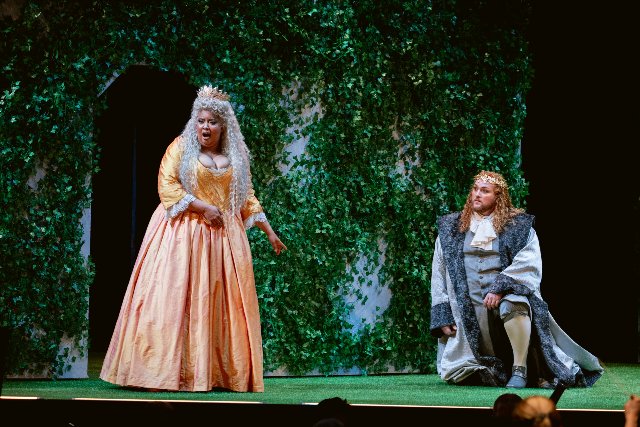
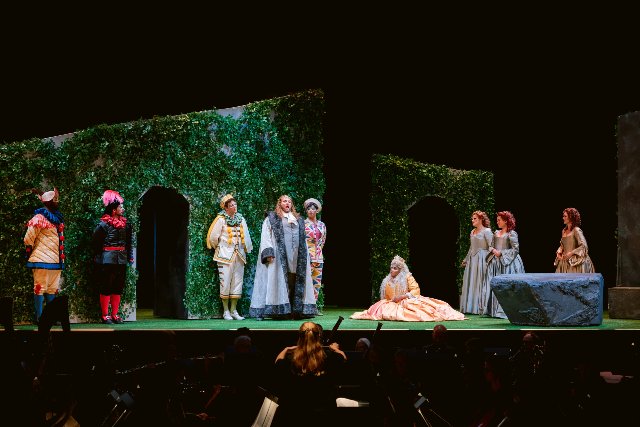
Merola Opera offers a spectacular take on this piece. Strauss loved the female voice. His first two operas had female title characters, and in each of his next two, the cast is headed by two sopranos and a mezzo in a trousers role. In this production, the trio is absolutely stunning. It may be added that the three female nymphs are stellar as well, along with the whole cast ensemble. Simple but effective gray-and-green-hued staging by Alexander V. Nichols provides a subtle backdrop for the bright costumery from Cynthia Savage. Accomplished Director Omer Ben Seadia brings it all together in brilliant fashion.
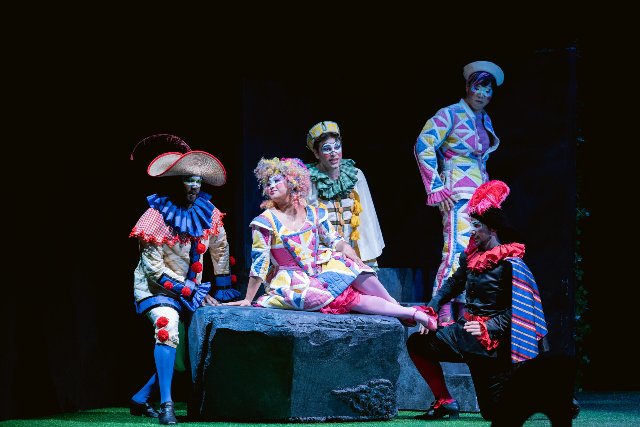
Ariadne auf Naxos is not the easiest opera to understand. First comes The Prologue in which an opera company and a comedy troupe are both to perform in the house of a wealthy patron. They clash upon finding that given time constraints, they must perform simultaneously!?!? “Act 2” is referred to as The Opera, but the dramatic story of mournful Ariadne awaiting death on a barren island is interrupted by five comic actors led by the flighty Zerbinetta.
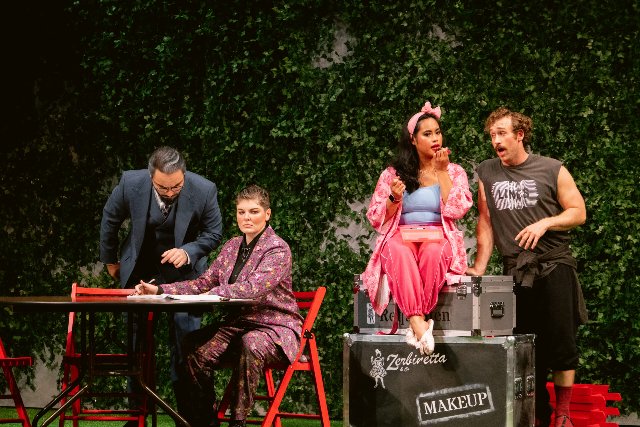
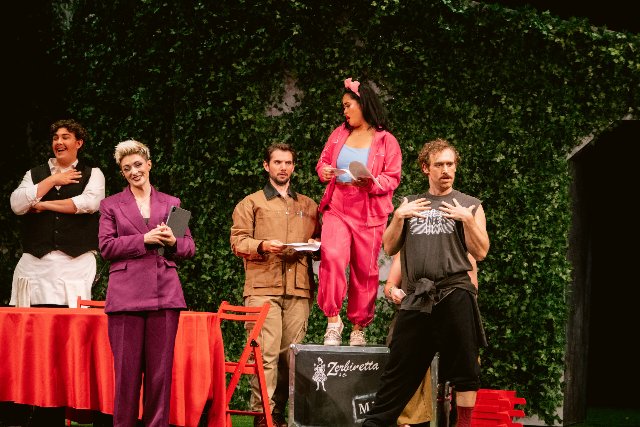
A prelude precedes all else, offering the opportunity for Conductor Ann-Katrin Stöcker and her unusually specified orchestra with doubled woodwinds to display its lush sound in its amalgam of melodious passages. The prologue itself introduces a cacophony of characters as the two teams skirmish on how to manage the unmanageable task of combining their two performances into one. This light-hearted and chaotic act contains all manner of variety including clashing musical styles to represent the two troupes and much spoken word.
Despite the involvement of a raft of performers, The Prologue is owned by the conflicted Composer who suffers angst as he must make changes to the opera score. Theo Claveles, with a silken, yet powerful mezzo in the trousers role excels, reaching Wagnerian proportions in the duet with Zerbinetta. The other intriguing performer is Ryan Bryce Johnson who stands out as The Choreographer, both for the rich timbre of his tenor voice and his comedic acting.
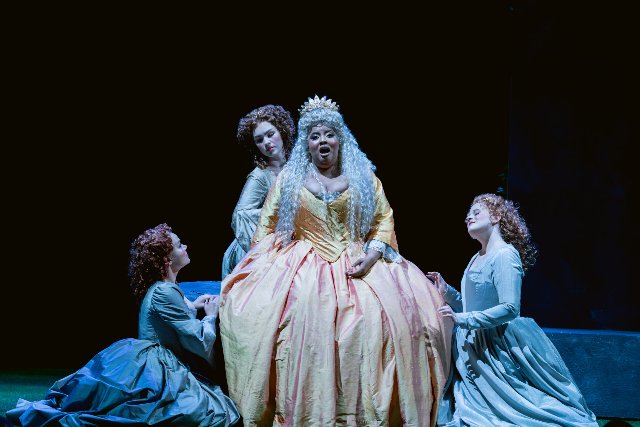
But the serious, sustained vocal excellence comes at the beginning of “Act 2”, The Opera. Ariadne lies on a rock in front of a cave awaiting Hermes to take her out of the world of the living as the nymphs stand by consoling.
The wonderful Adia Evans broods with sumptuous vocal beauty in the aria “Wo war ich?” (“Where was I?”), convinced that real life as she knew it is no more. Then, after a brief respite to catch her breath while the nymphs interject, she follows with the aria “Es gibt ein reich,” (“There is a realm”) in which she continues, anticipating death. Evans amazes with a honey-tinged soprano – round and powerful - while commanding the dynamics and range with great facility.
Yet, the signature aria from the opera, considered one of the most demanding in the coloratura repertoire is yet to come. That task is assigned to Zerbinetta, delightfully portrayed by Emilie Kealani. In “Grossmächtige Prinzessin“ (“High and mighty princess”), she rebukes Ariadne by noting that her love and her pain is no different than any other woman. They all have trembling, beating hearts.
Vocally lighter than Evans or Claveles, but extremely agile, Kealani rounds out the distaff threesome of delightfully memorable singers and performers. She delivers joyously and is able to navigate the treacherous leaps and trills of the demanding aria with abandon.
Ariadne auf Naxos is not generally considered among the very best of Richard Strauss’s operas, but nonetheless, it is a worthy masterpiece firmly in the repertory. The music is beautiful and the structure and story are engaging.
Because of the large ensemble with highlights for many performers, Ariadne gives opportunities to many Merolini. Thematically, its being a metaopera, it fits the very real trials that artists have to deal with like collaboration and compromise. Merola has mastered its challenges and produced a rendition of this opera that leaves the audience stunned and in awe.
One bone to pick is with the supertitles in this production. I was totally at sea early on as to who the characters were, and I’m certain that I was not alone. Particularly in an opera with many characters introduced at once and/or in which characters are not immediately introduced by name, it would be very helpful to identify characters in the supertitles minimally as they first sing. It is not clear to me why most opera companies are deficient in this matter, and not enough room on the supertitles or any shifting of responsibility to the audience is simply unacceptable.
For those unaware, Merola is a summer opera training program for young artists financially independent of but having close artistic collaboration with San Francisco Opera. It is one of the most esteemed programs of its kind in the world.
Ariadne auf Naxos, composed by Richard Strauss with libretto by Hugo von Hofmannsthal, is produced by Merola Opera and plays at San Francisco Conservatory of Music, 50 Oak Street, San Francisco, CA through August 1, 2026.