

David and Jonathan
Baroque Opera with a Modern Twist at West Edge
By: Victor Cordell - Aug 04, 2025
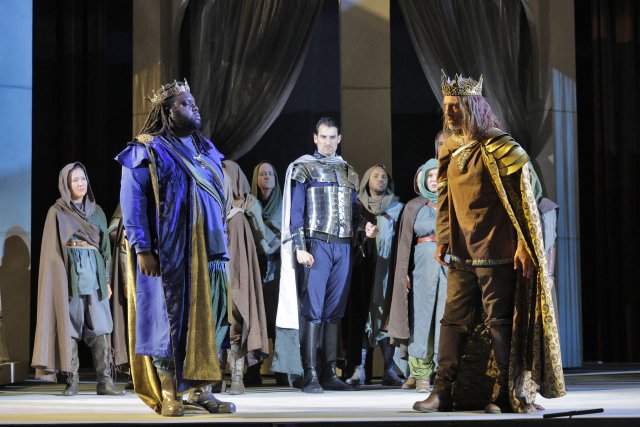
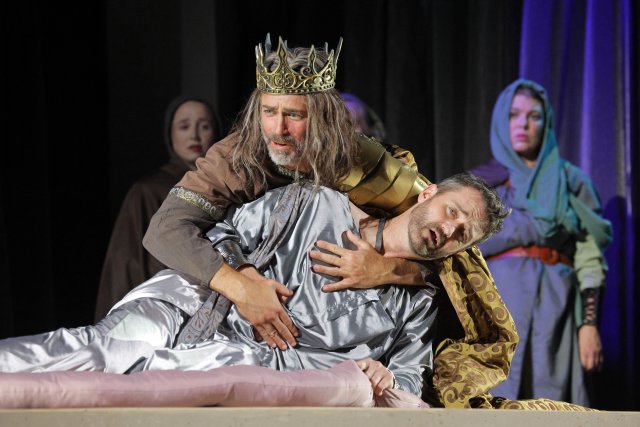
David, of David and Goliath fame, is one of the best known and respected heroes of the Old Testament. As such, he represents a good subject for artistic works of all types.
Early opera composers employed religious themes and texts in various musical idioms. The prolific Baroque composer Marc-Antoine Charpentier was no exception and wrote sacred music of all kinds. Of his several operatic works, David and Jonathan from 1688 survives owing to beautiful music and a story with drama and impact that will expand the knowledge about this familiar hero for most opera goers.
In the Biblical account that acts as the basis of the libretto, Israel’s first king, Saul, is told by God that it is time for him to step aside and let David ascend to the throne. Saul resists. Ultimately, and similar to our own time, the leader accepts the false accusation from a lying sycophant that David plans to overthrow and kill him. For this purported disloyalty, Saul will go to war with the Philistines who harbor David. The complication is that David’s lover is the son of Saul, Jonathan, who must cope with divided loyalty.
After meeting the usual selection criteria for presenting an opera, West Edge Artistic Director Mark Streshinsky, who also stage directs, has deliberately chosen a libretto that can be plausibly adapted to represent a queer love story. This one makes sense as the expressions of love are explicit, even if they convey different implications in the ancient context. Although elements of the original work are shifted or omitted, no changes to the text are made.
Thus, the interpretation of the love story of David and Jonathan is drawn wholly between the lines, in the unverbalized action rather than the text. The uncontroversial aspects of the production stand tall, with fine singing and clever, attractive, and effective staging. Not unlike many operas that were made with very different audiences in mind, this one does sag a bit, especially toward the end.
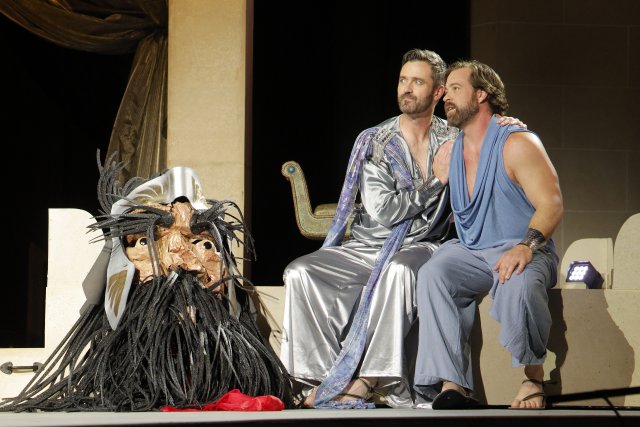
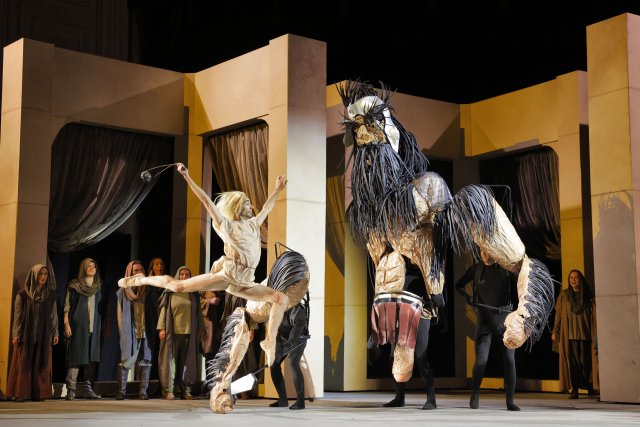
At the outset a magnificent gigantic puppet of Goliath, requiring three men to guide it, dominates the action until the antagonist is slain. Here, the most assertive statement about the adaptation’s orientation occurs, as Goliath’s gargantuan phallus hangs well below his skirt, and humorously, it is even used as a truncheon to deter enemies.
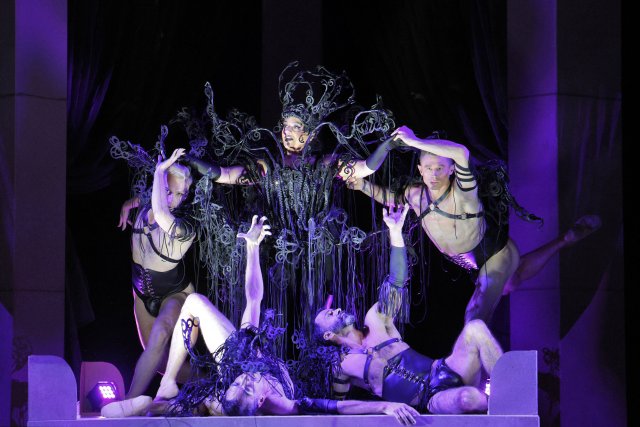
Soon, Saul, performed by baritone Matthew Worth, sings his mournful and resentful “What have I done to deserve the wrath of God?” which sets the narrative’s conflict in motion. After which, the all-male corps de ballet appear. And, while the choreography and execution are excellent, the leather/beefcake outfits with bare butts and breasts are another statement in keeping with the queer adaptation.
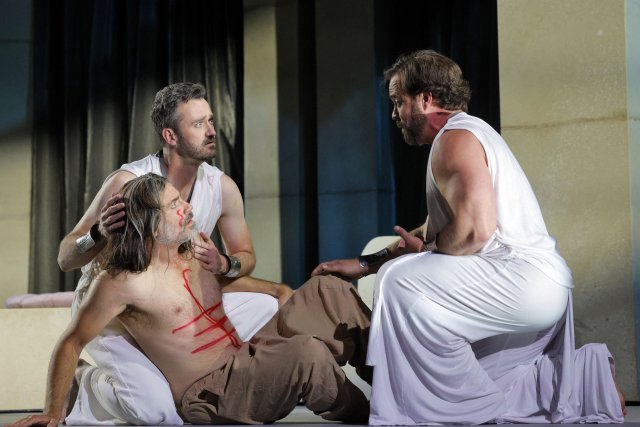
A wise adjustment devised by Streshinsky and Music Director and Conductor Adam Pearl was to transpose Jonathan’s vocals from that of a treble (boy soprano) to a tenor. Thus, the leads who share the intimate relationship, Derek Chester as David and Aaron Sheehan as Jonathan, both have warm tenor voices. The title characters sing well individually and together, with the duet “Why must we end such a sweet peace?” being the most compelling. Probably the most appealing music and touching moment is David’s final lament during the closing tragedy.
The crux of the action concerns Jonathan’s dilemma of duty versus love, when he must choose sides in the coming battle between his father and his lover. Graciously, David accedes to the notion of filial piety and releases Jonathan to join his father. David also does everything possible to demonstrate loyalty to Saul, but the latter’s obdurate resistance to knowing when to leave the fight behind represents another main thematic issue.
The small but luminous orchestra performs the lush music with great panache. In addition to modern strings and woodwinds, but forgoing brass and percussion, the orchestra includes period instruments - a theorbo, a viola da gamba, and a harpsichord played by the conductor, all of which contribute to the unique Baroque sound. Recognition is deserved for the design elements, in particular - Ember Streshinsky for the simple but appropriate scenic design with revolving modules; Marina Polakoff for costumes, especially the lavish black cladding of the witch; Michael Oesch for the effective use of colored and low lighting; Paul Hayes for the imposing monster Goliath puppet; and Benjamin Freedman for the handsome choreography.
The question remains whether David and Jonathan were really carnal lovers. While the Bible describes their relationship in the framework of love, it should be noted that the terms used and practices identified are wholly consistent with those of filial love or friendship described elsewhere in the Bible. In addition, the Bible shuns homosexuality, and it is unlikely that one of its great heroes would be cast thusly. As far as the opera’s version of the story, not only was Charpentier working for the Jesuits at the time the piece was created, but his librettist was a cleric. Nonetheless, we can’t get inside Charpentier’s mind to know his thoughts as the project evolved
The remaining question concerns the acceptability of the West Edge realization. It would seem that the market is trifurcated, with those who appreciate the nature of the adaptation, the neutrals, and the detractors. Certainly, the gay theme will play better in the Bay Area than in Birmingham or Omaha, but the consequences and viability of this treatment will be better understood by the end of the run.
David and Jonathan, composed by Marc-Antoine Charpentier with libretto by Father François Bretonneau, is produced by West Edge Opera and plays at Oakland Scottish Rite Center, 1547 Lakeside Drive, Oakland, CA through August 16, 2025.