
The Federal Theatre Project as Play
Hallie Flanagan and Subsidized Art
By: Susan Hall - Aug 10, 2025
It Can Happen Here: Hallie Flanagan and the Federal Theatre Project
Written by Melody Brooks, Katrin Hilbe, Tess Howsam, Daniel Jacobs, and Susan Quinn
Directed by Katrin Hilbe
First viewed in Queens, New York, March 30, 2025.
This is exactly the moment to remember a time when the federal government saw theatre not as a luxury, but as a public good—bringing professional productions to cities large and small across America.
The Federal Theatre Project (FTP; 1935–1939) was born during the Great Depression as part of the New Deal, funded through the Works Progress Administration. It was one of five “Federal Project Number One” programs—not conceived as a cultural indulgence, but as a relief measure to employ artists, writers, directors, and theatre workers.
Under national director Hallie Flanagan, the FTP became a federation of regional theatres producing socially relevant art, experimenting with form and technique, and—most radically—making live theatre accessible to millions of Americans for the first time. The program cost just 0.5% of the WPA’s budget, yet it became a lightning rod.
Its progressive ideals, especially racial integration, drew fire from Congress. Politicians accused it of Communist infiltration, and on June 30, 1939, they shut it down. One month before its end, drama critic Brooks Atkinson wrote:
“Although the Federal Theatre is far from perfect, it has kept an average of ten thousand people employed on work that has helped to lift the dead weight from the lives of millions of Americans. It has been the best friend the theatre as an institution has ever had in this country.”
Sound familiar? Funding for the arts is still contested terrain today. The idea of art as public service remains under threat.
This tension—between cultural ambition and political resistance—forms the backbone of the new play It Can Happen Here!, written by Melody Brooks with contributions from director Katrin Hilbe, Tess Howsam, Daniel Jacobs, and Susan Quinn.
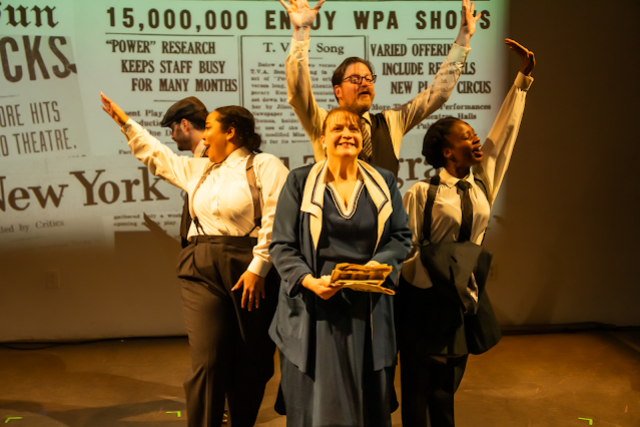
The play opens with Flanagan already facing hostile congressional hearings. It then jumps back to 1935, weaving together Quinn’s history Furious Improvisation, Flanagan’s memoir Arena, and transcripts from those hearings. What emerges is both inspiring and infuriating: the story of how Flanagan built the FTP into a national force for cultural enrichment, and how swiftly it was dismantled.
The script also refuses to treat Flanagan as a one-dimensional saint. It threads in her personal life, especially the strain her public mission placed on her surviving son Fred (DJ Davis, who also delivers soulful musical interludes).
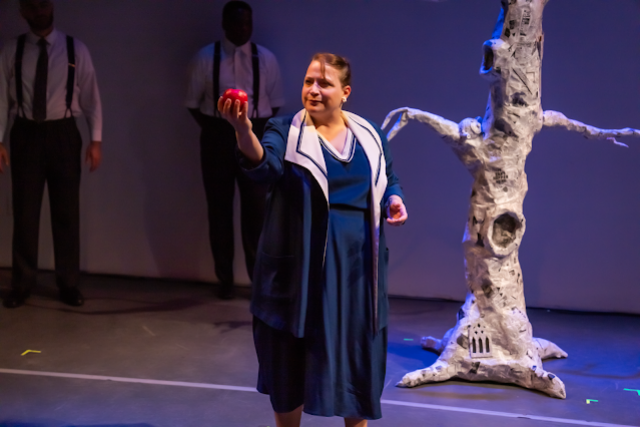
The production is visually and aurally inventive—blending puppetry, video projections, and multiple theatrical forms. It’s history brought to life with an immediacy that speaks directly to our own time.
It Can Happen Here! would work beautifully as a touring production for colleges and community theatres, sparking conversation not just about the Federal Theatre Project, but about the larger question it raises: Who gets to decide what art is for—and who it is for?