

Berkshire Author Steven Reed Nelson Publishes a Provocative Book
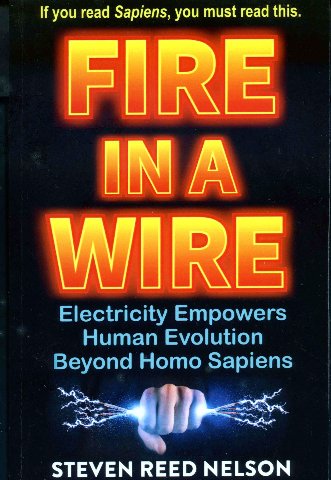
Fire in the Wire: Electricity Empowers Human Evolution Beyond Homo Sapiens
By: Charles Giuliano - Aug 15, 2025
Fire in the Wire: Electricity Empowers Human Evolution Beyond Homo Sapiens
By Stephen Reed Nelson
Massaemett Media, Williamstown, Mass. 2025
216 pages, illustrated, with index and bibliography
Available on Amazon at $20
At Suffolk University I was a member of the integrated studies team, drawn from all departments. In the first semester freshman were taught a selection of great books in the humanities. The second semester was more topical including evolution, relativity, Freud, the Holocaust, feminism and other subjects.
There was a weekly faculty seminar during which we discussed these topics and lectured each other. With slides I presented Sumerian archaeology in the context of reading Gilgamesh. I also took my colleagues on tours of the Museum of Fine Arts.
It is said the best way to learn a subject is to teach it. No doubt there were students who knew more about select subjects than I did. This was particularly true in areas of science like Darwin and theories of evolution. The mandate was not to teach the topic from a position of expertise but to create an insightful discussion about it. This process was as much, if not more, a benefit to me as it was to students. It was a remarkable opportunity to learn as well as teach which sharpened and intensified the experience.
By extension it may be argued that Steven Reed Nelson, an enlightened layman, has greatly learned through the process of researching and publishing Fire in the Wire: Electricity Empowers Human Evolution Beyond Homo Sapiens.
His hypothesis is that mankind was fundamentally changed some 200 years ago with the development of electricity and all of its related applications that continue to this day. That factor is so primal that he submits that the term Homo sapiens now be revised to Homo electric.
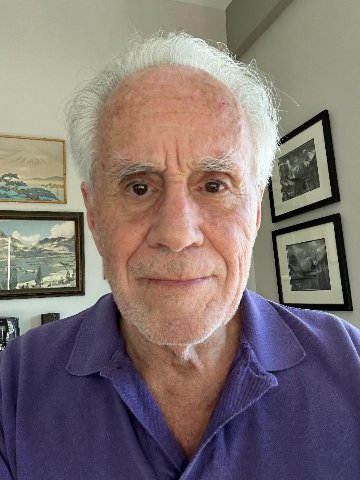
In About the Author he states that “Steven Reed Nelson is neither an academic nor a scientist. Call him an ‘outsider.’ As was the employee of the Swiss patent office who deduced that E=MC2. As was the Czech monk who discovered the principles governing heredity.”
He was a math major at Cornell University and a prize-winning student at Harvard Law School. As an undergraduate he participated in a muli-university anthropology immersion in a remote village in the Andes. Deprived of electricity for several months this is one of a number of personal anecdotes that punctuate the book. Others include stints as an entrepreneur of rock ‘n’ roll as well as solar energy and founder of the Nelson Network promoting cable television programming. During conventions his content was streamed live by hotel televisions. He reports being an eyewitness to great moments in the development of computers and electrical driven technologies.
In a banner across the cover of his book is a reference to another. “If you read Sapiens you must read this.”
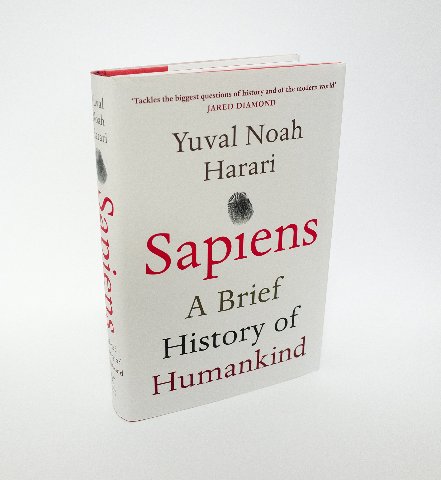
Sapiens: A Brief History of Humankind, is a best selling book published a decade ago. It’s adapted from a series of lectures given by Yuval Noah Harari, and translated from the original Hebrew into English “by the author, with the help of John Purcell and Haim Waltzman”.
Harari proposes three big revolutions around which his story revolves: the Cognitive Revolution of around 70,000 years ago (articulate language); the Agricultural Revolution of 10,000 years ago; and the Scientific Revolution of 500 years ago. The last is part of history, the second is increasingly well understood, but the first is still shrouded in a mystery that DNA research will probably one day clear up.
While Hahari has been widely embraced by the general reader his work has drawn skepticism from academics and specialists in the field.
If Homo sapiens emerged some 70,000 with the development of language, Nelson builds on the populism of Harari to just 200 years ago marking the emergence and rapid dissemination of electricity. Like that village in the Andes vast parts of the globe are literally powerless.
The latest report from World Health Organization confirms that “the number of people without access to electricity increased for the first time in over a decade, as population grew—mostly in Sub-Saharan Africa—at a higher rate than that of new electricity connections, leaving 685 million people without electricity in 2022, 10 million more than in 2021.”
Nelson chaired a movement “Wired West” to bring high speed internet to rural Western Massachusetts. This was a matter of significant social and economic impact.
The book is enlivened when his personal experience is applied to the subject at hand but this can also reach excess. In other writing we know of his involvement with The Velvet Underground. Here, however colorful, it’s off topic.
In the past five years the author has done extensive research. There is a section on primates that provides a nice thumbnail of how our ancestors prevailed over a spectrum of competitors including Homo erectus and the Neanderthals. Around 2% of the genomes of modern Eurasians contain Neanderthal DNA.
There is a thumbnail of the principles of heredity formulated by Austrian-born botanist, teacher, and Augustinian prelate Gregor Mendel in 1865. These principles compose what is known as the system of particulate inheritance by units, or genes. The later discovery of chromosomes as the carriers of genetic units supported Mendel’s two basic laws, known as the law of segregation and the law of independent assortment.
While there is a well defined mainstream to this book there are many detours. Arguably that makes it accessible and enjoyable. The many references and quotes save me several years of research. It was a refresher of what I already knew as well as provocative invitation to further thinking.
One result is that I will now read Sapiens which arrived today from Amazon.
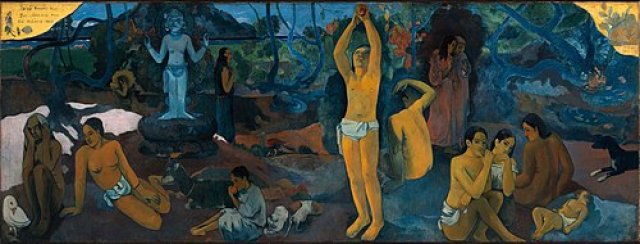
It makes me think of Gauguin in Tahiti when in 1897-1898 he painted the masterpiece “D'ou venons-nous ? Que sommes-nous ? Où allons-nous ?” The dark and mysterious painting in the Museum of Fine Arts, Boston, asked the basic questions of human existence. After which he went into the jungle to commit suicide. He vomited the poison, crawled back to his shack, and survived in agony.