

Alabaster
A Dramedy About Making Connections and Resurrecting Damaged Women
By: Victor Cordell - Aug 18, 2025
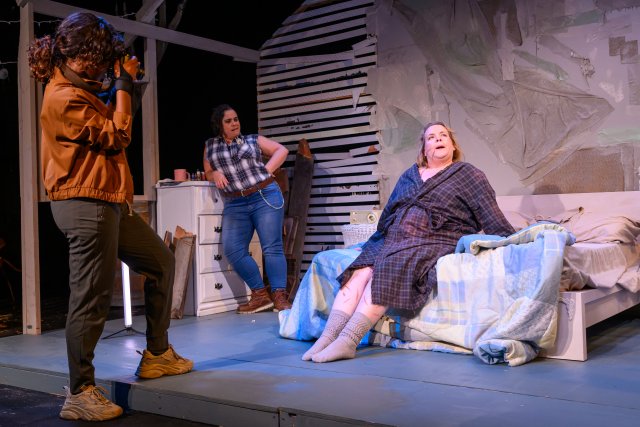
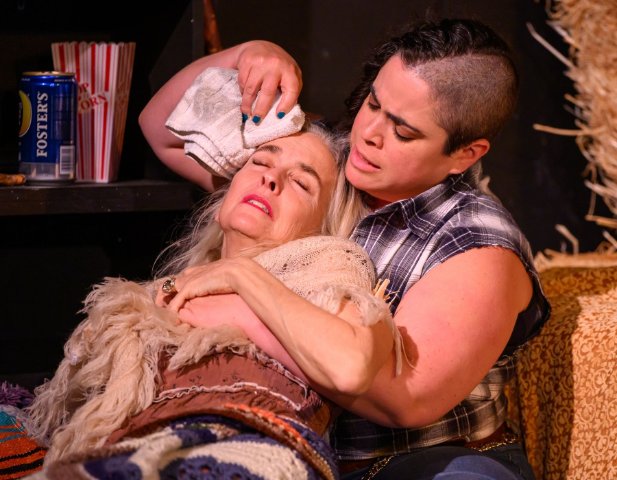
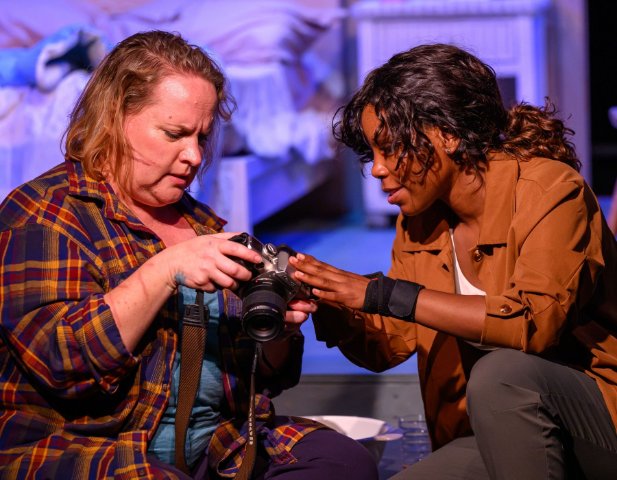
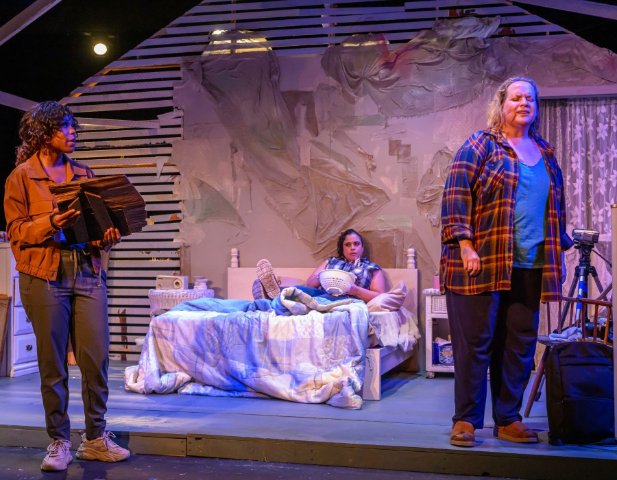
Alabaster is usually thought of in one of two contexts – the beautiful mineral appropriate to artistic carvings or the creamy skin associated with the stone’s warm, translucent color. Alabaster is also a real town in Alabama. But what playwright Audrey Cefaly probably had in mind in situating her darkly-comic play in that locale is the portmanteau hidden in the name – Alabama disaster. Town Hall Theatre has produced a compelling rendering of the quirky but touching and thoughtful narrative.
In this dramedy, the town had been hit with a devastating tornado. A survivor who lost her family, June suffered extensive injuries requiring a long recovery. She has since become reclusive on her unreconstructed farm. But a cousin convinces her to extend an invitation to a New York based photojournalist, and June agrees.
Alice, the photog, has developed a special visual portfolio – damaged women, who have suffered from natural catastrophes, accidents from human error, or abuse. Her goal is to present these women with dignity and beauty, and she has come to Alabaster in hopes that June would serve as a model.
Alabaster pays tribute to women in multiple ways. The cast of four are all women, and the two central characters are lesbians. Each has lost family in tragic accidents and carries guilt for surviving and not having been able to save loved ones. Each has adapted but carries additional baggage as well. Each in her own way needs to give in and move on from what holds her back.
The twist in Alabaster that produces the comedy is that June communes with Weezy, who happens to be a goat that only June can speak with. Two goats are all that remain of the farm’s livestock, the other being Bib, Weezy’s dying mother. In a nod to decisions that humans face, Weezy has told June that when Bib passes, she will leave.
Sarah Nowicki is convincing for the greater part as the flippant and independent June. In addition to farming, she paints, always on pieces of the barn destroyed by the storm because she values the history and the irregularity of wood as a medium. Nowicki’s star turns come in two soliloquies. The audience’s hush is palpable in the longer one when she describes how the tornado took away her parents and sister, one by one in different ways, and that she was unable to save them or even honor her father’s death wishes because of her own incapacity after the storm. Her other dramatic highlight is the shorter but more searing moment as she relives the trauma in a nightmare.
Raven Douglas as Alice has less to work with. However, she is also effective and gets to show dramatic zest in one anger scene. One area for improvement is that her dialogue is sometimes lost because of insufficient volume, especially when not facing the audience and in sensitive passages. Like many stage actors, she conveys the touching scenes visually, but lowers her voice as if connecting only with her counterpart on stage.
The humor is driven by Weezy, portrayed by Melanie Marshall, and casting a comedienne in this role is essential to achieving the right balance in the play. Marshall’s comic timing in her dialogue is exquisite, but perhaps more important is her uncanny mimicking a goat’s eating, facial expressions, and movement.
But the main dramatic thrust concerns the evolving relationship between the two women. Interestingly, they learn about each other not just through normal conversation but by often invoking the game of Questions, usually with the choice of two answers, that each must answer and defend. Before the questions between the women become more personal and penetrating, June asks perhaps the most ubiquitous and insignificant one asked in this game, at least by older generations - “Ginger or Mary Ann?” referring to the attractive young women in “Gilligan’s Island.”
Director Kerry Gudjohnsen harnesses the creative resources of the production in an exemplary manner. Scenery, lighting, and sound all contribute to the claustrophobic feel of June’s life of discontent. Into her life comes someone with her own unresolved issues. Is it possible that the two women can overcome their obstacles?
Alabaster, written by Audrey Cefaly and produced by Town Hall Theatre, plays on its stage at 3535 School Street, Lafayette, CA through September 6, 2025.