

Mother Play: A Play in Five Evictions by Paula Vogel
Regional Premiere at Shakespeare & Company
By: Charles Giuliano - Sep 01, 2025




Mother Play: A Play in Five Evictions
By Paula Vogel
Elayne P. Bernstein Theatre
Shakespeare & Company
August 29 to October 5
Lenox, Massachusetts
Director Ariel Bock
Set, Omid Akbari; Lighting, Madeline Herbert; Costumes, Arthur Wilson; Sound, Bryn Scharenberg; Movement, Susan Dibble; Cockroach art, Jim Youngernan; Production designer, Brandan F Doyle.
Cast: Tamara Hickey (Phyllis Herman), Zoya Martin (Martha Herman), Eddie Shields (Carl Herman)
Run time, 1 hour, 35 minutes with no intermission
Mother Play: A Play in Five Evictions by Paula Vogel is challenging, grating, roiling and difficult to feel empathy for. It unnerves rather than involves. The play is more to be endured than enjoyed. The drama is a disturbing but deeply thought provoking theatrical experience.
It is considered a coup for artistic director Allyn Burrows to secure the rights to present the regional premiere of work by one of America’s acclaimed playwrights. Making plays reflecting her own life experience Vogel, a self-described lesbian feminist, is regarded as a peer to Tennessee Williams, Eugene O’Neill and Clifford Odets. It speaks to where Burrows has taken the company and its risk taking that he has earned the trust and support of the board not to play it safe. In so doing it reflects the growth and sophistication of Berkshire audiences.
The assignment to direct this excruciatingly difficult play was given to company member Ariel Bock. As the mother, Phyllis Herman, the role is given a riveting and stunning performance by company member Tamara Hickey. She is supported by superb younger actors Zoya Martin (Martha) and Eddie Shields (Carl). They conflated with stunning resonance as the dysfunctional, impoverished family of a gin-swigging single mother.
Created as a memory play it is presented through the lens of Martha who steps out of character to note passages over some 40 years bookmarked by five evictions. They started in the 1960s with roach and vermin infested, slum, custodial basement apartments, to a residence in a gated community, eventually sold to finance assisted living.
As the play becomes more widely produced Phyllis may come to be regarded as a tough as nails, iconic character on a par with Martha in Who’s Afraid of Virginia Woolf. Hickey is more than up to the challenge as she rampages through the decades of this play from her 30’s to a dementia plagued senior snarling in a wheel chair.
There are some design tropes in the play which features shifting the same furniture while packing and unpacking boxes representing the five evictions. The Herman’s have gotten moving down to a science. In the Biblical sense there is a time to pack and a time to unpack. They have perfected it to a turnaround in a single day. This is executed in a functional and efficient set by Omid Akbari.
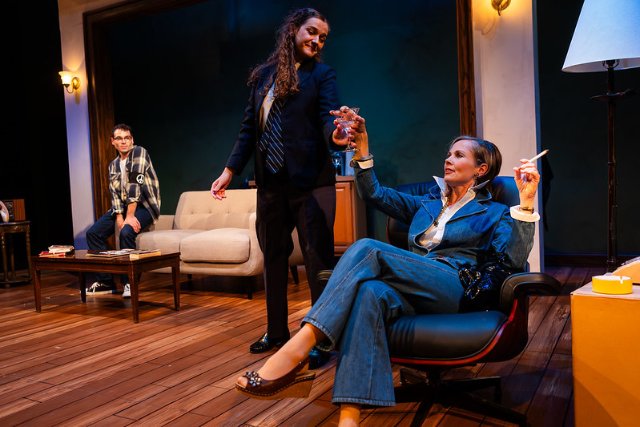
The siblings wax nostalgic while unpacking the stuffed animals of their fraught childhood. Phyllis is in a snit taking a flask of gin from a large handbag with fragments of her peripatetic life. "I need ice" she demands while miraculously Martha extracts an ice tray from one of the boxes. It is one of many such comic incidents with which Vogel softens the harsh edge of tragedy. The writing swings from bathos to slap stick.
Motherhood is an unwelcome life sentence that was imposed on Phyllis based on the condom that slipped or was never used. In an era of back room abortions she feared being butchered. Her parents disowned her for getting knocked up and marrying a Jew. They were later reconciled and Phyllis eventually called her mother every day. There are awkward holidays and eventual funerals but no material support. The husband was a putz who abandoned his family having first drained their bank accounts. Phyllis comments drolly that he keeps a mistress in a nearby high rise.
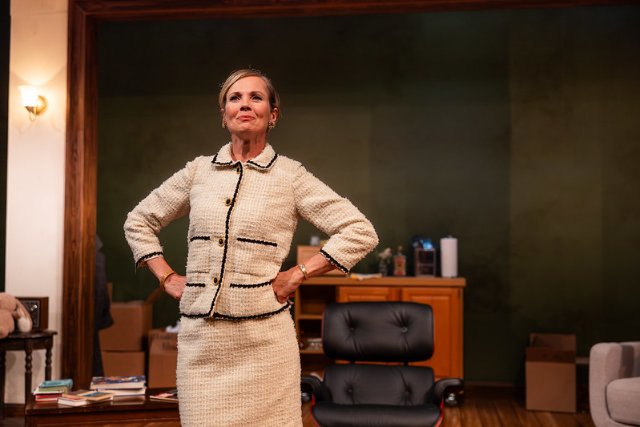
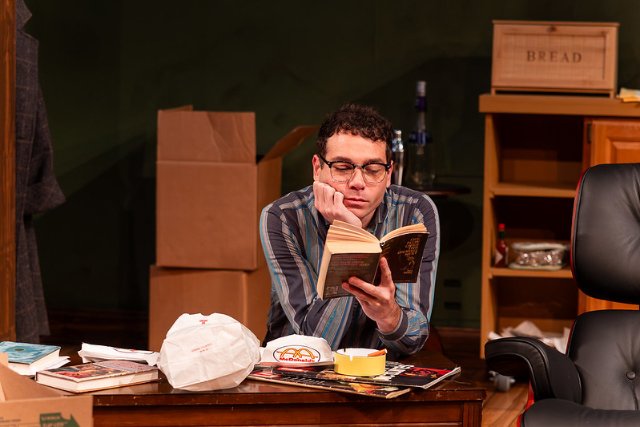
To support herself and kids Phyllis starts in the secretary pool of government bureaucracy. She makes barely enough to put food on the table. A typical meal is a bag from McDonald's. The teenagers are told of an austerity budget. This, however, does not prevent her from splurging on a Chanel suit.
She is proud of her acquisition and taunts Carl to name the designer. He rattles off several names and she becomes alarmed that he knows too much about women’s fashions. He is accused of sniffing through her underwear. Loudly, he protests that she only caught him once.
The saga of the Chanel suit, purchased for ten bucks, is told in compelling detail. She speculates that it was worn just once by a Washington socialite who soaked it with sweat on a typically muggy, summer occasion. Even after dry cleaning it had a lingering odor that, for the sake of fashion, Phyllis is willing to ignore.
As played by Hickey her character is an attractive middle aged woman. Designer Arthur Wilson was tasked with creating 22 costume changes including nightgowns and negligees. Of which the Chanel suit is more ratty than iconic. It is a signifier of social ambition above her paygrade.
With time she earns promotions which results in evictions and upgrades to even a three bedroom apartment. Finally, the very bright Martha, an emerging writer, has a room of her own.
Despite living below the poverty line it’s a well read family. The kids devour books. Carl advises his kid sister that if she studies books that he selects she can ace the college boards and earn a scholarship to one of three colleges he recommends. He is shocked, however, that their mother has given Martha the notoriously banned lesbian novel “Well of Loneliness,” 1928, by Radclyffe Hall. Phyllis is devastated when both kids are queer.
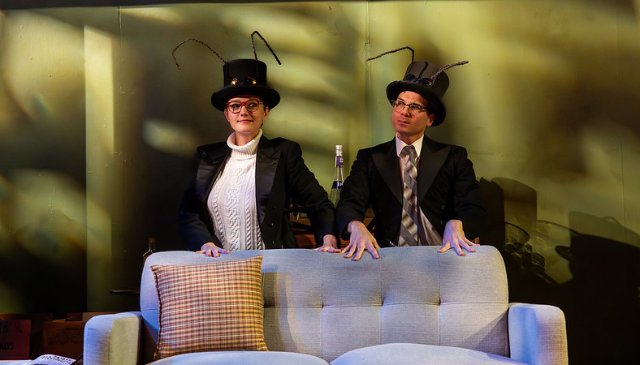
All of this is pretty grim but not really. Vogel is known for injecting disorienting humor in her plays, as a skewering dance macabre. Marking a passage of time mother and daughter romp through “Disco is Burning.” The kids as roaches execute a soft shoe dance in tails in the dead of night when critters slither about. There are creepy video projections as well.They reminded me of Nazi propaganda films in which Jews were depicted as vermin.
When openly gay Carl is booted out Martha is forbidden to communicate with her brother. She tries to reconcile them by taking her mother to Washington’s largest disco where they encounter Carl in his element. Where Phyllis is shocked to witness a woman with her tongue down her daughter’s throat. There is a confrontation and she too is evicted.
Now living alone, the momentum of the drama hits pause. Wearing a nightgown there is a ten minute silent interval during which Phyllis sits eating at the dinner table then begins to drink. The scene stretches out to real time which is demanding on the audience. Here Bock has excelled in directing Hickey through this conceit of the playwright.
Vogel also faltered in providing a satisfactory climax to the play which seems to drag on and on. It’s the 1980s and Carl is inflicted by AIDS. He is invited back home for hospice. But in a manner typical of her repulsive character, Phyllis vents that having finally made it to a gated community, because of him, they are shunned in the lobby and elevator. He bears the visible stigmata of Kaposi sarcoma.
There is a harrowing and grudging reconciliation between mother and daughter. Stating that she doesn’t owe her anything Martha makes weekly visits to her mother in costly assisted living. Off her gourd she asks when Carl will visit. It’s painful to watch and, by then, I just wanted it to be over.
That it lingers indelibly is a testament to a courageous and riveting production by Shakespeare & Company.