

The Three Treasures: The Candle of Life
By: Cheng Tong - Sep 01, 2025
In the modern world, we are inundated with ideas about health. We track our steps, count calories, and optimize our workouts, often treating our bodies like machines to be fine-tuned for maximum performance. We focus on curing diseases once they arise and pushing ourselves to new limits of endurance. While well-intentioned, this approach can create its own kind of stress and overlooks a deeper, more ancient wisdom. This is the gentle, profound art of Yang Shang, a central concept in Daoist thought that translates not just to “health,” but to the “Nourishing of Life” itself.
The character Yang means to nurture, to cultivate, or to raise. Shang means life, vitality, or birth. To practice Yang Sh?ng is to approach one’s life as a gardener tends a precious garden rather than as a mechanic fixes a machine. It is a proactive, moment-to-moment practice of cultivating our vitality, preserving our reserves, and harmonizing our existence with the natural cycles of the universe. It shifts the focus from merely preventing illness to actively fostering a life of radiant well-being. The foundation of this art lies in understanding and nurturing the Three Treasures, the fundamental energies that constitute our existence: Jing, Qì, and Shén.
The Three Treasures: The Candle of Life
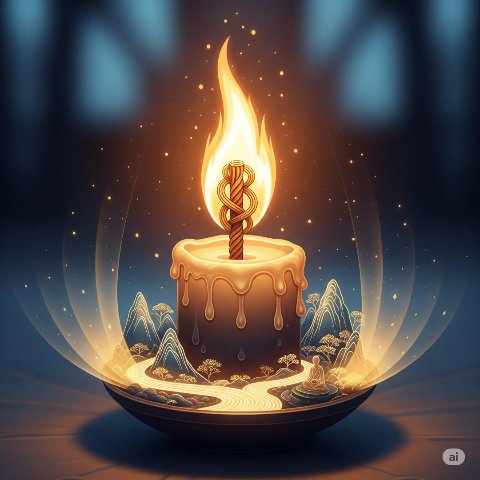
Imagine your life as a candle. The wax and the wick of the candle are your Jing, your essence.
Jing is our deepest, most foundational energy. It is our constitutional strength, our genetic inheritance, and the source of our longevity and reproductive capacity. We are born with a finite amount of this “prenatal” Jing, stored in the kidneys. It’s like a trust fund given to us by our ancestors. A lifestyle of chronic stress, burnout, overwork, and excessive indulgence depletes our Jing rapidly. Therefore, the first principle of Y?ng Shang is the preservation of Jing. This is achieved not through intense effort, but through its opposite: deep rest, adequate sleep, and the conservation of our vital energy. It is the art of living wisely so as not to burn through our foundational inheritance too quickly.
The flame of the candle is your Qì, your vital energy. Qì is the animator of life, the energy of our daily functions. It powers our movement, warms our body, drives our metabolism, and defends us from illness. Unlike the finite Jing we are born with, we can generate “postnatal” Qì every day from the air we breathe and the food we eat. When we feel energetic and vibrant, our Qì is abundant and flowing smoothly. When we feel sluggish, stuck, or weak, our Qì is deficient or stagnant. The core purpose of practices like Qigong (“energy work”) is to directly cultivate our Qì. Through gentle, mindful movements and coordinated breathing, we release blockages, gather fresh Qì from our environment, and store it in our energetic center, the Dantián.
Finally, the light given off by the flame is your Shén, your Spirit. Shén is our consciousness, our awareness, our mind, and the light of our inner being. It is said to reside in the Heart. When Shén is bright and steady, we experience clarity, joy, compassion, and inner peace. Our eyes sparkle, and we possess a calm radiance. When our Qì is weak or our mind is disturbed by anxiety, anger, or worry, our Shén flickers and dims. A disturbed Shén is the root of much suffering. The ultimate goal of Yang Sh?ng is not just a strong body (J?ng) or abundant energy (Qì), but a luminous and peaceful Spirit (Shén).
These three treasures are inseparable. You cannot have a bright light (Shén) without a strong, steady flame (Qì), and the flame cannot burn for long without sufficient wax (Jing). Nourishing life means tending to all three.
The Daily Practice of Tending the Garden
So how do we practice this art in our daily lives?
To nourish Jing, we practice conservation. We honor our need for rest. We learn to say “no” to avoid burnout. We engage in restorative practices like yoga nidra or simply lying down for 20 minutes in the afternoon. We see sleep not as an inconvenience but as a sacred activity for rebuilding our deepest reserves.
To nourish Qì, we practice cultivation. This is the domain of Qigong and Taiji. These arts are not strenuous workouts that deplete us; they are sophisticated systems for enhancing the flow and volume of our vital energy. We also cultivate Qì by eating fresh, vibrant, and seasonal foods, chewing thoroughly, and eating in a calm state, which allows our digestive system to extract maximum energy from our meals. Breathing deeply into the belly throughout the day is another simple yet powerful way to build Qì.
To nourish Shén, we practice tranquility. This is where meditation becomes essential. By sitting in stillness, we allow the turbulent waters of the mind to settle. We are not fighting our thoughts but creating a space for them to arise and pass without disturbing our inner peace. This calms the Heart and allows our Shén to shine brightly. Furthermore, nourishing Shén involves emotional hygiene. In TCM, intense emotions disrupt the flow of Qì and disturb the Spirit. The practice is not to suppress emotion, but to cultivate the capacity to observe our feelings without being swept away by them, fostering a state of emotional balance and grace.
We refer to this daily practice of Meditation, Qigong and Taiji as our Daoist Longevity Practice. We commit to this practice, both at our temple and after returning to society. We understand that if we are not good, we are of no good for others. You can see clearly, then, why this dedication to Ying Shang can be instrumental to your work life success.
Yang Shang is a gentle rebellion against the modern world’s frantic pace. It is a loving commitment to our own well-being, an understanding that true vitality comes not from pushing harder, but from cultivating deeper. By preserving our root (Jing), cultivating our energy (Qì), and calming our spirit (Shén), we cease to be at war with our bodies and our lives, and instead become graceful custodians of the precious gift of life itself.