

Dead Man Walking
San Francisco Opera Reprises 21st Century's Most Successful Opera
By: Victor Cordell - Sep 19, 2025
Among people of good will, legitimate differences can occur. Based on a true story, Dead Man Walking deals with a difference of the highest order, the death penalty. Advocates cite the rights of victims’ families to exact punishment and achieve closure. Biblically, they note the dictum of “An eye for an eye.” Detractors argue that killing a murderer doesn’t bring back the victim; precludes redemption; and rejects the Christian notion of turning the other cheek.
Despite its harrowing topic, San Francisco Opera commissioned Dead Man Walking, composed by Jake Heggie with libretto by Terrence McNally. It has become the most performed 21st century opera, and the company reprises it with a stupendous production on the opera’s 25th anniversary.
At one level, Dead Man Walking can be perceived as the intimate story of an unrepentant killer and the nun who befriended him and acted as his spiritual counselor as he faced execution. The opera however is grand in scale, having a great many principal roles and choruses. It is blessed with melodious tonal music replete with rich categorical diversity and motifs; a libretto of immense thought and consequence; and breathtaking staging that reveals its heart-breaking scenes.
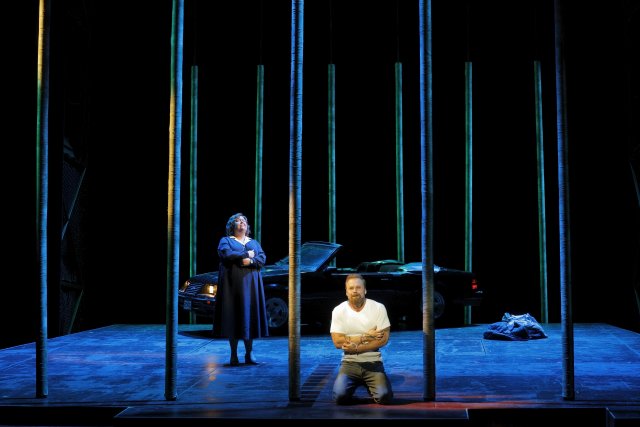
The opening captivates with its depiction of the lurid crime to ominous music. With a parked car at a lovers’ getaway onstage, its headlights attract the two rapist/murderers to the site like moths to a flame. A young, naked couple on a blanket is ravaged and knifed to death senselessly – she 35 times.
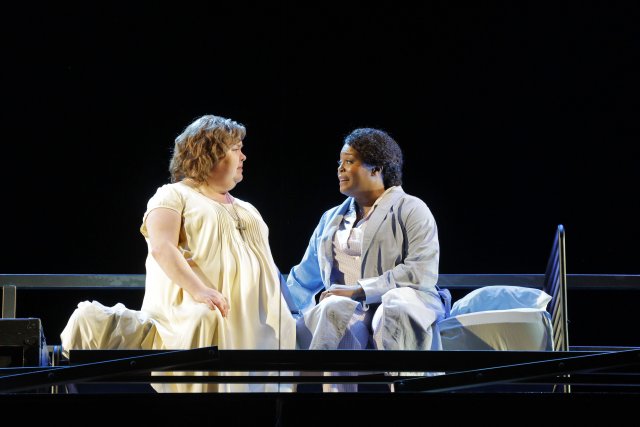
We then jump to the final month before the execution, when Joseph de Rocher calls upon Sister Helen Prejean, a nun previously unknown to him, to comfort him. The wonderfully cast Ryan McKinny is chilling as the vile Joseph, having a deep, expressive baritone voice delivered with menace and an authentic sounding Louisiana accent. Though he seeks grace and deliverance, he verbally abuses and disparages those whom he asks for help. In his aria “A warm night” when he first meets Sister Helen, he shares his sexual desires and conquests with her, showing contempt for her station.
The fine young mezzo Jamie Barton is Sister Helen. She captures the nun’s gentility and complex reactions with a mellow and nuanced voice as she fights revulsion in trying to induce Joseph to confess and seek forgiveness. Her dedication to her calling is revealed in the recurring hymn-like “He will gather us around,” and she realizes the watershed she faces in the reflective “This journey.” But the journey is not only thankless, she is vilified by the victims’ parents, the warden, and even the prison priest.
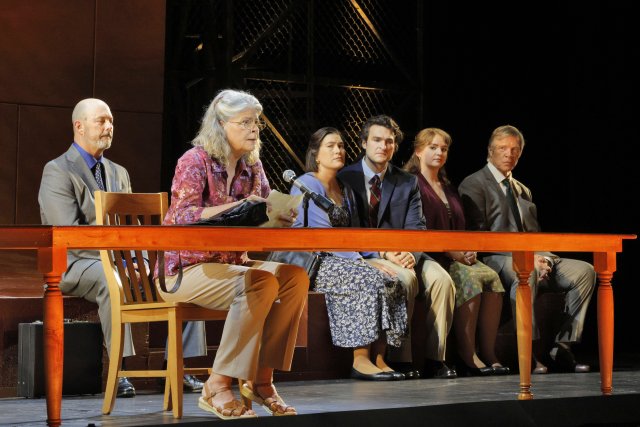
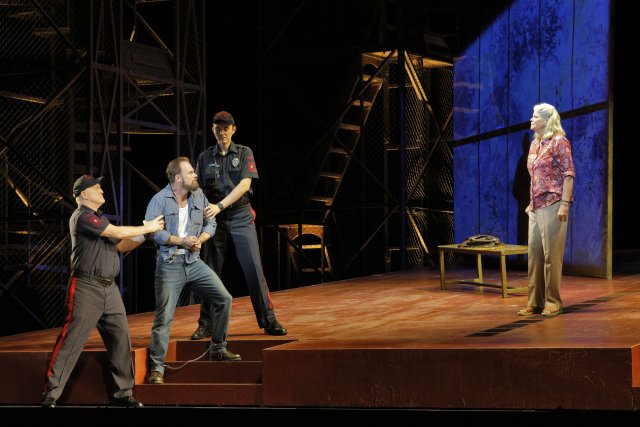
Among the many highlights of the opera, a powerful and accusatory sextet “You don’t know” involving the victims’ parents, Sister Helen, and Joseph’s mother addresses the pain and grief the parents confront, down to remembering the last, inconsequential things that they said to their lost children. In the end, an understated Mrs. de Rocher, performed by the redoubtable Susan Graham with tremulous restraint, faces grief as well. One difference is that she knows that these will be her last words to her son, and in the attempt to keep alive her hope that Joseph is innocent, she begs his silence in the plaintive “Don’t say a word.”
The composer’s music engages not only in its operatic mode, but in pastiches of other styles. Along with hymns, the score imitates blues and rock, and in a sequence that brought about some bonding, the two main characters share their love of Elvis, who Sister Helen had seen live in Las Vegas. Heggie also utilizes motifs throughout the score. But in addition to a recurring musical phrase identifying a particular character, when characters interact, their motifs sometimes do as well. In the case of Sister Helen’s “This journey” motif, it is also adopted by Joseph in his confessional “I did it” as he takes the final steps in his journey.
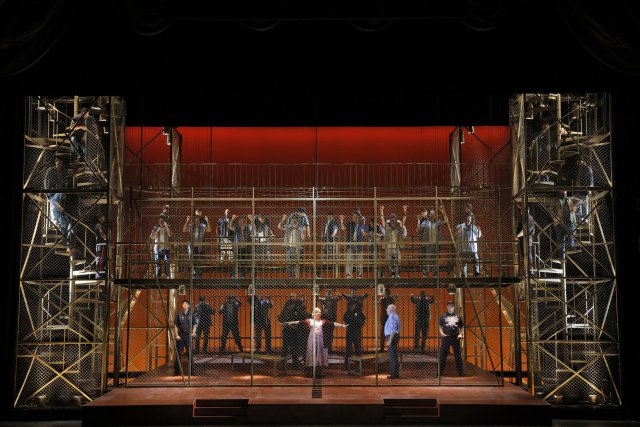
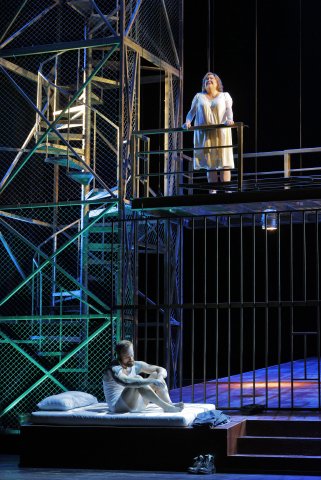
Central to the stellar staging is the steely prison set. Its daunting mobile components - catwalk, chain link fencing, and circular staircase towers are disturbing evocations of life behind bars, and dramatic lighting accentuates the isolation of prison existence. But all of the scenery gives a strong sense of place, even the occasional fragmentary sets or the projection-based views of rural Louisiana when Sister Helen first drives to Angola Prison.
Even though the opera’s topic matter may be off-putting and though numerous personalities are unpleasant as well, the exceptional creative artistry and execution, as well as the significance of the story, overcome these objections. The overall production is sensational with the orchestral music of Heggie’s appealing score conducted by the acclaimed Patrick Summers. The only defect of note is that a number of artists sometime fail to project suitably so that much of the singing seems underpowered.
Dead Man Walking, composed by Jake Heggie with libretto by Terrence McNally, is produced by San Francisco Opera and plays at War Memorial Opera House, 301 Van Ness Avenue, San Francisco, CA through September 28, 2025.