

Bates, Szymanowski, Lutoslawski at NY Phil
David Robertson Conducts
By: Susan Hall - Sep 29, 2025
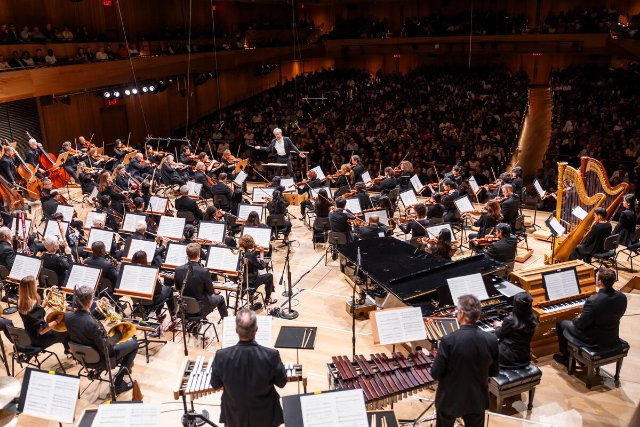

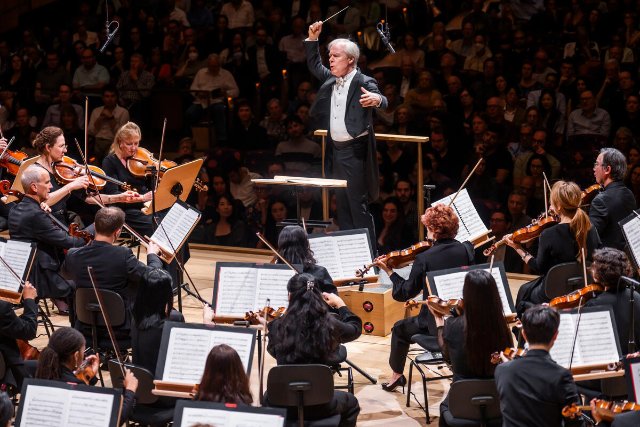
David Robertson joyfully led the New York Philharmonic in an adventurous program, including the New York premiere of Mason Bates’ Devil’s Radio. Though Bates is currently represented next door at the Metropolitan Opera, the Philharmonic gave us a far clearer sense of who he is as a composer.
While the two self-styled Polish composers were an obvious fit, Bates belonged in their company as well. All three combine a firm classical foundation with atonality, polytonality, and rhythmic complexity. Folk sounds of their native countries are woven into their music. The result is work that is both exciting to hear and deeply moving.
Devil’s Radio
Bates has long been fascinated by communication. Over a decade ago, under Michael Tilson Thomas, he stumbled across transmissions between Dutch parents and their children, who had been sent to Java as pages during Holland’s colonial period. That early fascination with distance and exchange reappears here: Bates separated two chorus members, placing them far apart in the hall’s balcony so their solos could communicate across space. Every gesture felt shaped to the composer’s vision.
In just nine minutes, Bates gives us a vivid taste of his craft. Devil’s Radio is classically organized but layered with post-minimalist textures, riffs, and jazz-like rhythms. At his best, Bates fuses these elements into something both lively and purposeful. The performance served as a reminder of what the Metropolitan Opera missed when it hired Bates but allowed theater people and word-heavy librettists to dominate his work.
It is difficult to write music that draws on so many different forms and still holds together. Yet all three composers on this program managed it. Robertson conducted the Philharmonic as both one sound and many, drawing out moments for the bassoon, the woodwinds, and the brass.
Szymanowski’s Violin Concerto No. 2
Leila Josefowicz, the soloist in Karol Szymanowski’s Second Violin Concerto, is an arresting performer. Yet the new acoustics of David Geffen Hall worked against her. The brightness of sound in the hall—popular with contemporary audiences—favors the brass. Midway through the concerto, her tone was difficult to hear. The full string orchestra, by contrast, fared better in this environment. Still, in the cadenza bridging the first and second movements, Josefowicz displayed both impeccable technique and a finely honed sense of the music.
Lutosawski’s Concerto for Orchestra
The second half of the program featured Witold Lutosawski’s Concerto for Orchestra. This modern classic, with its inventive showcase of each orchestral section, remains a thrill. The interplay of lines—easily discernible even in their complexity—highlighted the orchestra’s virtuosity. Robertson drew out both the clarity and the power of the counterpoint, allowing each section to shine without sacrificing the whole.
Oddly enough, whatever the titles and whoever was in the spotlight at any given moment, all three works felt like concertos for the orchestra itself. And it was wonderful to hear the New York Philharmonic shine in this role.