

Metamorphoses at Berkshire Theatre Group
Ovid Makes a Splash
By: Charles Giuliano - Oct 05, 2025



Metamorphoses
After Ovid
By Mary Zimmerman
Directed by Isadora Wolfe
Berkshire Theatre Group
Unicorn Theatre, Stockbridge Mass
September 25 to October 26
Scenic design, Jason Simms; Costumes, Amanda Roberge; Lighting Matthew E. Edelson, Composer/ sound design, Scott Killian
Cast: David Adkins, June Carryl, Eveln Chen, Paul Deo, Jr., Gregg Edelman, Stephanie Jean Lane, Tim Liu, Fedra Ramirez-Olivares, Kelli Simpkins, John William Watkins, Sean Wiberg
Waiting for the play to begin I was astounded by the transformation of the intimate Unicorn Theatre in Stockbridge. A quite literal, tiled Roman pool is featured in the magnificently brilliant and inventive set designed by Jason Simms. There are votive candles in niches of the back wall framing an entrance.
The stage fades to black as we become aware of a clutter of actors in the pool. In the dim light, designed by Matthew E. Adelson, they gradually become visible scrambling out as the stage becomes illuminated. It is a surprise launch of Mary Zimmerman’s, 2001, 90 minute, one act play deftly and cleverly directed by Isadora Wolfe.
The actors range from wet to dry with numerous costume changes designed by Amanda Roberge. The setting is contemporary with classical accents. The eleven actors play multiple roles. The tall and imposing Kelli Simpkins primarily stays on dry land as an occasional narrator. When dry in a bathrobe, this also defines Gregg Edelman, who plays a primary character the familiar King Midas with his notorious touch. Another dry character and narrator is Stephanie Jean Lane who as Woman of the Water is more at its edge than immersed.
The loosely connected string of myths rightly starts with a more familiar one. Having read 400 plus pages of Ovid, many are arcane. Here the production resonates more with familiar tales than obscure ones.
The production gets off to a strong start with the familiar tale of Midas. Because of a kindness the gods have granted him one wish. There are unheeded caveats when he wants whatever he touches to turn to gold. Initially, as well played by Edelman, he is dizzy with delight. A shell he has extracted from the pool is transformed as are the pebbles beneath his feet. There is no end to his increased fortune. Then his daughter (Evelyn Chen effective in multiple roles) embraces him and is transformed into a rigid sculpture. To reverse the spell he is tasked to travel to the edge of the world and seek redemption in a mystical pool. That occurs during the coda of the play.
Publius Ovidius Naso, (43 BC to 17/18 AD) known in English as Ovid, was a Roman poet who lived during the reign of Augustus. He was a younger contemporary of Virgil and Horace, with whom he is often ranked as one of the three canonical poets of Latin literature. He completed the epic work in 8 AD but it scandalously resulted in exile from Rome. He described it as his “Carmen et error” poem and mistake.
Since its inception the epic poem has been a resource and inspiration for the arts. It is essential for understanding many masterpieces of art history from the sensual paintings of Titian to Bernini’s astonishing depiction of Daphne morphing into a tree while escaping the lust of Apollo.
A fine cast has been tasked with the endurance of all that water as well as delineating numerous cameo roles. Initially, there is surprise and wonder as the actors, clothes and all, splash about. As the play evolves that trope runs dry. There are intervals of housekeeping where the area around the pool is dried with towels. The laundry bill for this production must be staggering. To keep the actors healthy through the run of the production the theater was warmer than comfortable for the audience. That induced somnabulance through the less familiar passages.
For Zimmerman, Ovid represented an abundance of riches to draw upon. How delightful to have Paul Deo Jr. traveling to the underworld as Orpheus, the magnificent musician, attempting to get the gods to give back his deceased Eurydice (Evelyn Chen). He violates a demand not to look at her before returning to earth.
One of my favorite films is Black Orpheus, 1959, directed by French filmmaker Marcel Camus and starring Marpessa Dawn and Breno Mello. It is set during the pageantry of Carnival.
David Adkins is a renowned actor who often performs with Berkshire Theatre Festival. Here he performs in the myth of Myrrha (Fedra Ramirez-Olivares) who falls in love with her father Cinyras (played by Adkins) and conceives Adonis. In darkness and unknown she offers sex to the older man. He wants to know what she looks like. The coy answer is of the same age and resembling your daughter. Blindfolded he seduces her. When with impulse he rips it off he is devastated at the realization of incest.
The pace and energy waned with the less familiar myths. Vertumnus, the Roman god of gardens (John William Watkins) with frustration pursued the elusive Pomona (Evelyn Chen), goddess of the orchard. She is more interested in horticulture than romance. Psyche, the goddess of the soul, (yet again Evelyn Chen), is a mortal who loves Amor but is pursued by his mother Aphrodite (June Carryl) for proof of her worthiness.
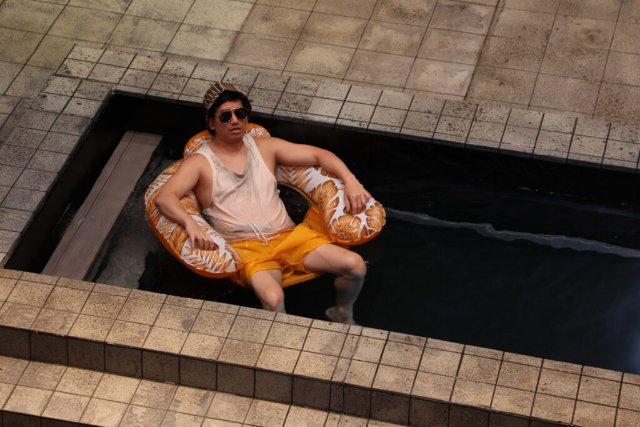
The play perked up with the tale of the spoiled brat Phaeton (Tim Liu). Hilariously Wolfe has him floating in an inflatable chair. He tells of arduous travel to seek his father Helios who illuminated the earth with his daily travel from East to West in a brilliant chariot. In a coming of age ritual he demands the opportunity, just for one day, to drive the chariot. Set in the present the chariot is represented by a sleek car. With many warnings the father forks over the keys with disastrous results. Phaeton screws up so badly that he is dispatched by a thunder bolt hurled by Zeus.
This inventive and memorable production ends the season of theatre in Stockbridge.