

In our modern world, the day often begins not with a gentle dawn, but with the jarring alarm of a phone, instantly pulling us into a digital torrent of demands, notifications, and anxieties. We are taught to be productive, to multitask, to hustle. But sometimes, amidst the noise, a quiet part of us yearns for something simpler. For those moments when you are feeling a little monkish, this is a guide to reclaiming your day.
These practices can transform the mundane into the sacred. They define my day, not a rigid set of rules, but a gentle path back to one’s self. If you wish to live as many monks live, Daoist and Zen Buddhist alike, or at the least are curious, read on to understand monk-ly habits.
1. Claim the Sanctuary of the Morning
Before the world awakens with its noise and expectations, there exists a profound stillness. To be an early riser is to claim this sacred time for yourself. In the pre-dawn quiet, you can experience a solitude that is not lonely, but deeply nourishing. This is the time to simply be. Coupled with this is the practice of early morning meditation. It is reported that the Dalai Lama rises at 3:00 am every day for three hours of meditation. Although it is drudgery to him, he understands its importance to himself and to the world that he do so, and that understanding informs his decision to capture these morning hours for such an important task. I am not so hardy, and instead rise at 4:30.
Sitting in silence, you allow the sediment of the mind to settle, revealing a natural clarity. Laozi asks in the Tao Te Ching, “Do you have the patience to let your mud settle and the water above to become clear?” This simple act sets the energetic tone for the entire day, creating a foundation of peace from which you can act, rather than react.
2. Purify Your Space, Purify Your Mind
The state of our external environment is a direct reflection of our internal state. As the ancient principle states, to purify the home is to purify the mind. When you clean and organize your living space, especially in the calm of the morning, you are doing more than a simple chore. You are clearing pathways for energy, or qi, to flow freely. An uncluttered home fosters an uncluttered mind, creating a sanctuary that supports your practice and brings a sense of spaciousness to your thoughts.
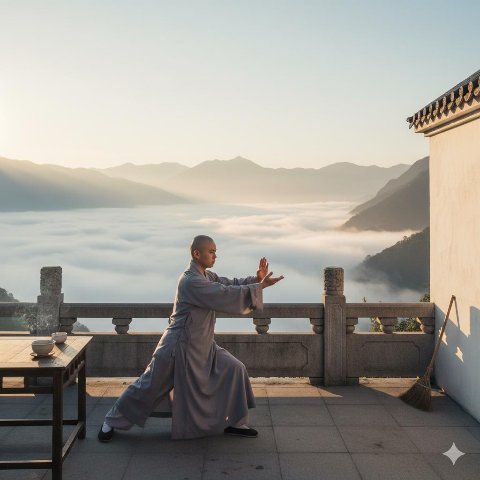
My Temple chore at the Five Immortals Temple was to sweep the leaves off the courtyard where we trained every day. I made a broom from 15′ bamboo stalks and spent 30 minutes each early morning sweeping away, a further extension of my 30-minute meditation at 4:30. Today, I do the same on both the steps leading to the red deck where I train and teach, as well as the red deck, and not only are leaves swept away, but I am carried back to early mornings at my temple. In the image above, I imagine myself in Qigong practice, above the clouds, the morning sun rising above nearby mountains, first cup of tea on the table, the broom I used to sweep away the leaves leaning against the temple house.
3. The Art of Simple, Deliberate Action
Once the day’s work begins, the greatest challenge is to maintain that morning clarity. The key is to keep your day’s schedule simple. Focus only on what is essential and pay deep attention to what is right in front of you. This is the practice of single-tasking. Do one thing at a time. Multi-tasking is a myth; it is merely the act of switching rapidly between tasks, which scatters our attention and depletes our energy.
Furthermore, approach your day’s tasks slowly and with deliberation. Whether writing an email, preparing a meal, or walking to your car, move with intention. Don’t rush toward the completion of the task; instead, savor the process of each moment. In this slowness, you will find not only greater effectiveness but a deeper richness in the experience of living.
4. Find the Sacred in the Mundane
This deliberate attention extends to even the most routine chores. As the revered teacher Thich Nhat Hanh wrote, when you wash the dishes, don’t do it just to have clean dishes for the next meal. Instead, wash dishes to wash dishes. Cherish the feeling of the warm water on your hands, the sight of the soap bubbles, the sound of the plates. In that moment, dishwashing is the most important thing in the world. By cherishing these mundane tasks, we realize that there are no ordinary moments.
5. Practices of Body and Heart
How we fuel our bodies and interact with the world are extensions of our practice. Eat moderately, favoring a plant-based diet that shows compassion toward all life. See food not as a source of fleeting pleasure but as the fuel that sustains your practice and your life. Eat only enough to be nourished.
And throughout the day, smile. Smile even when there is no particular reason. A gentle, inner smile softens the heart and radiates a quiet joy. It is an acknowledgment of the gift of being alive, a simple act that can transform your entire disposition from the inside out.
6. The Culmination: A Life of Service
Ultimately, the purpose of cultivating this inner peace and clarity is not for our benefit alone. The final practice is to live a life of service to all living beings. When our own minds are clear and our hearts are open, we are better able to see the needs of others and act with genuine compassion. Our small, mindful acts ripple outward, contributing to the well-being of the whole.
These practices are a return to simplicity. They teaches us that a meaningful life is not found in grand achievements, but in the quality of attention we bring to each breath, each step, and each small task of our one, precious day.