

Saariaho's Passion in New York
Mannes Opera Presents La Passion de Simone
By: Susan Hall - Oct 14, 2025
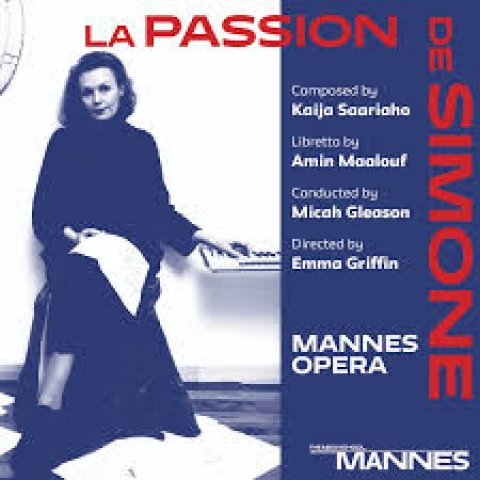
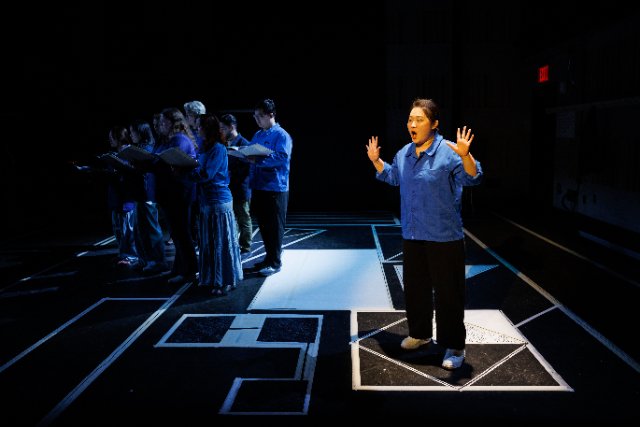
Mannes, the most interesting and daring music school in New York, presented Kaija Saariaho’s La Passion de Simone at the Nagelberg Theater, just steps from its usual home in the Tishman Auditorium. At the Tishman, works were often presented catwalk-style, the action taking place on a narrow strip in front of the orchestra.At the Nagelberg, director Emma Griffin finally had space to mount the first fully-staged chamber version of Saariaho’s oratorio.
The result was striking — a through-composed, musically and sonically balanced meditation that Saariaho once described as “a musical path in fifteen stations.” The work follows the life of philosopher and mystic Simone Weil, whose life, about as long as Christ's, encompassed staggering commitment: resistance to illness, sexism, racism, fascism, and finally to the limits of the human body itself. Weil’s late turn toward Catholic mysticism gives Saariaho her emotional core.
Earlier productions of Passion emphasized Weil’s political activism; Saariaho and librettist Amin Maalouf here chart a more spiritual journey — one Griffin’s production captured with grace and intelligence.
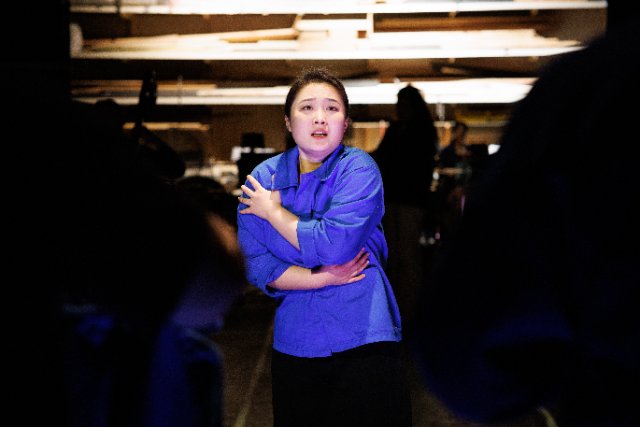
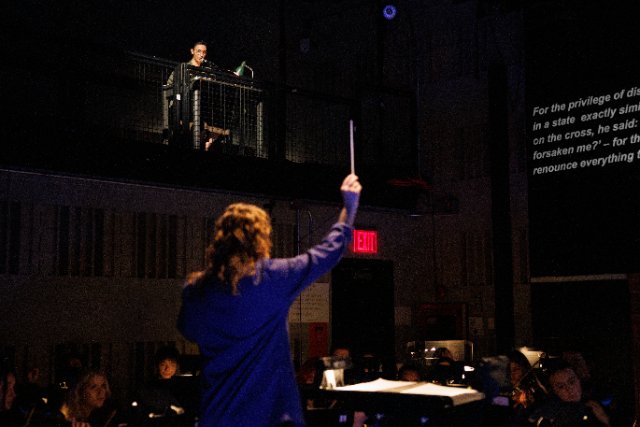
Clara Camacho served as narrator from a balcony above the stage, while the chorus drifted across the floor, meditating, commenting, and occasionally engaging with the principal figure — sung by three sopranos, each superb.
Ruija Dong deserves special mention for her radiant coloratura, full of texture and drama.
Micah Gleason conducted the Mannes Orchestra, shaping Saariaho’s sound world with precision and imagination. Her pacing revealed the “Palestrina bass line” Saariaho so admired — not just an underpinning, but an independent melodic thread, constantly conversing with the voices above. The higher textures — chimes, bells, whispering strings — lifted the music into another realm.
Much of the score unfolds slowly, yet never idly. The climactic Sixth Station crescendo felt earned and exhilarating, drawing together the many threads of Weil’s tormented inner life.
Saariaho remains one of the most important — and distinctly feminine — composers of our time: fierce, lyrical, endlessly curious about sound. Her decades at IRCAM in Paris, often collaborating with her husband Jean-Baptiste Barrière, yielded a vast sonic palette. Their daughter once studied violin at Mannes, and their son directed the school’s earlier Passion production — a true family circle honored here.
The new Nagelberg venue suits Mannes perfectly. Freed from the Tishman’s catwalk, singers could move through a geometric design that was both visually playful and practical. As Griffin noted, she’d admired the space from prior “black box” opera projects like Prototype and Heartbeat Opera — and here it blooms. The acoustic, open and generous, allows woodwinds, percussion, and voices to meet and clash in vivid relief.
Saariaho’s Passion de Simone is both tormenting and luminous — an apt reflection of Weil herself. The text may falter at moments, but the music grips completely.
In this staging, Mannes and Saariaho gave us a work that unsettles, consoles, and finally transcends.