

Samson et Dalila
West Bay Opera's Fine Production
By: Victor Cordell - Oct 14, 2025
In the performance world, a title comprised of a man’s and a woman’s name is pretty reliably a love story, sometimes tragic – Romeo and Juliet, Abelard and Heloise, and so on. For those not versed in the Biblical saga of Samson from Judges, Chapter 16, they may expect “Samson and Delilah” might fall into that category. But rather, it is a grand deception, motivated from the hatred by the Philistine seductress for the enemy Hebrew people and revenge for what she wrongly believed was her paramour’s rejection and ridicule of her.
Today, we accept Biblical stories and personages on the stage as routine. But when the French opera, Camille Saint-Saens’ Samson et Dalila, with libretto by Ferdinand Lemaire, premiered in 1877, such representations were typically banned from performance, especially in English speaking countries. Interest in the composer’s home country of France was so tepid that it opened in Germany. However, this masterpiece worked its way into the repertoire and has become an understandably beloved work.
Illustrative of French music of the late 19th century, Samson et Dalila has much to recommend it. Its lush orchestration and its stirring choruses are compelling. Arias and ensembles are melodic and important to the plot. Especially noteworthy is the trio in which the Old Hebrew warns Samson that love for Dalila would lead to tragedy. Saint-Saens also adopted Wagnerian motifs. Most enchanting is the graceful fluttering, especially of the flute, that produces anticipation for the opera’s signature aria. And while the basic plot line is known to most opera goers, it is nonetheless dramatic in its consequences and its execution.
West Bay Opera’s production extracts all that can be expected from the opera by a company of its size, and that is considerable. As the first opera that General Director José Luis Moskovich ever saw, his enthusiasm and search for excellence in the piece come through in his spirited conducting, bobbing and weaving with exacting thrusts at the instruments as they deliver highlights in the score. The resulting sound is exemplary
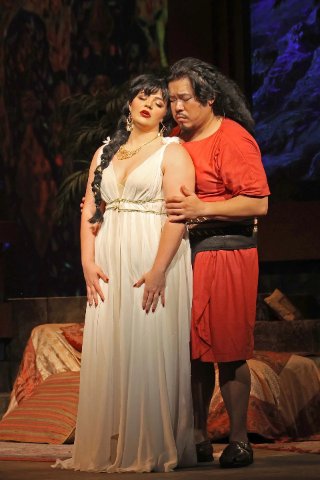
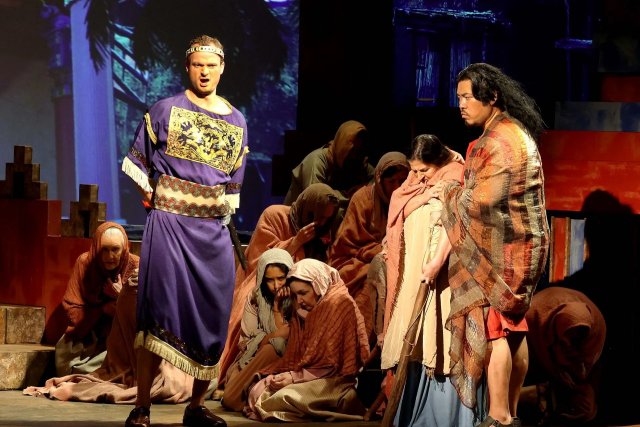
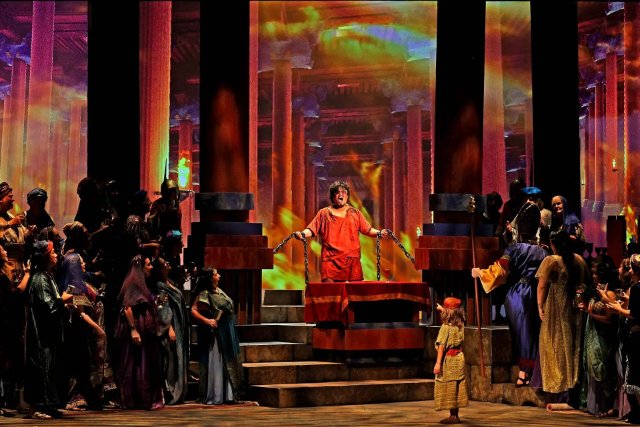
Veteran of recent West Bay productions, John Kun Park as Samson brings a powerful tenor voice and presence to the role. He is imposing in his portrayal, first strutting and energetic as the potent leader of the Hebrew people enslaved by the Philistines and later subdued as the blinded and weakened shadow of his former self. Park’s particular strength is in revealing anguish in his singing and acting, both when depicting rage and submission. Despite his ability to achieve great passion and volume, however, his timbre is a little muffled, having less than exemplary clarity.
Dalila is among the more venomous, detestable title characters in all of opera. Yet this is one of the great mezzo-soprano roles. Although the gullible womanizer Samson is deluded into thinking that she loves him, betrayal and destruction motivates her from the start. Mezzo-soprano Kim Stanish is Dalila, and she possesses the demanding vocal characteristics required for the role, which include a strong and complete mezzo range and the ability to sing with the extremes of sweetness and anger.
The aria “Amour! Viens aider ma faiblesse” (“Love! Overcome my weakness”) early in Act 2 tests the artist. Stanish conquers it with a delightful ascending run from her resonant chesty lows to her bright heady highs. If there is a vocal weakness, she doesn’t fare as well in competing with the orchestra at points in her mid-range. In terms of her portrayal, perhaps the wig, makeup, or costumery undermine her, but she doesn’t convey the grim resolve as convincingly as desired.
The signature aria in the opera is Dalila’s captivating, unforgettable “Mon coeur s’ouvre à ta voix” (“My heart opens at your voice”), which has even crossed over into other musical genres. Given its opening line, and as one of opera’s truly beautiful arias, most listeners would expect that it is a sincere love song, but it is really a hypocritical deception. Stanish gives a completely pleasing rendering of the aria, and when it turns into a beautifully harmonized asynchronous duet, Park joins in showing a mellifluous quality to his voice.
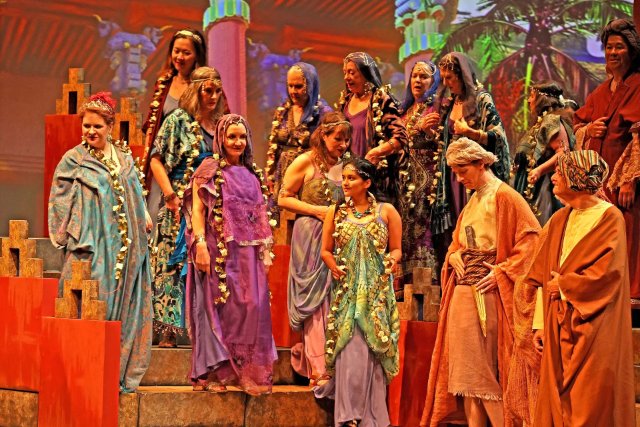
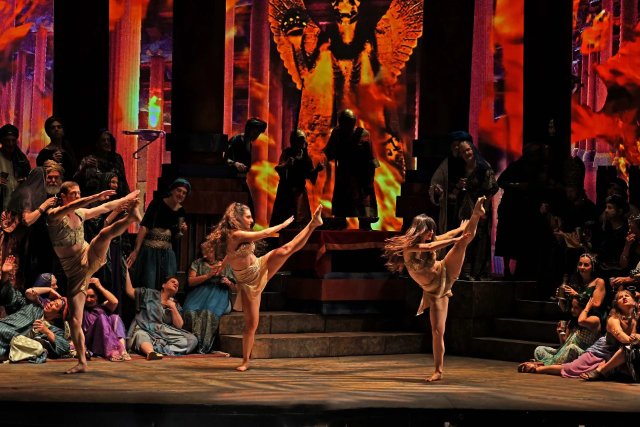
With the French market of the period in mind, the composer also inserted ballet, most significantly the Bacchanale, which contains the other most recognizable music from the opera. Unlike the remainder of the score, the exotic, heavily punctuated dance music is very Middle-Eastern. The writhing dance is well choreographed and performed. However, while the orgiastic theme and dance fits with the storyline, it comes at a strange time in the opera, just when the audience is looking for denouement and closure.
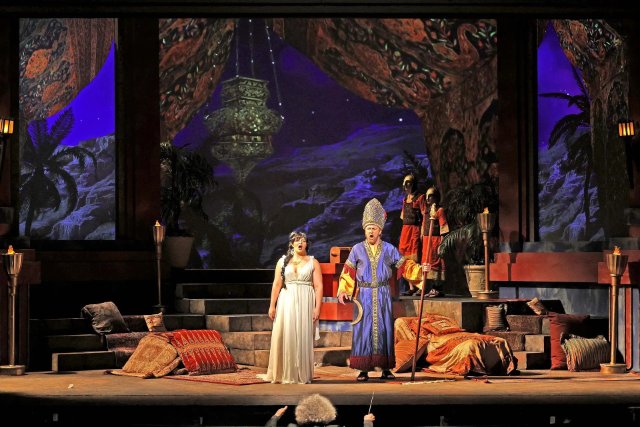
The overall production, stage directed by Maestro Moscovich, works nicely. West Bay has long been adept at making the stage seem larger than it is through tiering and projections, with credit as usual to Peter Crompton and Frédéric O. Boulay. Callie Floor’s extensive costumery also adds to the look of the production.
While the stage isn’t large enough to accommodate several columns from the temple physically collapsing at the conclusion, a combination of live action and graphics is used to depict the destruction. But for some reason, the simple act of the Philistines falling to the ground to demonstrate that Samson destroyed everyone in the temple does not occur. Notwithstanding these minor quibbles, the opera and this production are highly worthy and enjoyable.
Samson et Dalila, composed by Camille Saint-Saens with libretto by Ferdinand Lemaire and based on the book of Judges Chapter 16 from the Bible, is produced by West Bay Opera and plays at Lucie Stern Theatre, 1305 Middlefield Road, Palo Alto, CA through October 19, 2025.