
Boston Public Art Triennial
Overcoming Civic Neglect
By: Mark Favermann - Oct 16, 2025
For over 200 years, Boston has been considered a literary and musical city. Unlike New York, Chicago, Seattle, or Miami, Beantown has placed visual art — and thus public art — at a much lower civic cultural level. Here, public art has generally been relegated to minor-league status and impact. In fact, during nearly three-quarters of the 20th century, public art was not even acknowledged in Boston. The venerable Museum of Fine Arts ignored contemporary art until the ’70s. Founded in 1936 as a poorer sister institution to New York City’s Museum of Modern Art (MoMA), the Institute of Contemporary Art (ICA) made the dubious decision more than 90 years ago not to collect contemporary art at all. In the first decade of the 21st century, this was finally, and somewhat reluctantly, changed.
Certainly, over the years, there have been hit and miss attempts at public art in Boston — most selections were historical individual bronze statues, all honoring white males. Abstraction was not even on the docket. About 50 years ago, the Massachusetts Bay Transportation Authority (MBTA) commissioned the Arts on the Line program to supply public art to subway stations. Previously, commissioning artwork was a hit-or-miss proposition. UrbanArts, administered by the Cambridge Arts Council, proved to be more creative when selecting for art inside and outside the “T” platforms in the late ’70s and ’80s. Twenty permanent artworks for stations were created by 1985. Many prominent locally based artists initially took part in this program — the results were mixed. Outstanding works were installed by artists Mags Harries, David Phillips, Paul Matisse, and Dimitri Hadzi. Many other artists who were commissioned proved an old axiom: most studio artists are not cut out for making public art. Still, the project was an overall major success.
Initially administered by the very talented and passionate Pam Worden, UrbanArts’ mission was based on the belief that the cultural vitality of communities depended on incorporating the arts in the public realm, and to do this successfully artists and citizens needed to be engaged. Successive administrations of UrbanArts ranged from near invisibility to the suspiciously shady. With 21st-century flair, the final UrbanArts called on artist/curator Kate Gilbert to become director in 2014. Under Kate’s energetic and creative leadership, UrbanArts soon reemerged as a new organization, called Now + There. The organization’s revised mission was to be curatorial: to foster temporary artwork that was sensitive to context and place.
Gilbert further transformed Now + There into the Boston Public Art Triennial in May 2024 and began planning for its first citywide display event, which was launched in May 2025. The rebranding led to an ambitious new arrangement — a citywide, city-focused event held every three years. The previous model was to present, one at a time, single temporary installations or multiple installations. The BPAT’s goals are to support established and up-and-coming artists in the creation of site-specific public artworks that would tap into concerns for needed social and environmental change. Its major goal: to transform Boston into an open and dynamic major public art city.
Featuring over 20 commissioned public art projects with the theme “The Exchange,” the Boston Public Art Triennial is free to the public (it runs through October 31) and the artworks have been displayed across various Boston neighborhoods, adjacent communities, and partnering museums. Curators included Senior Curator Pedro Alonzo, Tess Lukey, and Jasper Sanchez. Alonzo and Lukey focused on national and international artists whose interests reflected The Exchange’s key themes of indigeneity, climate, and biodiversity. Sanchez chose three locally based artists — Andy Li, Alison Croney Moses, and Evelyn Rydz — whose artwork was also relevant to current issues. Admirably, the curators wanted artists to create works that would be catalysts for community conversations.
Each artist was paid $105,000 to $225,000 to create their pieces. The total project cost was approximately $8 million. With rare recent exceptions, such as multimillion-dollar commissions for Janet Echelman’s “As If It Were Already Here” (2015), hosted on The Rose Kennedy Greenway Conservancy, and Hank Willis Thomas’ s“The Embrace” (2023) on the Boston Common, this amount of funding was more in keeping with commission amounts in other big cities. Historically, Boston has paid consistently smaller fees for public art.
Creating a new major public art program is a difficult journey, filled with damaged roads and cluttered pathways. The Triennial staff understood from the beginning that this first attempt would serve as a learning process for the future. In terms of aesthetic accomplishment, the Triennial’s 20 artworks are a mix of the wonderful and the unexceptional. Too many pieces needed to lean on extensive explanations and complicated artist statements in order to be understood by the public. Several were appropriations of earlier artists’ works, especially those drawing on textiles (there was little of the eloquent simplicity of Tibetan prayer flags), words (done much better previously by others), as well as uninspired neon. Unfortunately, some artworks seemed to be more about displaying process rather than making visual statements. Some site selection and placement of pieces — albeit limited by what was available — were awkward to view. A personal pet peeve: apparent ageism. No older artists were included in the Triennial mix.
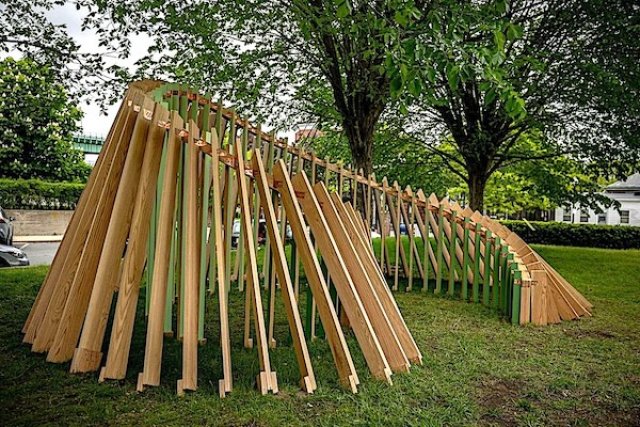
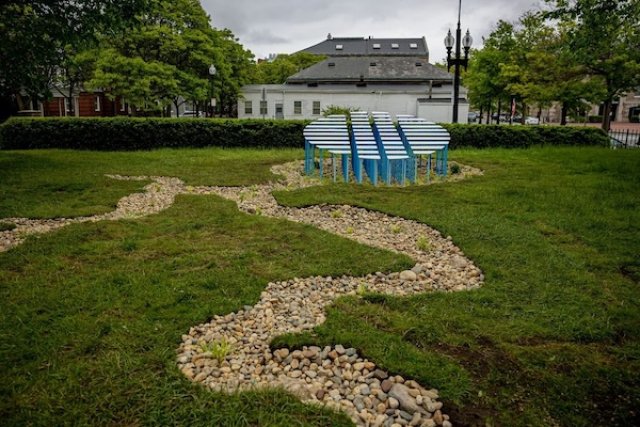
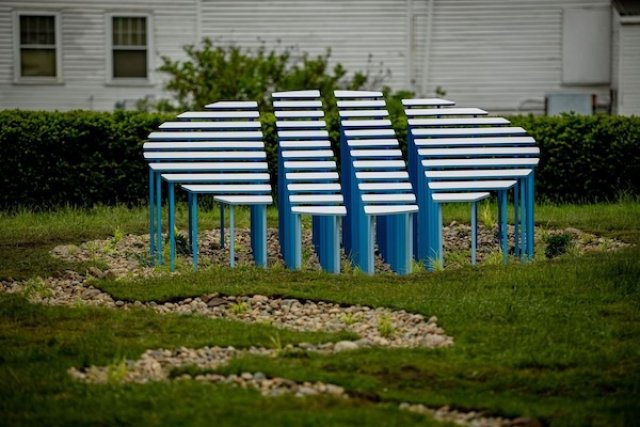
On the other hand, some of the wonderful Triennial pieces included This Moment for Joy by Boston artist Alison Croney Moses, a graceful undulating wall of wooden slats on a gradient curve representing the loving warm embrace and inspiration of important Black women in the artist’s life. Set at the Charlestown Navy Yard, Moses’s piece demonstrates how a minimalist approach to skillful woodcraft could create public art that evokes the warmth of a sanctuary in form and scale. Also at the Charlestown Navy Yard, Evelyn Rydz served up a splendid environmental installation, Convergence: Porous Futures. Created from an elegant grid of mirrors set on low posts — modeled on abstracted storm drain — the piece sat above winding lines of stones cut into the lawn, which depicts the confluence of the nearby Mystic and Charles Rivers. Like most of Rydz’s art, this work focuses on water infrastructure and its environmental impact in the context of increasing weather extremes.
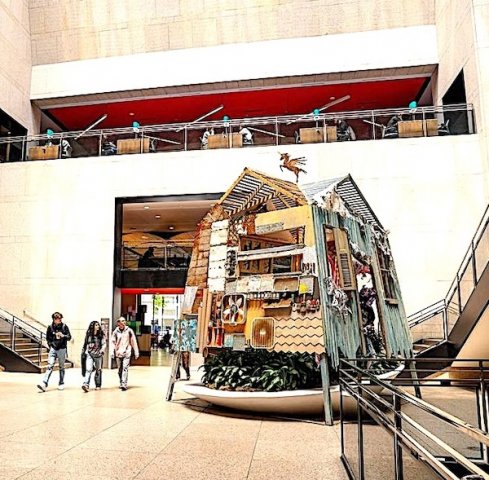
In the Well: The Stories We Tell About Addiction, by Swoon (aka Caledonia Curry) — located at Boston Copley Library’s central atrium — looks like a dilapidated cabin, pieced together from various recycled odds and ends; it sits dreamlike, floating on a small barge. The idea for the artwork sprang from the artist’s novella, “Sibylant Sisters,” a story about two sisters who live with a witch who subsists on a pernicious substance brewed in the well of toads. Drawing on this story from her adolescent imagination, Swoon questions how drug addiction is perceived, explained, and often misunderstood.
Located at Evan’s Way Park in front of the Isabella Stewart Gardner Museum, Alaskan artist Nicholas Galanin’s I think it goes like this (pick yourself up) references his Northwestern Indigenous heritage through a totem with thunderbird atop a decomposing robotic body. On the ground, imitation totem pieces and sections surround the kneeling form. The point is clear: this is a dramatization of the damage to Indigenous culture by colonization, particularly the difficulty of repairing the enormous harm done by outside interference and attempts at cultural homogenization.
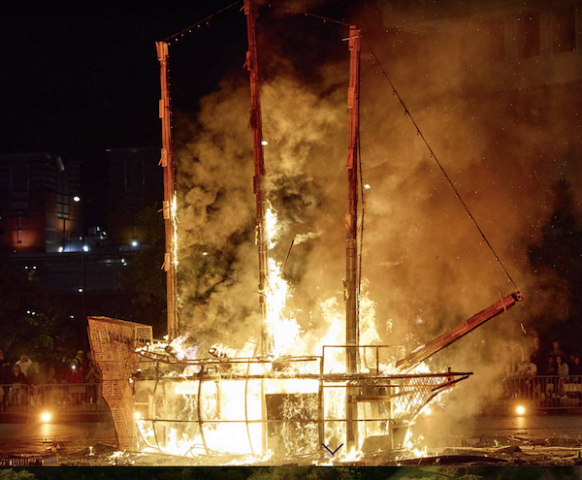
Most theatrical of all, Adela Goldbard of Providence and Mexico City erected an elegant, quarter-scale replica (32 ft long) of the type of 17th-century sailing ship that first brought European colonists to the Americas. She then burned it to the ground. Installed on Boston City Hall Plaza. The artist used the public spectacle of burning a colonial ship as the spectacular antithesis of a solid bronze statue of a founding father (“They invaded by sea, we responded with fire. An omen”).
Boston has been slow to learn that public art has a tremendously positive impact on a community. Through the efforts of the Boston Public Art Triennial, the City of Boston’s civic life and built environment have been enhanced and strengthened. Bravo!