

Krapp's Last Tape at NYU
Stephen Rea Stars in the Skirball Production
By: Susan Hall - Oct 19, 2025
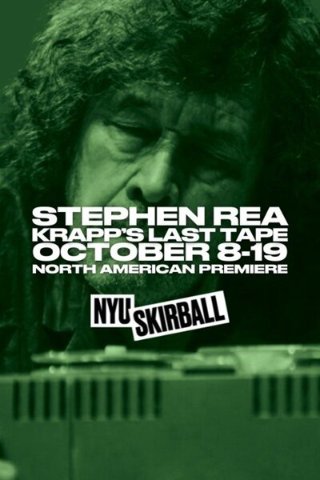
Krapp’s Last Tape by Samuel Beckett is playing at NYU’s Skirball Theater, with the great Stephen Rea in the title role. Years ago, Rea rehearsed this play with Samuel Beckett himself and recorded Krapp’s early memories. It is those old recordings we now hear in this production—Rea, in the present, listening to the voice of his younger self.
For the actor, that must make a difference. The voice belongs to another time and place—not the present performance. Yet for the audience it is now.
Vicky Featherstone, a brilliant director, is at the helm. Her interpretation gives us a Krapp whose responses are flat, suggesting that our histories may ultimately be meaningless. Yet Rea’s stillness doesn’t leave us untouched. He is very funny in the opening moments, peeling a banana like a comic sexual object, maybe for the last time. After that, he is somber, reflective, almost empty. The tapes hold the audience fast—stories of failed love, of a dog and a ball, of memory itself. We hear them in the present, and they echo.
The set by Jamie Vartan is perfect, true to Beckett’s black-and-white world. Lighting by Paul Keogan adds depth and warmth, often framing Rea as a figure in a Rembrandt self-portrait.
A door opens from time to time as Krapp tries to leave and returns. When it does, a beam of light slips in from the world beyond, a Vermeer window on another reality.
Beckett believed that Joyce had exhausted human language, and he turned in the opposite direction—toward silence, toward reduction. Proust hovers nearby: the search for lost time plays out on the tapes, though stripped of Proust’s mystery.
Perhaps that is the point. Perhaps Featherstone and Rea mean to show that the past has no meaning in the present.
Beckett thought Joyce had said everything language could say, so he sought to erase it. Yet his nights at concerts in Paris left him with an always present sense of rhythm and musical phrasing. Even a three-word line carries a cadence.
Beckett at the Skirball is a treat.