

Pulitzer Prize-winning English by Sanaz Toosi
TheaterWorks Hartford
By: Karen Isaacs - Oct 23, 2025
My first day in French class, our seventh-grade French teacher taught us to say “my name is.” And then she carefully pronounced our French names; for many it was very similar though perhaps pronounced slightly differently: Mary became Marie, but for others, such as William, the name was very different.
Anyone who has tried to learn a foreign language knows that it is more than just memorizing words and learning a different syntax. It is contorting your tongue in different ways, using your lips, throat, and face muscles differently. It is also learning to feel tongue-tied in inadequacy as you struggle to speak a coherent sentence, saying something very simple that you probably have said in English since you were five.
It is even more than that, a friend who learned Japanese said it taught him a new way of thinking. Language is connected to culture in many ways.
That is at the heart of the Pulitzer Prize-winning English by Sanaz Toosi at TheaterWorks Hartford through November 8.
Four Iranian students in a midsize city are trying to perfect their English skills so they can pass the TOEFL, the test for speakers of English as a second language, which is often required by colleges and companies in English-speaking countries. Their teacher (Marjan) is an Iranian woman who spent nine years in Manchester, England, and is fluent in English.
Each student has a reason for wanting to learn English and to pass the proficiency exam: Roya wants to emigrate to Canada to live with her son and granddaughter; Omid has a green card interview in the not-so-distant future; Elham has been accepted to an Australian medical school. The young woman, Goli, is there because she feels learning English will be helpful.
If there is a problem with the play, it is that Toosi ignores the political realities of 2008, when there was a major crackdown on the One Million Signatures Campaign, which focuses on women’s rights. The following year saw a rise in political prosecution and arrests of people viewed as dissidents of the Islamic regime.
The play continues in a short series of short scenes, each representing a class. Tensions arise because some of these students resent the need to learn English. The grandmother, Roya, questions and complains that learning English is throwing away a centuries-old culture. She is angry that her son has become a Canadian – changing his name and abandoning Iranian traditions. Elham, the aspiring medical student, resents that this is keeping her from her dream. She is brilliant in the sciences but is struggling with English.
We discover that even the teacher has some mixed feelings. It’s never quite clear why she returned to Iran, where she is married to a man who does not speak English and has a daughter.
It may take the audience a few minutes or longer to catch on to how the playwright differentiates between the students speaking Farsi and when they are speaking English. The dialogue that is supposedly in Farsi is more sophisticated and fluent. The English is simpler and halting.
In this production, the differentiation was harder to recognize.
Added it into the play, and perhaps unnecessarily so, is some romantic tension between the teacher (Marjam) and Omid, who is by far the most fluent in English. The tension was overplayed in this production.
The cast and director (Arya Shahi) are all of Iranian descent; this is, to some extent, their own story or the story of their parents.
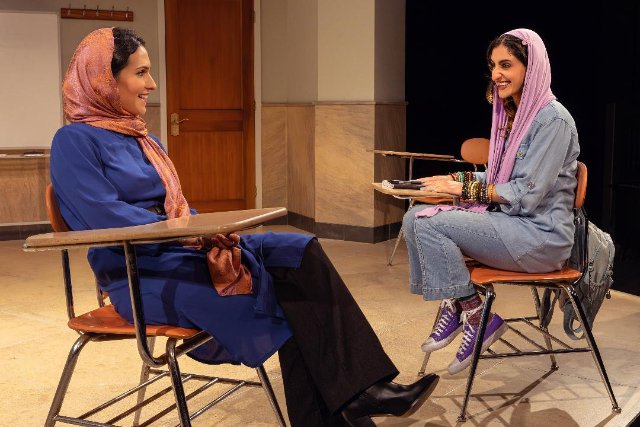
The simple set is a plain classroom with typical chairs, Venetian blinds across a bank of windows, and a movable whiteboard.
The cast is uniformly good. Neagheen Homaifar as Marjam combines the strictness that a teacher needs with warmth and empathy. When she tells the students how she felt riding the bus in Manchester, or being called Mary, you feel her pride in her independence and the new image that the new name gave her. She became a different person whom she liked.
Anahita Monfared as Goli is charming as the teenager, particularly when she defends her choice of music —American, of course. It is the two students who struggle the most, who also resent the effort the most. Sahar Milani as Elham, the medical student, is angry either at the requirement or at her inability to meet it. She challenges Marjam constantly. Pantea Ommi as Roya, the grandmother, looks almost too young to be a grandmother. The audience realizes what she doesn’t; that her son’s requirement that she speak English is a way to delay her visit. Afsheen Misaghi plays Omid with a young man’s confidence and assuredness.
The play has flaws, but it is a credit to the playwright that we want to know more about these characters.
The question that English illuminates is universal. As immigrants move to new countries, how do they keep their birth cultures alive and vibrant while also accepting new cultures? Is it discarding the old? Is it rejecting the new? What is the balance?
For tickets, visit TWHartford.org. This is a co-production with Long Wharf Theatre. English will play from Jan. 16 to Feb. 1 at the Kendall Theatre Lab in Southern CT. State University campus.
This content is courtesy of Shore Publications and Zip06.com