

Life of Pi on Tour
Broward Center for the Performing Arts in Ft. Lauderdale
By: Aaron Krause - Oct 24, 2025


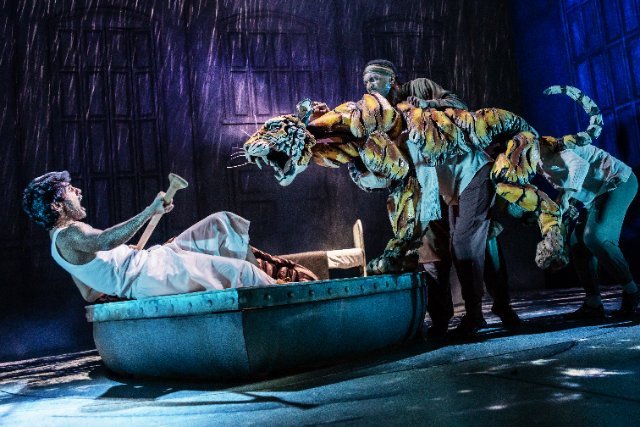
The roar chills your bones. You strain to locate its source, but the sound seems to fill the entire large space. Then he appears—slowly, chillingly. He looks real, but this isn’t your ordinary Bengal tiger. It’s one of several meticulously crafted puppets in Lolita Chakrabarti’s gripping stage adaptation of Yann Martel’s novel, Life of Pi.
A riveting Equity national touring production brings the sights, sounds, battles, heart, and genuine emotion of the play to audiences across the country. Through Sunday, it remains docked at the Broward Center for the Performing Arts. The show lasts about two hours and 15 minutes, including a 20-minute intermission. From the production’s dramatic opening moment to the breathtaking conclusion, the show mesmerizes the eyes and heart, setting the tone for a story as visually striking as it is emotionally spellbinding.
Chakrabarti’s adaptation features some of the most lifelike and intricate puppetry seen on stage since The Lion King debuted on Broadway in 1997. You marvel at how effortlessly the puppets move and the stamina the puppeteers maintain to operate them for so long. This production strikes a compelling balance between spectacle and soul in telling Indian teenager Pi Patel’s story.
Set in the mid-1970s, the tale follows Patel and his family, who decide to close their zoo and escape to Canada to leave behind their homeland’s political turmoil. While Pi, his family, and the zoo’s animals are aboard a Canada-bound ship, the vessel encounters a storm and sinks. Pi’s family perishes, but he survives along with the animals. Altogether, they endure a harrowing 227 days at sea. This ordeal tests Patel’s faith and endurance.
Technically, the adaptation takes place in the present. Patel is hospitalized after his ordeal, answering questions from investigators who wish to learn the truth about what really happened aboard the doomed ship. In fact, he offers two different versions of the story. The action shifts between the institution and flashbacks to his days stranded at sea.
Throughout the show, the tension between reality and fantasy pulls audiences in different directions, blurring the line between what is real and what isn’t. Chakrabarti’s engrossing storytelling consistently captivates as the youth, the tiger, and the other animals struggle to survive.
Faith, survival, and storytelling drive this adaptation, faithful to Martel’s novel while creatively shaping the story for the stage. Nail-biting suspense, impressive visuals, and deft puppetry are among the play’s draws. Conflict—both man versus beast and man versus self—pulls us into the tense narrative. Patel maintains his strong faith even while enduring the unimaginable. As a vegetarian, he faces the moral and practical dilemma of survival: when the only food is meat, how long can he resist? The tale becomes a gripping meditation on survival, where every choice matters.
If the notion of surviving so long alongside a tiger and other wild animals feels far-fetched, Patel offers an alternative, less satisfying, and darker story in which he battles fellow humans. Which one do you prefer, you may ask yourself after the performance concludes. Either way, questions arise: is Richard Parker merely a tiger, or a symbol of Patel’s survival instincts?
By the way, the origin behind the large cat’s name accounts for some of the story’s humor. Apparently, somebody mixed up the tiger’s real name with that of its owner, Richard Parker. After a while, people continued to refer to the beast as Richard Parker. Naming the tiger this way can also symbolize humans’ dual man/beast nature.
Chakrabarti endows Richard Parker with relatable, human qualities. During one scene, the large feline appears exhausted, panting and struggling to move, much like we would if we endured prolonged hunger or vigorous exercise for an extended period. The titular character and the tiger slowly, almost imperceptibly, bond throughout the course of the play. At one point, the tiger seems to sit on the young man’s lap. In another heart-tugging moment, Patel lies on his stomach, desperately trying to reach out before the large cat leaves. But Richard Parker doesn’t respond.
Credit must go to the multiple puppeteers who bring Richard Parker and the other animals to vibrant life. These artists are always in full view of the audience, yet the puppetry never draws attention from the story. They appear fully invested in the story, working hard and remaining present in every moment. They work in the trenches, like the dancers depicted in A Chorus Line, blending seamlessly into the action.
During a media event the day after opening night, reporters learned how the puppeteers must work together as a team, each responsible for specific parts of each puppet. Their movements are precise, and even the loud roar at the top of the show sounds lifelike. Nick Barnes and Finn Caldwell designed the puppets, and Caldwell handled puppetry and movement direction.
The puppeteers work alongside the actors portraying the human characters. This cast’s leading man is Taha Mandviwala as the titular character (Savidu Geevaratne portrays Patel at certain performances). With dark piercing eyes, brown hair, and clad in all white, Mandviwala’s Patel gradually transitions from a wary, tense youth to a more open, vibrant, and eager young man. Mandviwala shines onstage whether his character is vigorous or struggling to merely survive. When Patel becomes desperate, his screams and cries sound convincingly intense and primal.
Other cast standouts include Sorab Wadia as Patel’s father. Wadia effortlessly commands the stage and maintains a strict, no-nonsense demeanor in voice and physicality. Yet he fleshes out his character with moments of sympathy. One instance that is hard to watch comes when he ties a goat near the tiger and encourages the big cat to kill the helpless animal. While we may understand the character’s motivation—to teach his sons the dangerous nature of wild animals—the moment is brutal. Truly, after the kill, you feel for Patel, seated on the ground despondent while his father towers over him.
Meanwhile, Alan Ariano imbues investigator Mr. Okamoto with palpable impatience for Patel’s far-fetched tale. Speaking in an irritated voice and pacing at times, Ariano’s rational, unromantic Mr. Okamoto is visibly frustrated as he questions the title character.
In addition to portraying distinct individual characters, the performers work well as an ensemble, listening to one another and always remaining in the moment.
The actors perform on scenic designer Tim Hatley’s sturdy and realistic-looking set. It’s spacious and claustrophobic at the same time, giving the sense of entrapment but providing the performers plenty of space to move. Greyish walls reinforce the story’s seriousness. Various set pieces enter as needed without derailing the story’s momentum. Hatley also designed the costumes, such as the all-white outfit for Patel, which reinforces his bright eagerness and naivete. The white outfit contrasts with some of the other darker, greyer costumes.
Tim Lutkin’s and Tim Deiling’s lighting realistically creates illusions such as lightning and establishes mood. Meanwhile, drifting stage fog creates a sense of mystery and tension. Likewise, dramatic, propulsive music by composer Andrew T. Mackay enhances the story, while sounds such as thunder help convey the chaos during storms and other danger-filled moments.
The video and animation design by Andrzej Goulding lends realism to objects such as raindrops and trees. The projections also provide practical context, including clear markers of how many days Patel and the animals have been adrift. This helps audiences track the passage of time and the increasing intensity of the characters’ ordeal.
Under Max Webster’s sensitive direction, clear chaos reigns at appropriate times, but quieter, more affecting moments also have space to land. Undoubtedly, Life of Pi is an intense tale that amazes with visuals and artistry, but the show’s beating heart is man—and beast’s—will and capacity to endure despite conditions that threaten to destroy them. It’s a compelling tale of survival that grips us from start to finish.
IF YOU GO
WHAT: The equity national touring production of "Life of Pi"
WHEN: Through Sunday.
WHERE: Broward Center for the Performing Arts, 201 S.W. 5th Ave. in Ft. Lauderdale.
TICEKTS: Visit www.browardcenter.org. For information about the tour's future stops, visit www.lifeofpibway.com.