

Endgame at the Irish Arts Center
Druid Mounts a Magnificnet Production
By: Susan Hall - Nov 03, 2025
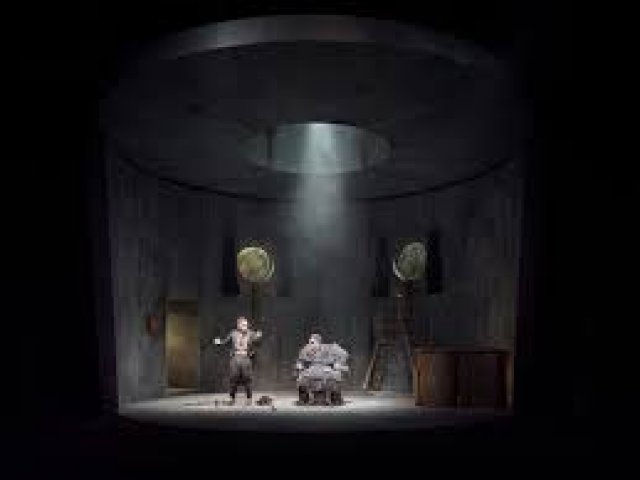
The Druid Theatre’s staging of Samuel Beckett’s Endgame, now at the Irish Arts Center, feels both grimly precise and unexpectedly alive. The set—curved like the inside of the two garbage cans that sit onstage, veiled at the start—suggests the concave interior of Beckett’s world: a place of confinement masquerading as a home. Inside the cans reside two stumps, the cheerfully doomed couple Nagg and Nell, played by Bosco Hogan and Marie Mullen (a Druid founder), who manage to radiate a kind of tender futility.
Beckett, who dismissed Waiting for Godot, considered Endgame his sharper instrument. If Godot captured the mid-century’s absurd stasis, Endgame belongs to our darker age. “Nature has forgotten us,” says Clov, the servant. “There is no more nature,” his master Hamm replies. The line lands less as despair than as fact.
Beckett called Endgame “more inhuman” than Godot—a work meant to claw at the audience. There is no waiting here; the day is already dying. Repetition—of words, gestures, and defeats—becomes a grim kind of music. The play begins with an ending: “Finished. It’s finished. Nearly finished. It must be nearly finished.” Hamm announces it before we know what “it” is. Beckett’s cruel joke is that the play has barely begun.
“Nothing is funnier than unhappiness,” Nell observes, in the line Beckett deemed most important. The laughter in Endgame comes from exhaustion, not relief.
Beckett loved chess but bungled the endgame; his human pieces fare no better. Clov (Aaron Monaghan) hobbles across the stage, all twisted limbs and expressive grimaces, mounting a ladder to peer at the dimming world outside—his reports as bleak as weather bulletins from extinction. Rory Nolan’s Hamm, blind and imperious in his wheeled chair, meets him with the flat, affectless delivery Beckett prescribed. Their exchanges thrum with the rhythm of a master/servant relationshiop gone on too long.
Beckett’s ear for language—sometimes lyrical, sometimes cruel—betrays his musical receptivity. The dialogue feels scored: every pause a fermata, every sigh a motif. Director Garry Hynes amplifies this sense of confinement; the stage resembles a basement cell, lit by two grimy portal windows through which Clov spies the fading light.
In the final moments, Hynes dresses Clov in bright green—a flash of life, or mockery of it. Does he leave? Does it matter? In Beckett’s universe, even the gesture of escape feels choreographed. The curtain falls not on resolution but on persistence.
Playing at the Irish Arts Center in New York through November 23rd. Tickets here.
Nagg Bosco Hogan
Clov Aaron Monaghan
Nell Marie Mullen
Hamm Rory Nolan
Director Garry Hynes
Set and Costume Designer Francis O'Connor
Lighting Designer James F. Ingalls
Sound Designer Gregory Clarke
Hair and Make-Up Designer Gráinne Coughlan
Associate Costume Designer Clíodhna Hallissey