

From Epic Theater to “Oh, Mary”
Cole Escola Receives the Erwin Piscator Award
By: Jessica Robinson - Nov 03, 2025
If Erwin Piscator — the German theater director who turned politics into performance — could see Broadway today, he might choke on his cigar. The father of epic theater, who believed the stage should be a weapon against complacency and capitalism, now has an award in his name that’s gone to Cole Escola, the first non-binary performer to win a Tony.
Honored for Oh, Mary!, a hysterical, historically inaccurate Broadway hit that reimagines Mary Todd Lincoln, the 16th president’s wife, as a perpetually tipsy, attention-starved First Lady who longs to be a cabaret singer.
Performed in drag by Escola (who also wrote the play), Oh, Mary!’s author and star might seem an unlikely recipient for the Piscator Award.
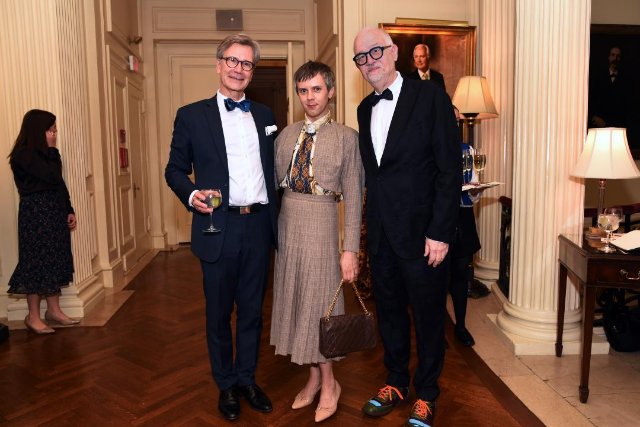
However, on October 23rd, at the 38th Annual Erwin Piscator Awards dinner, Elysium-between two continents, Michael Lahr von Leitis, Elysium’s Chairman and Executive Director, pronounced Escola the new recipient.
About Elysium
Founded in 1983 by Gregorij von Leitis, Elysium-between two continents is dedicated to combating hate, racism and anti-Semitism through the transformative power of art. Two years after its founding, von Leitis established the Erwin Piscator Award to honor and commemorate the artistic and humanitarian legacy of the man whom Bertolt Brecht called “the greatest theater man of all time.”
An Ironically Perfect Venue
The Lotos Club — one of New York’s oldest literary institutions, with paneled library rooms and an air of old-world civility — provided, ironically, a perfect setting. Founded in 1870, it counts Mark Twain among its early members, along with John Hay, who had once served as Abraham Lincoln’s private secretary. One imagines Hay might have raised an eyebrow — or a glass — at Escola’s booze-soaked interpretation of Mrs. Lincoln.
Kicking off the ceremony was playwright, screenwriter, librettist and Pulitzer Prize winner, Doug Wright, who served as Master of Ceremonies.
“I’m really overwhelmed,” said Escola when they took the podium to thank Elysium for the award. They then went on to say “How I feel right now can be summed up in this Emily Dickinson poem: There are those who are shallow intentionally and only profound by accident. Then, deadpan, they added: “I feel that I devoted myself to shallowness, and for some reason you found it — which speaks ill of you.” The room erupted in laughter. It was a moment both disarming and perfectly Escola: self-deprecating, precise, and mischievously aware of its own absurdity.
At first glance, the pairing seems improbable. Piscator dramatized social conflict and political struggle. Escola wields sharp dialogue, emotional collapse, and one of the funniest breakdowns ever committed to footlights. Yet, scratch beneath the hoop skirt, and the logic emerges: both artists use exaggeration as a form of truth-telling.
Piscator wanted theater that jolted audiences awake. Escola achieves that — only with petticoats, panic, and a well-timed bottle of wine. Their Oh, Mary! skewers the moral pieties of American history with the same zeal Piscator brought to dismantling bourgeois pretension in Weimar Berlin.
For Piscator, radical theater meant Marxist engagement. For Escola, it’s queer irreverence—mocking American sainthood and rewriting history through camp.
Piscator filled his stage with scaffolds, projections, and statistics; Escola fills theirs with hysteria, lace, and impeccable timing. If Piscator’s work was satirical agit-prop for the proletariat, Oh, Mary! is camp-prop for the gender-fluid age — a séance where history’s ghosts get drunk and finally tell the truth.
Would Piscator approve? Perhaps cautiously, perhaps with delight. His whole mission was to make audiences think — and nothing makes audiences think quite like watching Abraham Lincoln’s wife crawl across a parlor floor in search of another drink. (Even if that’s not the kind of ‘thinking’ Piscator had in mind.)
Piscator wanted revolution; Escola delivers revelation through farce. It’s still epic theater, just with better wigs.
And so, more than a century after Piscator first transformed Berlin’s stages with his bold, politically charged productions, the award bearing his name lands, fittingly, in the hands of another provocateur. From epic to outlandish, the spirit of radical theater endures — now with a splash of wine and a wink.