

Liberation
Reflection on Feminism in the 70s on Broadway
By: Victor Cordell - Nov 17, 2025
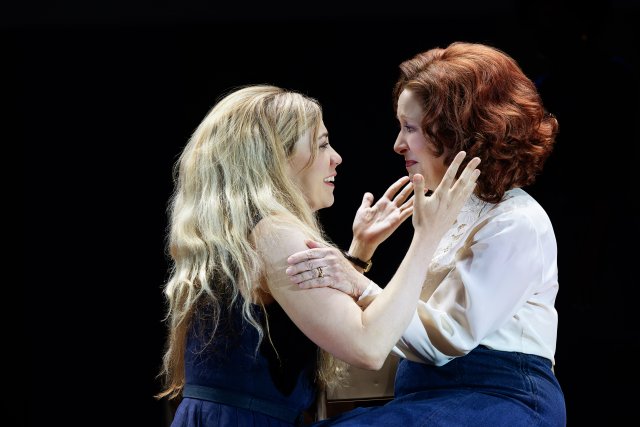
I saw this wonderful show on a trip to New York. Thanks to the producers of Liberation, represented by public relations firm The Press Room, for their generous provision of press tickets for members attending the American Theatre Critics Association Conference. Also, thanks to playwright Bess Wohl, director Whitney White, lead actor Susannah Flood, and key actors Betsy Aidem and Kristolyn Lloyd for dedicating their time for an informative and interesting discussion panel about the play at the conference.
One of the first things to note about Liberation is that I haven’t seen so much smoking since Mount Saint Helens and so much skin on stage since Oh! Calcutta! But those aren’t what it’s really about.
It is a memory play about a woman, Lizzie, trying to better understand her mother by conversing with her mother’s past associates. Like most children, Lizzie had seen her mother through the lens of their relationship, failing to know her as a complete person.
Playwright Bess Wohl plumbs her own family history, and the fact that her mother had worked for Ms Magazine in its earliest days, to draw a loving portrait of the women who took part in the feminist movement in the ‘70s. The result is a well-produced and directed, compelling and deep dramedy with broad appeal. To borrow the words of one of my colleagues who also attended, “It’s not perfect, but I love it anyway.”
The action takes place in a rec center gymnasium in Ohio and switches back and forth between the 1970s and current time. It starts with Lizzie’s mom organizing the “consciousness raising” group and ends with Lizzie interviewing the women who were involved.
For those of us who were there and should remember the footsteps of Betty Friedan and Gloria Steinem, the show is a reminder that while there were many doctrinaire feminists, there was a broad array of positions. Characters in the play are clearly drawn, ethnically and otherwise diverse women – some unhappy in marriage, and others not so unhappy in marriage; closet lesbian and motorcycle dyke; and more. They are shy and gregarious; diplomat and bomb thrower; bombshell and Plain Jane.
Susannah Flood strikes all the right notes as Lizzie, often breaking the fourth wall as a narrator to share thoughts directly with the audience. Besides playing Lizzie, she also plays her (unnamed) mother, navigating the policy clashes among the newly enlisted feminists, like whether to join in the Strike for Equality, which carried the risk of job loss by some participants. On the personal side, a secret is long withheld by one of the women that she has been dating a man and is considering following him to New York, while at the same time rejecting the practice of marriage. Some of her cohorts are troubled by the secrecy and her commitment to a man. Very conflicted.
Dialog crackles. Led by the terrific Betsy Aidem as the repressed “older” Margie, she spews a catalog of the many chores that she performs without any assistance from her husband. Another juicy role is that of Dora 1 (there are two Doras), the effusive green-card-seeking immigrant firebrand portrayed by Irene Sofia Lucio.
The most stunning event is the opening of Act 2, which in the earlier panel discussion was not revealed, or shall we say, unveiled. Beginning on a darkened stage, the audience can see the women disrobing, and when the lights come up, they are totally nude and will remain that way for perhaps 15 minutes. This courage is the ultimate expression of women’s liberation, and it also provides the opportunity for the characters to demystify body evaluation in their discussions.
This is an exceptionally insightful and fascinating play. My only real criticism concerns the confusion of time and characters. Sometimes it is difficult to sus out whether the action is current or from the past which could be easily resolved with a device as crass as having a person walk across the front of the stage with a sign indicating the year.
Lizzie’s mother should be given a name that is used by others, particularly because she is usually played by the same actor who portrays Lizzie, and with an unchanging set of actors/characters on the stage. To make matters more confusing, two other actors play the mother at other times. At least in one case, it is funny. In a scene where Lizzie’s future father will be kissing her future mother, Lizzie tells the audience that playing that scene would just be too creepy, so someone else would have to stand in, which Lizzie then watches. Because the sociological notion of “becoming one’s mother” has merit, the idea of the same actor (and a powerful one in this case) playing both roles has great appeal, but it should be managed better.
It’s surprising that these issues survived the show’s transition from off-Broadway to Broadway. Nonetheless, the funny and serious Liberation should have legs, or better yet, wings to fly.
Liberation, written by Bess Wohl, plays at the James Earl Jones Theater, New York, New York, on an open run.