

Madama Butterfly
One of Opera's Most Beloved by Opera San Jose
By: Victor Cordell - Nov 18, 2025
What more can be said about Giacomo Puccini’s Madama Butterfly that hasn’t been said a million times before? Along with his other monster hits La Boheme, Tosca, and Turandot, no other composer forged a core of operas that have been so beloved by so many and received so many productions year after year, though Verdi and Mozart do have more breadth of offerings.
What is Puccini’s secret? Like no other opera composer from the classical-romantic era, he loved women as his central characters – perhaps because his first full-length opera, Edgar, was a failure. Just look at the titles of each of his seven mature, full-length operas – only women are referenced in the title. The heroines are highly diverse and often vulnerable, though in different ways – from frail (Mimi) to vibrant (Tosca) and from imperious (Turandot) to submissive (Cio Cio San).
Opera San Jose takes on the war horse Madama Butterfly. Thanks to a cast of fine voices plus the rich-sounding orchestra conducted by Joseph Marcheso delivering the sumptuous score, the result is a delight. Although several set pieces always stand out, absent those highlights, the music is still luminous throughout, shimmering like moonlight reflecting on water. Innovatively, Puccini also introduces Japanese pentatonic musical forms, most memorably in the unique off-stage “Humming Chorus.” Meanwhile, the dramatic storyline is cohesive and highly emotive.
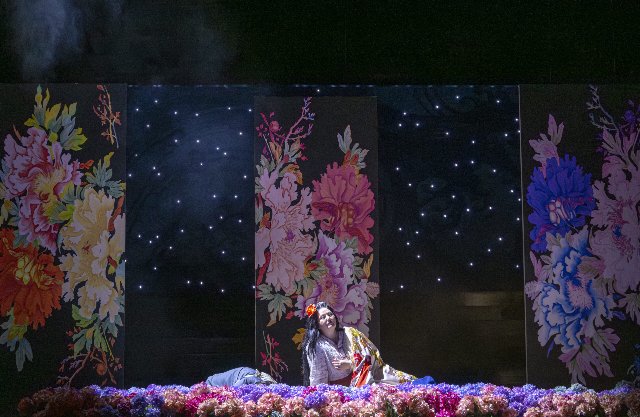
The opera belongs to Cio Cio San, Butterfly that is, who dominates the action. Emily Michiko Jensen makes the most of it in her role debut. Of course, there are many conceits in opera, and though young herself, Jensen’s powerful voice would hardly be that of an ingenue of 15 years, as Cio Cio San is in the source material. The soprano appears to love the role. She displays particularly well in the mid-and-upper ranges, calling on a strong and mellifluous vibrato, and giving a beautiful rendering of the protagonist’s signature aria, the universally loved “Un Bel Dia Vedremo” (“A Beautiful Day Will Come”).
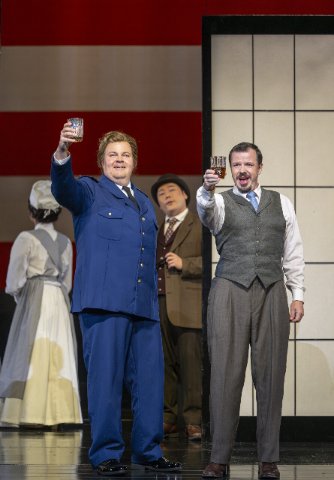
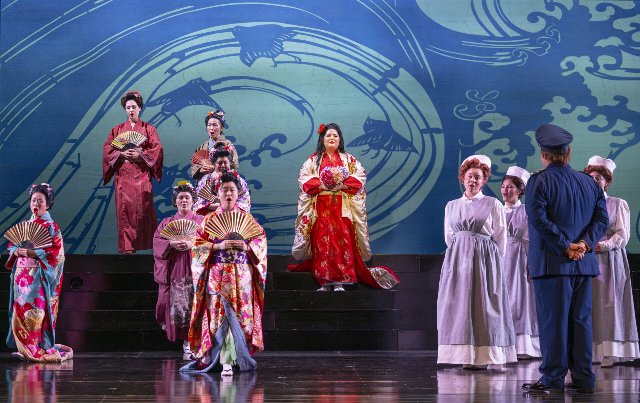
Cio Cio San is from a good but now poor family in Nagasaki, Japan. She is banished by relatives and friends when marrying American Naval Lieutenant B. F. Pinkerton, played by the formidable tenor Christopher Oglesby, who brings vocal and dramatic heft to the part. The artist’s effective portrayal is callous and condescending but accurate. Pinkerton reveals from the outset that he sees the marriage as a convenience, and his attitude toward Cio Cio San is denigrating, even though he conceals it from her. Happily, Oglesby’s voice is commanding. And though cowardly, the character even elicits a little sympathy toward the end with his lament “Addio Fiorito Asil,” (“Goodbye Flowery Refuge”) when he realizes that Butterfly has waited devotedly for him for three years.
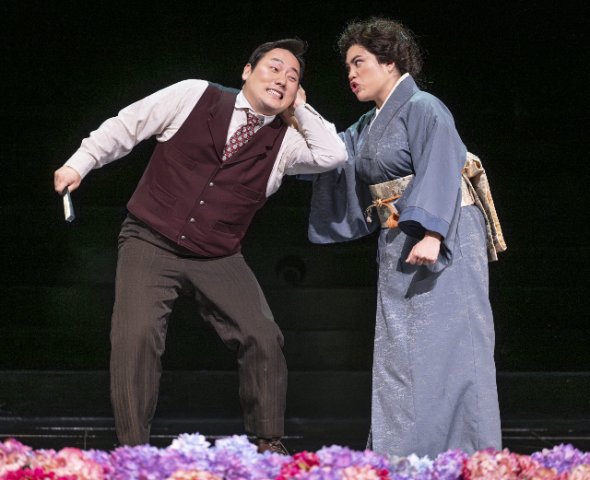
Two other roles play prominent in the storytelling but not in the consequences of the action. American consul Sharpless, the resourceful and popular baritone Eugene Brancoveanu, detests what he suspects of Pinkerton’s intentions. But despite his righteousness and respect for local people and culture, he is unable to intercede. Family retainer Suzuki, rich-toned mezzo Kayla Nanto, displays loyalty and compassion, remaining as Cio Cio San’s servant and primary access to the outside world.
Madama Butterfly remains one of the most controversial popular operas, largely because of the relationship dynamics. She sacrifices all and does her best to adopt all things American, but Pinkerton sees her as chattel, and other than paying the rent after his ship sails, everything about his treatment of her is despicable. So, aspects of pedophilia (though supertitles in this production list Butterfly as 18 years old, probably to allay that issue), racism, and spousal abuse can be lodged against the American. As a consequence, American chauvinists may consider the opera anti-American. Unrelated to the content of the libretto, the dodgy question of appropriability by non-Japanese performers is inherent in this opera. But because of its manifold assets, Madama Butterfly remains in the firmament where it belongs.
Although the production is very rewarding, a couple of issues deserve mention. The beautiful orchestral score is replete with frequent crescendos that don’t seem that loud. But particularly when volume stays at a plateau after rising, singers are surprisingly overpowered by the orchestra, notably in the lower ranges of their voices.
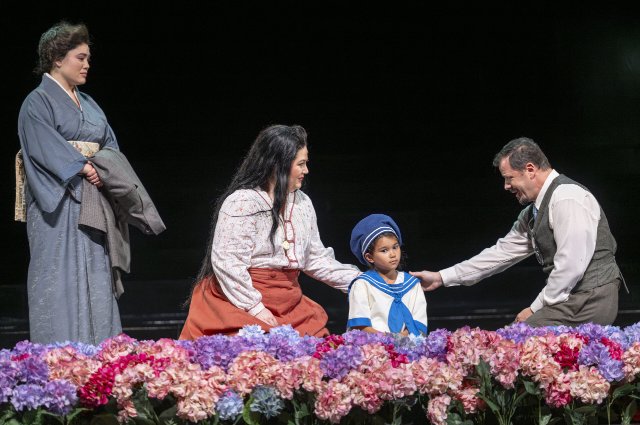
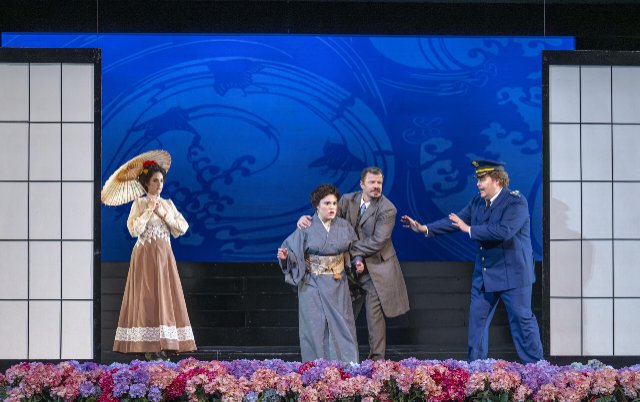
Another element that some patrons will not care for is the set design with a stage dress in black and the absence of a physical house, though the unobtrusive backdrop does have the positive effect of making the performers’ appearances pop. Plus, some setups are quite striking like the flowers and stars staging. Finally, the back wall projection is underutilized and provides no scenic framework. Presumably the intention is to paint the opera with the darkness that it may deserve, but many will find the black box look unreal and unappealing.
Notwithstanding, Madama Butterfly remains a favorite in the repertory, and the maestro’s music delivered by artists with great aplomb will engulf the audience as it has to millions of opera goers before.
Madama Butterfly, composed by Giacomo Puccini with libretto by Luigi Illica and Giuseppe Giacosa and directed by Michelle Cuizon, is produced by Opera San Jose and plays at California Theater, 345 South 1st Street, San Jose, CA through November 30, 2025.