

Chess Revived on Broadway
Still Problematic
By: Karen Isaacs - Dec 04, 2025
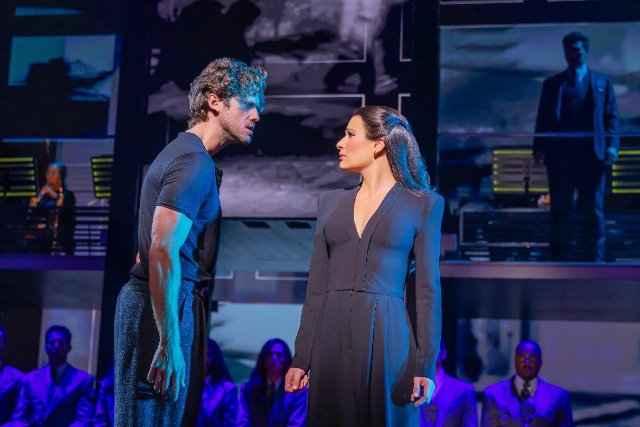
The analogy is obvious. In chess, the pieces are meant to be manipulated by the players, even the powerful king and queen. All are, in reality, pawns for the two players to move about and to determine their fates. Likewise, characters are figments of the writer’s imagination for their destiny to be determined by the author. But the moves should not seem random or predetermined like the figures on a chessboard. We should feel that their actions are related to their characters.
The problem with the musical revival of Chess is that the characters seem less like real people and more like symbols that are manipulated by the authors.
The game of chess is a game of strategy, and more of being able to think of multiple moves ahead of your opponent and to consider multiple options. In the latter half of the 20th century, the international chess world paralleled the political world in many ways: the conflict between the US and the USSR played out in the world chess championships.
Chess, getting a revival currently on Broadway, began its life as a concept album with music and lyrics by Tim Rice, Benny Andersson, and Bjorn Ulvaeus based on a book by Rice. This means the focus was on music, not dialogue. It had a London production in 1986 and a brief Broadway run in 1988, but has had a loyal fan base ever since.
It is dizzying to read about the many productions of the show, both concert and full-staged, around the world. The plot and song list have radically changed, and then gone back to earlier versions, and then changed some more. The current production seems closest to the 2018 Kennedy Center production. After all the rewrites, the problem remains: it still seems to be simply manipulating pieces at random and inexplicably.
Act one sets up a love triangle between the erratic American (and World) chess champion, Freddie (Aaron Tveit), his brilliant strategist and lover, Florence (Lea Michele), and the Russian chess champion, Anatoly (Nicholas Christopher). A tournament between the two will determine if the Russian can claim the title.
Billed as the first Cold War musical, we see a KGB agent and a CIA agent who want to manipulate the outcome of the 1979 tournament to influence both the 1980 election, where President Jimmy Carter was seeking a second term, and the SALT, or Strategic Arms Limitation Talks.
Act two is four years later; Reagan is in office; there is another chess world championship, but this time it is between Anatoly, who defected to Britain following his win, and Leonid, the Russian. Once again, the KGB and CIA are trying to manipulate the outcome of political aims. Florence and Anatoly have been lovers since his defection; Freddie is now a chess commentator.
The plot requires major suspension of disbelief; for example, Freddie seems to have miraculously managed to control his temper and his tendency to behave outrageously. Florence becomes almost friends with Anatoly’s estranged wife, Svetlana.
The production is blessed with a fine cast. Aaron Tveit as Freddie makes the character as believable as possible – if we wonder if he’s too good-looking for a chess champion, that is just our stereotypes working. If you aren’t moved by “Pity the Child,” you should check your empathy quota. He’s also great in the various duets with Florence and Anatoly. A highlight is “One Night in Bangkok.”
Lea Michele as Florence has a more difficult job because Florence’s actions do not always seem plausible; her life seems like a soap opera character with multiple emotional disasters occurring just when you think things are going smoothly. Despite that, Michele delivers on her big numbers, particularly “Someone Else’s Story.” She and Hannah Cruz as Anatoly’s estranged wife, Svetlana, succeed in making “I Know Him So Well” touching.
As Anatoly, Nicholas Christopher scores big with the Act One curtain number, “Anthem.”
We have a narrator who also serves as the referee for the chest match, an obvious
borrowing of the Cabaret MC. This one, played by Bryce Pinkham, who’s terrific despite being stuck with some bad jokes and clumsy direction, explains the scenes and the setting, including comments on the politics. Since the main character’s name is Freddie Trumper, he immediately tells us that there is no relation in the name to our current president, reminding us that this was written decades ago.
This is a show for people who are particularly fond of the high belt sound. Certainly, the three leads are all experts at that, but the problem with the high belt, particularly for the female voice, is the tendency for lyrics to be totally unintelligible. While for the most part, you can understand Tveit and Christopher, a good half of Lea Michele‘s lyrics are simply sound.
The choreography by Lorin Latarro is puzzling in the beginning numbers. The ensemble makes a variety of seemingly random hand and arm gestures and other moves that leave you wondering what they’re supposedly doing and how they relate to the lyrics being sung.
Fans of the show, of course, may find the music and therefore the production interesting and enjoyable, but don’t get trapped into thinking that there’s anything meaningful being said. What point the show is trying to make — in this case, both the US and the Soviet Union were willing to manipulate people as if they were pawns on a chessboard — is obvious.
Go for the music; ignore the plot.