
Artists CinemaCraftDanceGalleriesMuseumsMusicTheatreLodgingDineShop
Ads by BFA
Share

Flush With the Walls 40 Years Later

Does the MFA Give a Crap About Boston Artists

By: Sarah Hwang - 06/17/2011

Click to Enlarge
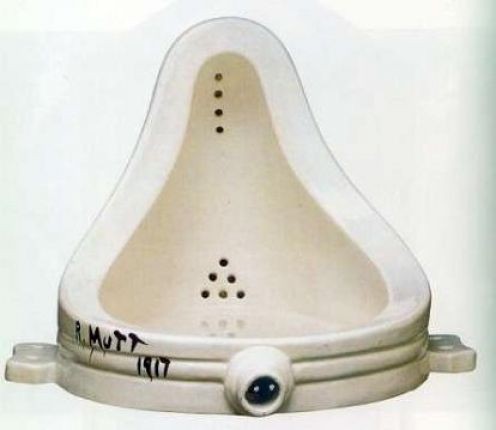
Marcel Duchamp’s Fountain, signed R. Mutt, pissed off the art world in 1917.
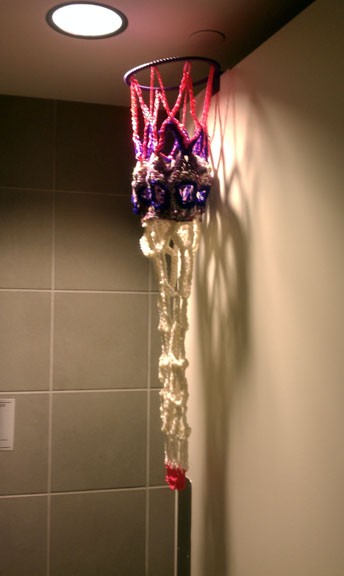
Shooting hoops in the men’s room of the MFA. Sarah Hwang photos.
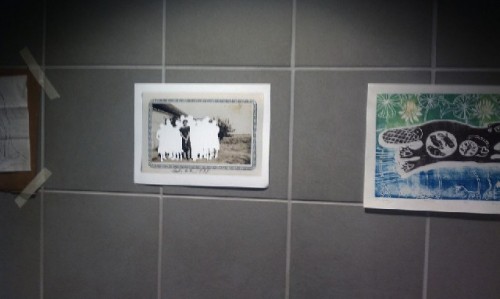
Works by Caleb Cole and Keri Percival.
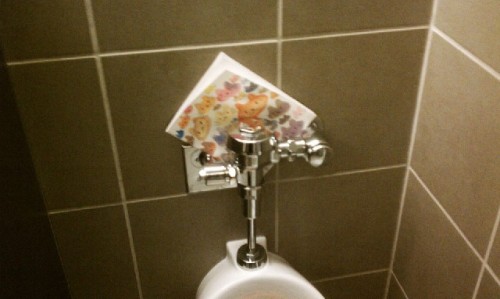
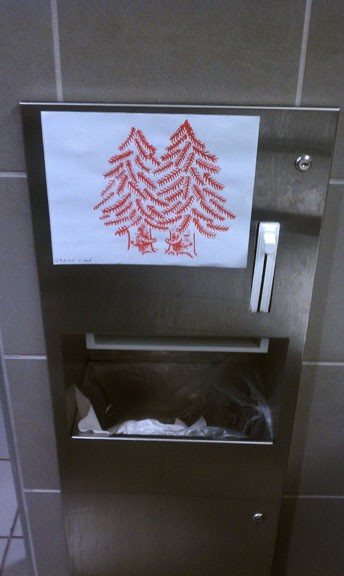
A cat comic book by Dan Moynihan rather casually installed.
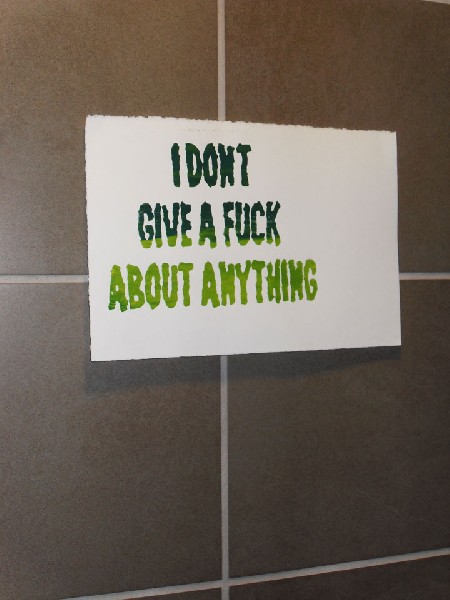
The sign above Moynihan’s piece says it all.
A work by Greg Cook who organized the event.
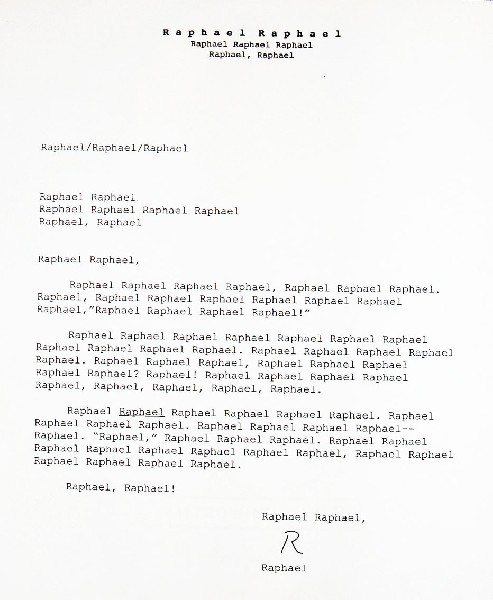
David Raymond’s Raphael letter was posted during the first Flush with the Walls event.
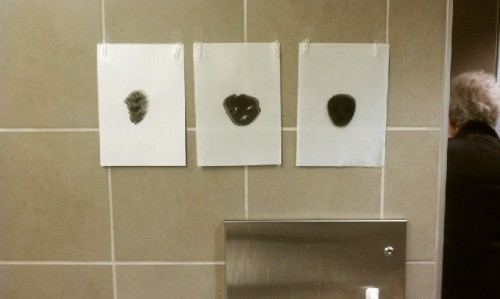
Jo Sandman participated then and now.
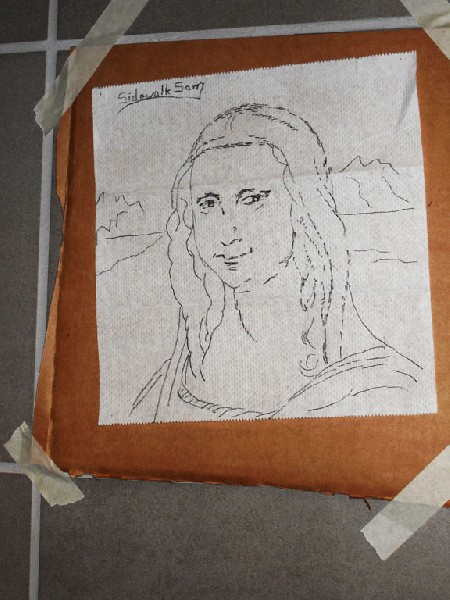
Robert Guillemin was an original participant now signing his work as Sidewalk Sam.
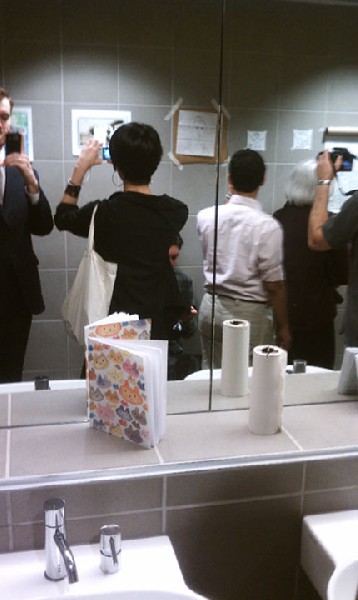
Reflecting on art at least for 20 minutes at the MFA.

June 15, 2011 will most likely go down unnoticed by many people in Boston and especially the MFA (Or they’ll choose to ignore it). But those in the know will remember it as another memorial event in art history. Last night, as the Museum proceeded to give tours of the new Art of the Americas wing to its members and request donations from visitors in exchange for free admission (the woman at the front desk informed me that Wednesday evenings are “donation” nights), another renegade exhibition occurred in the MFA’s restrooms—this time in both the men’s and women’s and located halfway down the stairs to the Chihuly exhibition in the new Shapiro Family Courtyard.

Best of Boston 40-ennial was organized by Greg Cook of the Boston Phoenix as a celebration of the 40th anniversary of the infamous (or maybe not so much) Flush With The Walls show. While the original show only featured 6 artists from the area, Cook’s exhibition included the works of a whopping 21 artists that represent a part of  Boston’s art scene today.

The works ranged from paintings, sculptures, drawings, prints, and so on—each one just as good as and/or better than the next. A few of my personal favorites were Elizabeth Alexander’s acrylic installations spilling out of toilets, Laura Chasman’s gouache work of a Boston-beloved Sargent painting renamed Ou sont les toilettes? Homage to Sargent (translation: Where are the Toilets?), and the Institute for Infinitely Small Things’ plaque (in the MFA’s own design) dedicating the bathroom to a survivor of a LGBTQ hate crime. Some of the artists who were in the original FWTW exhibit attended and contributed new works to the event: Bob Guillemin (aka Sidewalk Sam) hung his paper towel drawings of Mona Lisa and Picasso’s palette, Jo Sandman had prints of globular faces hanging by the sink, and David Raymond’s “Raphael” letter, referring to former MFA director Perry T. Rathbone’s Raphael scandal.

During the museum's year long, 100th anniversary (1971), Rathbone unveiled an alleged portrait of Eleanora Gonzaga by the Italian Renaissance master, Raphael. It was later revealed that the small painting had been smuggled out of Italy. The museum later returned the painting. The widely reported incident prompted the departure of Rathbone and served as a signifier for much needed change.

The show officially began at 7pm and was busted at around 7.20pm. Somewhere around 50-100 people, including artists, family, and friends, attended (the Boston Globe reported about 75 in their article). There were visitors who were honestly trying to use the bathroom and were confused as to whether or not the large group of people was waiting in line for the toilets.

Greg Cook gave a speech just in time explaining that Best was supposed to be commemoration of Flush With the Walls and thanked the artists and everyone for attending. The museum guard squeezed into the crowd (right next to me), waited until Greg finished his speech, and stated that the group had to move along because the fire exits were blocked. The critic thanked the guard for being civil about the situation and encouraged him to look around the bathrooms (which he did). The crowd dispersed and that was that.

Interestingly, it seems that much of the circumstances for Cook’s show is not unlike those for FWTW. Both events occurred during a time in the MFA’s history when contemporary art was (and still sometimes is) overlooked. The original FWTW, forty years ago to the day, occurred during a Cezanne exhibit under the reign of Rathbone. This was a time when former MFA director Rathbone was introducing modern art with an international rapport to the public. The priorities for the museum were other than establishing a department committed to contemporary art.

Best of Boston happened opposite of, metaphorically and physically, a large scale exhibition featuring Dale Chihuly whose glass sculptures really just reflect Color Field but in 3D. Perhaps I am just being harsh because I grew up in the Pacific Northwest, and as you may suspect, Chihuly-ed out.

Forty years ago, Kenworth Moffett, the first curator of contemporary art, was  enthusiastic about acquiring Color Field paintings for the museum. The formalist, Greenbergian aesthetic which Moffett reflected was yielding its primacy to the emergence of Pop, Minimalism, and Conceptual art. While Moffett primarily collected abstract art for the museum his program was diverse and included guest curators. John Arthur, an authority on Realism, curated two shows for the MFA: Richard Estes and Alfred Leslie. Christopher Cook, for one year the director of the Institute of Contemporary Art and long term director of the Addison Gallery of American Art, at Phillips Academy, curated a show of conceptual work at the MFA by Douglas Heubler.

Given the reenactment of FTWT last night, arguably, the MFA hasn’t really changed much between then and now. Though I must give credit to the establishment for finally making progress in dedicating a sufficient amount of gallery space for the contemporary art department’s collection and exhibitions.

The only thing that really differentiates the two guerilla exhibitions is in its motives. FWTW was a political statement organized by the 6 artists (Martin Mull, Todd McKie, Jo Sandman, Kristin Johnson, Bob Guillemin, and David Raymond) as a response to the MFA’s and Boston’s conservatism. These artists knew that there was no way that the museum would produce an exhibition including their works and acted accordingly.  It had an objective which was realized, shortly after the action, when Rathbone announced the appointment of Moffett.

It was one of the last acts of Rathbone’s tenure. To his credit the flamboyant Rathbone was viewed during his administration as transforming the museum into a more progressive institution.

Best was more along the lines of an MFA thesis exhibition; its intentions were to celebrate FWTW in the same guerilla manner and present “the best of Boston art today.”  However, it could just be that it’s too soon to tell what effects Wednesday night’s show had on the museum and the public. Who knows? Maybe the museum will add another $50,000 to their security budget by the next fiscal year.

Nonetheless, the spirit of FWTW was alive and well among everyone who was involved in Wednesday’s event and it was wonderful. In a 1971 Cambridge Phoenix article about FWTW, Jean Bergantini-Grillo pointed out that “the men’s room seems to be the only place in the Museum of Fine Arts that an exhibit by contemporary local artists can be seen.” And 40 years later, that statement remains true. At least, until the contemporary art wing is finished. After Greg gave his speech, Bob Guillemin, with his grandchildren in his lap, thanked Greg saying “Applause for Greg for his good idea!” And indeed, it was a good idea.

Sarah Hwang has recently graduated from Boston University. During the spring semester she wrote a term paper on the original Flush With the Walls event for a seminar on Boston Art for Professor Theodore E. Stebbins, Jr. who was formerly the curator of American Art at the MFA. It is a postion he now holds at Harvard University and its Fogg Art Museum. An edited version of Hwang's research paper was published in Berkshire Fine Arts.

Reader Comments
From "Maria Molteni"
06-22-2011, 07:09 pm
Aha! Thanks Mark. I didn't actually know about Jo, mostly because I had to participate from out of town- currently visiting my fam in TN. And my comments about gender weren't meant to be preachy or self-righteous. It's just that this aspect was the most interesting part for me. The historical reenactment, institutional protest, and best of boston aspects certainly aren't for nothing, but I'd like to have been there to observe men and women in one anothers' typically allotted separate spaces. I like to see how these behavioral habits and social interactions pan out when they're thrown a curve ball, even regardless of what is on display. So far I haven't heard anyone describe or refer to this.
From "Mark Favermann"
06-20-2011, 02:59 pm
Maria, didn't you know that Jo Sandman is a woman? She participated in both shows. Alas, only the Men's Room was used for the first exhibit.
From "Maria Molteni"
06-19-2011, 04:14 pm
For the most part there was a lot of interesting info here and I appreciate the background research and the article. But while we're making corrections, I just want to say that the basketball net made by myself- Maria Molteni... in case you wanted to credit all of the artworks?... was on the door of the women's bathroom, not the men's. I am a woman artist that makes basketball nets in collaboration with men and women for everyone to play on. It could have easily been in eaither restroom, but if we're talking differences between the first and second iterations of the show, I'm really surprised no one has mentioned that there were women artists and facilities involved this time around. Just sayin ; )
From "Mark Favermann"
06-19-2011, 02:47 pm
Thanks for your clarification in regard to Paul Laffoley's work. However, this is not what Paul Laffoley told me at the time of the event. As he did not tell me, I had no idea that his work was in the MFA Men's Room. There were no "catalogues" in the Men's Room and the Women's Room was quite crowded when I entered it. As an artist myself of a certain age that was around for the Flush to the Walls 1971 original event, I was not invited to participate in your event. Several artists that I know were not invited either. So, I came to the logical conclusion that inclusion in the show was by you to those you knew. I also noticed that you included yourself in the exhibit. Only as a writer was I later informed. Unfortunately, I did not see the quality that you allude to in this exhibit. BTW, one woman artist refused to tell me her name and was quite rude when I tried to interview her while she was taping up her work, strips of painted blue paper. Some other much more friendly artists from NH seemed to be quite clueless in regard to what the purpose of the event was other than as a performance piece. Among other things, this led to me not wishing to write a formal piece on the exhibit. I guess this difference of perspective is what makes bettors on horse races.
From "Greg Cook"
06-19-2011, 12:44 pm
I very much appreciate your interest in the "Best of Boston 40-ennial" exhibition, which I staged in the MFA bathrooms on Wednesday evening. However I'd like to try to clarify a few things that seem to me to be inaccuracies. I'm e-mailing Berkshire Fine Arts a photo that shows Paul Laffoley and Bob Guillemin in the MFA men's room Wednesday night with their art on the wall beside them. (One can also see the Laffoley artwork--partly obscured--in Mark Favermann's photo of the art near the sinks on this page: http://www.berkshirefinearts.com/06-16-2011_art-in-the-loo.htm) I picked up the art by Laffoley a couple days before the show, which was the first time I met him. Most of the artists in the show were only invited to participate a week or three beforehand--in part to maintain secrecy. Also, Mr. Favermann's note that I "limited participation of artists to a few that he knew personally" also seems inaccurate. The exhibition (and catalogue) included 21 artists and collectives. An aside: I'm sorry "other artists felt left out by Greg as well," as I would have liked to include more folks. A handful of artists declined my invitation. And during my public talk at the MFA Wednesday night, I noted that the exhibit was just a sampling of the many talented artists here. But one could argue that the number of local artists I was able to secretly get into the museum compares quite favorably with, say, biennial exhibits of local artists at the ICA or DeCordova, which are organized over months and months by teams of paid curators and support staff. And one could argue that the exhibition put more work by living local artists on the MFA walls than has been seen in quite some time. If Favermann means to say that I only asked friends to participate that would be inacurate. While a handful of close friends were in the show, the majority of the 21 local artists included were not people I hang around with--though one might call several of them acquaintances. And I'd never communicated in any way with a handful of artists in the show before inviting them to participate. Like Laffoley. I guess I feel the need to clarify this because Mr. Favermann's point seems to be that artists were only included due to nepotism, not talent. Of course, a quick guerrilla bathroom exhibit is not the best venue to discern the talent of the artists involved, nor was it intended to be. But one could argue that the talent of many of the artists--like Laffoley--becomes apparent when one becomes familiar with their careers. And there were some excellent pieces in the show--despite everyone involved working on the assumption that the MFA might trash all the art. Happily, the MFA says the art from Wednesday's show has been "retained in the MFA's archives for historical purposes." If so, one success of Wednesday's show would be that Laffoley's artwork would be, I believe, his second work to enter the MFA's collection--and the first piece in the collection for most of the other artists. Certainly, the MFA should own much more work by talented local artists like Laffoley, but we celebrate progress as it comes. Thanks again for your attention to this exhibition. It's much appreciated. P.S. Did you happen to see that a report on the MFA bathoom show was posted to the front page of the Huffington Post yesterday? I'm quite honored that the show has been able to bring national (if brief) attention to our local artists and to the way the MFA too often ignores art made here.
From "Mark Favermann"
06-18-2011, 09:44 am
Actually Paul Laffoley was told about it only the day of the event by Greg Cook as an apparent afterthought. Paul felt that he needed more time than that to come up with a piece to exhibit. Other artists felt left out by Greg as well.
From "Charles Giuliano"
06-18-2011, 08:46 am
Actually in a note from organizer Greg Cook it seems that Paul Laffoley, the renowned visionary artist, and an icon of the Boston art world, however neglected, was invited to participate. Which is why he was there.
From "Mark Favermann"
06-17-2011, 05:39 pm
Ms. Hwang may be giving too much credit to Flush with the Walls as a signifier event. The emerging BVAU was challenging Director Rathbone about contemporary artists, and Rathbone's own perspective had led to negotiations taking place with Ken Moffett for many months prior to his appointment as the first contemporary curator. As for the recent event, Mr. Cook limited participation of artists in the exhibit to a few that he knew personally. Artist Paul Laffoley feels badly that he was not invited to participate in either event! Would Marcel Duchamp have appreciated an anniversary celebration of one of his exhibits? This Flush II was an example of less as much less.
And just to be sure you're human, please finish the simple math problem below.
click on the image to reload it Click to reload image
* Email address required for verification and does not appear with comments. - (Comments may not show up immediately)