
Contemporary Art in Boston
Smoke and Mirrors at the MFA
By: Charles Giuliano - Sep 23, 2011
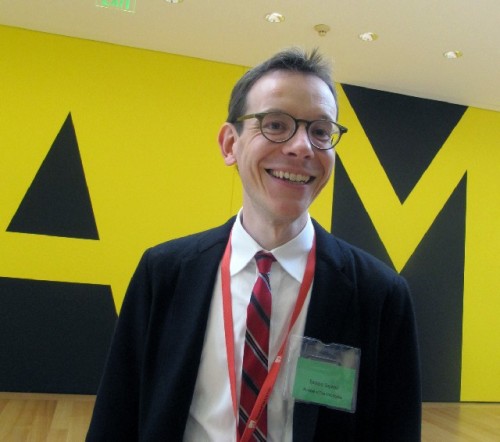
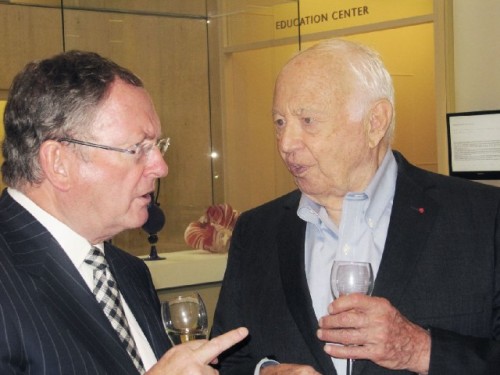

During a dialogue with the Museum of Fine Arts director, Malcolm Rogers, on the occasion of the opening of the Linde Family Wing for Contemporary Art, told me “We’re conscious that work has to be done in the Twentieth Century and in the contemporary period. You’ll see in these galleries a statement of good intentions. Some achievement. More still to do.”
It’s 2011 and the venerable dame on Huntington Avenue is finally making a full tilt commitment to acquiring and displaying the art of our time.
What we see is indeed impressive. Congratulations to all for a stupendous effort. But this is too little and way too late.
Like the orphan, Oliver Twist, will a starving art critic take a flogging for approaching the head table, with outthrust empty bowl, asking plaintively “Please sir I want some more.”
That’s coming from a lifelong passion for the MFA that started when I first visited in short pants in the late 1940s. My first job after college was two and a half years in the basement of the Department of Egyptian Art. Mostly I assembled and repaired stone vessels from the Old Kingdom digs at Zawiet El-Aryan and Giza. Some of my restorations, including a plate with the cartouche of the Pharoah Ka Ba, are on display in the galleries.
While working at my bench in the basement a guard told me that Perry Rathbone, director of the MFA, requested that I turn down the radio. I liked to listen to soul music on WILD. In later years, as an art critic, I covered Rathbone and every MFA director since then.
As a teenager I loved the annual Boston Arts Festival which was held under tents in the public gardens. The metal sculptures of “Saint John the Baptist” and a reclining female nude with splayed legs by Kahlil Gibran (nephew of the poet) won prizes and intrigued me.
Some of the artists I saw there were also on the walls of the MFA in a single small gallery: Fannie Hillsmith, Donald Stoltenberg, along with a semi abstract painting by Loren Maciver. There was a wonderful painting of “Lilacs” by the Provincetown master Karl Knaths. The largest contemporary painting on view was by Nicolas DeStael. There was a Cobra portrait by Carel Appel and a large figurative expressionist work of a man in a row boat by David Park. On extended loan there was a group of Picasso sculptures of “Bathers".
Rathbone, who befriended Max Beckmann when they lived in St. Louis, was slowly trying to nudge the museum into modernism. But, as I reported in the Rogers interview, he ended the experiment to merge with the Institute of Contemporary Art and its director, Thomas Messer. Rathbone had his own ideas and it was only when he was on the cusp of retirement, in 1971, that he appointed Kenworth Moffett as the founding curator of the department of contemporary art.
Like the ICA under founding director, James Plout, and Harvard’s Busch-Reisinger Museum, Rathbone shared an interest in Northern European and Germanic art. On his watch the MFA acquired and showed works by Ernst Ludwig Kirchner, Oskar Kokoschka, Beckmann, and Emil Nolde. There were also major shows of Vincent van Gogh and Amadeo Modigliani.
During the Messer era it wasn’t easy to get to the ICA on Soldier’s Field Road in Brighton by public transportation. But it was worth the effort to see the first major exhibition of Egon Schiele in America. I vividly recall that experience.
After Messer the ICA abandoned Soldier’s Field Road and had a bright period on Newbury Street in the New England Life Insurance building under Sue Thurman. She mounted the first museum level Warhol show. Andy sent an impersonator and The Factory to the opening. She also installed “Barney’s Beanery” by the California artist Edward Kienholz.
Thurman mounted the American exhibition from the 1967 Montreal World Fair at Horticulture Hall opposite Symphony Hall. I covered it for Arts Magazine. It was money the ICA couldn’t spend. That plus the termination of its lease on Newbury Street brought the ICA to its knees. It was a story I reported in The Avatar “The ICA on the Run” in the summer of 1968.
The resources of the bankrupt ICA were stored in its former Soldier’s Field Road venue. That included what was then the only real library of books and periodicals on contemporary art in the Boston area. Essentially the ICA was padlocked.
Andrew C. Hyde, a well born college drop out and wizard, went to work for Mayor Kevin White’s Summerthing. They created neighborhood parks on vacant lots in the South End and Roxbury. There were also murals by African American artists like Gary Rickson, Roy Cato, Jr., and Dana C. Chandler, Jr.
It was an exciting time of anti war protest, student activism, the founding of the Boston Tea Party and the conversion of WBCN to a rock music format. Through Louis Kane, a trustee of the ICA, Hyde was appointed director of the then moribund ICA. To kick start it he organized Boston Now in the gallery of City Hall. Drew and I co-curated a show of realist paintings at City Hall. I also curated an exhibition of protest paintings by Arnold Trachtman for the ICA in Brighton.
In 1969 Boston artists organized the first ever open studios as The Studio Coalition. Which I covered in my column Art Bag for Boston After Dark (later the Boston Phoenix). Of those artists Katherine Porter became nationally recognized and Andy Tavarelli was shown in the Whitney Annual.
In the South End Hyde took over an abandoned factory as the Act Now Workshop. Portia Harcus, Barbara Krakow, Phyllis Rosen and Joan Stoneman (Sonnabend) opened a loft gallery Parker 470 across the tracks from the MFA. John Chandler and I initiated a series of artist meetings there and from that emerged The Boston Visual Artists Union. BFA’s Mark Favermann was its founding Secretary General. Rathbone was invited to speak during which he was confronted about the lack of contemporary art at the MFA. That was soon followed by the Flush with the Walls conceptual assault on the men’s room of the MFA. Then the announcement of the appointment of Moffett.
Through his close ties with Mayor White, Louis and Kathy Kane (she was Deputy Mayor), Hyde was given the Parkman House on Beacon Hill as a temporary home for the ICA. As one of his final acts Hyde moved the ICA to a former police station on Boylston Street. The architect was Graham Gund who was then the companion of Gabrielle Jeppson who succeeded Hyde as the ICA’s director. She was followed by Sydney Rockefeller.
During the 1970s while Moffett was acquiring Color Field paintings for the MFA he also invited guest curators to organize exhibitions. John Arthur, formerly curator for the Boston University Art Gallery and an authority on realism showed Richard Estes and Alfred Leslie. Former Addison Gallery of American Art director, Chris Cook, showed conceptual artist Doug Heubler. Cook served a one year term as ICA director at the Parkman House before returning to the Addison. Moffett installed the York Series of steel sculptures by Anthony Caro on the lawn in front of the Christian Science Church on Mass Ave. He also curated the MFA space at Quincy Market while the museum was under renovation.
The ICA in the 1970s, when it moved to Boylston Street, was more notable for its social gatherings than insight and commitment to contemporary art. Its annual benefit parties were legendary. For one staged at Quincy Market artists were invited to make edible art. That ended up in a huge food fight. Another at Filene’s Basement was dubbed Fellini’s Basement. I still recall former Celtic star Jungle Jim Luscatoff grabbing panties off of a rack and putting them on his head as a cap while frugging madly. All of which was duly reported in the Boston Globe by society/ gossip columnist Bill Fripp.
There was an attempt to provide the ICA with some gravitas through the appointment of Stephen Prokopoff (died in 2001 at 71)who served as director from 1977-1981. He started as an artist before earning a Phd in art history. The exhibitions he presented were less frivilous but hardly seismic. His curator Elisabeth Sussman curated a exhibition of the visionary surrealist Florine Stettheimer. He also hired Jillian Levine and David Joselit.
Then the ICA got serious by appointing a visionary firebrand David Ross. When Ross took over he retained and worked with Prokopoff's curatorial team. He initiated a series of ever changing low cost Currents exhibitions modeled on the Matrix series of the Wadsworth Athenaeum. Later Ross took the curator Elizabeth Sussman with him to the Whitney Museum. Another former curator, David Joselit, is now a professor at Yale.
Ross followed the money like a heat seeking missile. His wife, Peggy, worked for the mega rich Charlene Engelhard. Under the influence of Ross she bought the Sigmar Polke painting “Lager” (1982) which is now on display at the MFA. There were also artist grants through the Engelhard Foundation.
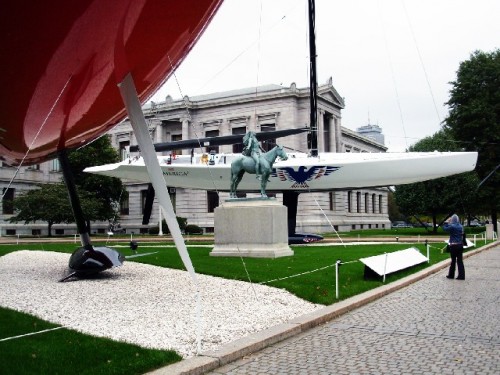
At the time I reported in the Patriot Ledger that the Englhard fortune was founded on South African mining by Charles Engelhard who inspired Ian Fleming to create the fictional 007 character Goldfinger. Ross was also being funded by William I. Koch, whose father, as I reported in The Patriot Ledger, was a founding member of the John Birch Society. Malcolm Rogers later invited Koch to show his America’s Cup yachts and empty vintage wine bottles at the MFA.
By outing Englehard and Koch, quoting from the Biblical “sins of their fathers,” Ross scolded me that I had cost the Boston art world “millions of dollars.”
As F. Scott Fitzgerald would say “The rich are different than you and me.”
While Ross put the ICA back on its feet he failed in the greatest challenges: To find an adequate new space and to found a permanent collection. These ambitions also eluded the administration of Milena Kalinovska. Both of those goals have now been accomplished by the ICA’s current director, Jill Medvedow.
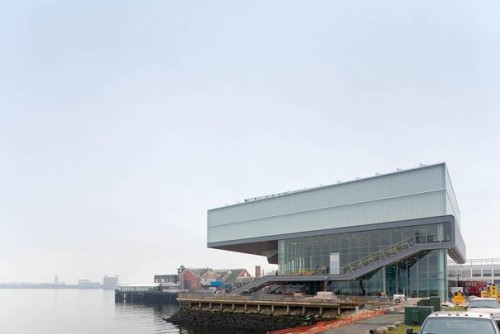
The New ICA has been praised for its architectural design by Diller + Scofidio. Now that the initial euphoria has cooled off we realize that the Institute is land locked, with no possible room for expansion, limited gallery space, and nowhere to store a growing permanent collection. That TV monitor space sloping down to a view of the harbor below is rarely used and an absurd architectural folly. There is also an enormous entrace lobby used for the occasional opening or function. How long will it be before push comes to shove?
The decision of the ICA to collect, after decades of squandered opportunities, has been trumped by the MFA’s Linde Wing. Although things are getting better, there is the daunting paucity of serious collectors for contemporary art. Too many cultural institutions are feeding at the same trough.
When the ICA was building its waterfront venue, and the MFA its American Wing, there were reports of bad blood between Rogers and Medvedow hitting up the same limited pool of donors.
With evident diplomacy Rogers told me “If you think about all the institutions there are in town. Think of the influence of the new ICA.” I asked “Are you going to work together?” He replied “Of course. If you look at the labels on the walls you will see that many of the benefactors are supporters of the ICA and the MFA.” Hmmm.
For now critics are dazzled by the abundance of riches on view in the Linde Wing of the MFA. But David Bonetti, for BFA, and Greg Cook, in the Boston Phoenix, can’t refrain from giving us a wish list for acquisitions. They also point out that among the works on view they are not always the best example of works by major artists. Boston Globe review by Sebastian Smee. Former Globe critic Ken Johnson for the New York Times.
MFA directors, from Rathbone to Rogers, have fancied themselves as authorities on modern and contemporary art. While Moffett was narrowly focused on formalism nobody doubts his integrity and scholarship. That has not been the case, until now, among curators that followed him. After Moffett there was the Amy Lighthill pratfall. She reported to Theodore E. Stebbins, Jr., head of the department of American Art. They made interesting acquisitions some now in storage: An Anselm Kiefer, Gerhard Richter, Georg Baselitz as well as an Alice Neel portrait and Northampton Realists, Gregory Gillespie, Frances Cohen Gillespie, Jane Lund, Scott Prior and Randall Diehl. The Richter and two Priors are currently on view.
When the Lighthill experiment ended in acrimony MFA director Alan Shestack lured Kathy Halbreich from the List Center for Art at MIT. It was a brilliant but brief appointment. She quickly moved on to a successful run as director of the Walker Art Center and is now at MoMA. Her associate, Trevor Fairbrother, was elevated to curator. He was relatively new to contemporary art having written a dissertation on John Singer Sargent. Bonetti claims that Trevor was brilliant. He showed Warhol/ Beuys and the Prop Art of Robert Wilson. On his watch the museum acquired its first Warhol.
Trevor left for the Seattle Art Museum and is now an independent curator. When, early on in his tenure at the MFA Rogers sought to replace him no established curator was willing to take the position without a collection or commitment. Eventually, Cheryl Brutvan of the Albright-Knox Art Gallery in Buffalo took the job. She appeared willing to be micro managed by Rogers who launched a series of vulgarian exhibitions for the MFA from Guitars to the Cars of Ralph Lauren, photographs by Herb Ritts and Yusuf Karsh as well as a project for Wallace and Gromit. Critics had a field day carving those turkeys.
In 2008 Brutvan left the MFA and was appointed curator of contemporary art by the Norton Gallery in Palm Beach.
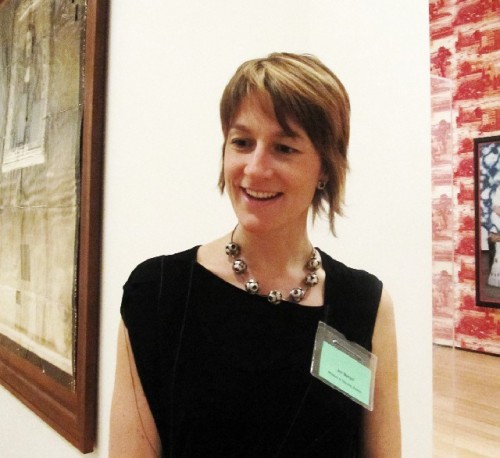
With the opening of the Linde Wing the MFA finally appears to be connecting the dots. It is time to move on from dwelling on the past and the ones that got away. The museum is on firm footing with an energetic, bright and lively curatorial team. Edward Saywell, chair of the Linde Family Wing of Contemporary Art and head of the Department of Contemporary Art and MFA programs has served in that position since 2007. He oversaw the most recent acquisitions and their stunning opening installation. Another key member of the team is a yet to be proven Jen Mergel, formerly of the ICA, as the Robert L. Beal, Enid L. Beal and Bruce A. Beal Senior Curator of Contemporary Art at the MFA.
Under the Rogers mantra of One Museum there was a weeding out and house cleaning of the MFA’s powerful departments and fiefdoms. There was bloodletting at the time. But moving along the parts of his design have fallen into place. Saywell and Mergel are not Cinderellas among curators in the current scheme of things. Contemporary art is now visible as a legitimate wing of a great, encyclopedic museum.
Under curator Cliff Ackley, and the support of collector Lois Torf, the museum has always aggressively collected works on paper and photography. As one of the new contemporary team put it to me “Cliff has everything.”
Finally the MFA has taken on a dominant role in the field of contemporary art. In addition to the ICA there have been other institutions contributing to a rich and diverse history. Although Brandeis has been tarred and feathered its crown jewel is the Rose Art Museum. Its collection, valued at some $300 million, is an asset which, after a firestorm of protest, the university has decided not to liquidate.
Harvard’s Fogg Art Museum is under renovation but has important modern and contemporary works with depth in works on paper. Perhaps one day it may be persuaded to show its trove of juvenilia by Hyman Bloom and Jack Levine. The Harvard University Art Museums also includes the renowned Busch-Reisinger collection as well as The Sackler Museum.
In the field of art/ science and technology MIT has been a global resource with little or no synergy with the ICA, MFA and other fine arts organizations. During the 1960s Minor White headed an influential photography program that taught and influenced a generation of artists. The Hungarian artist, Gyorgy Kepes, founded the Center for Advanced Visual Studies which contined under German Group Zero artist, Otto Piene. CAVS famously organized Centerbeam for documenta and numerous Sky Art events. Wayne Anderson ran the Hayden Gallery. Under Kathy Halbreich it became the List Center for Visual Arts housed in the Media Lab building. In recent years under recently retired director, Jane Farver and former curator, Bill Arning the List consistently curated the most challenging and provocative exhibition program in the region. Nobody made more studio visits and covered Boston artists more thoroughly than Arning. He is currently director of the Contemporary Art Museum in Houston.
The Addison Gallery of American Art at Phillips Academy in Andover has an important and unique collection. In addition to historic works it occasionally mounts major exhibitions such as that for an alumnus Frank Stella. Former Addison director Adam Weinberg is the current director of the Whitney Museum of American Art.
The DeCordova Museum in Lincoln is dedicated to exhibiting and collecting the artists of New England. In Brockton The Fuller Craft Museum has a niche focus. The Danforth Museum, in Framingham, under its director, Katherine French, has dedicated itself to Boston Expressionism and the region's great depth in realism and figurative art.
No, Boston will never be New York. But what it lacks in scale it makes up for in depth, quality and critical thinking. Intellectually, pound for pound and inch for inch, Boston is one of America’s greatest cultural resources.
It is sad to say that Boston's greatest artists have only been recognized and appreciated by leaving town. The MFA and ICA have the great challenge and opportunity of reversing that trend. While they rightly have global mandates there is an obligation to encourage and develop its community of artists, collectors, curators, critics and appreciators.
This is a time for art workers to unite. We have nothing to lose but our chains.